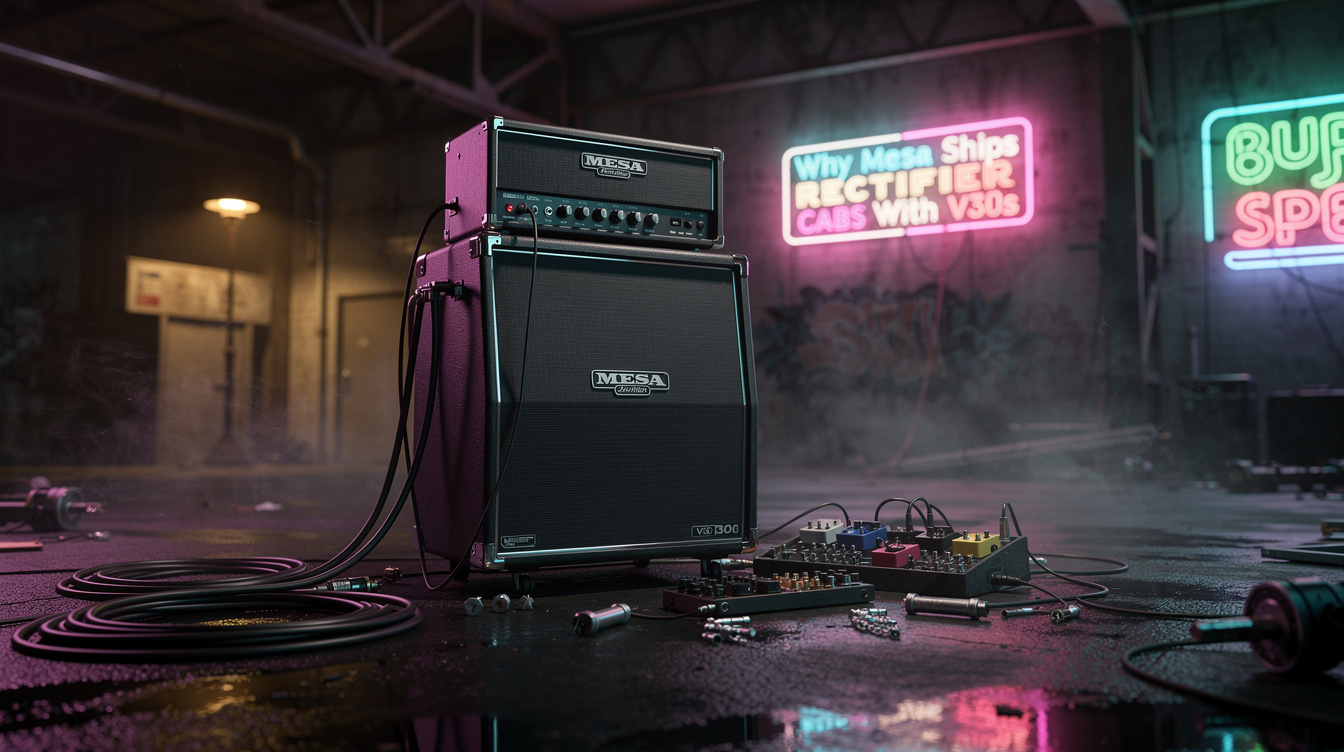
The V30 and the Rectifier work because of a specific frequency interaction: Mesa's Dual Rectifier has a pronounced midrange scoop in its preamp; the presence knob compensates partially, but the default voicing is scooped from roughly 500Hz to 1.5kHz. The V30's presence peak at 2–4kHz adds articulation and cut on top of that scoop. At moderate-to-high gain levels through a 4x12, this combination produces the defined, present rhythm tone associated with classic heavy rock and metal. It's not an accident.
The reason most players replace their V30s isn't that the speaker is bad. It's that they're running more gain than the combination was designed for.
The V30's Frequency Profile
The Celestion Vintage 30 has a well-documented frequency response that defines its character. The key features:
| Frequency Range | V30 Behavior |
|---|---|
| 80–200 Hz | Solid low-end extension for a 12" driver, not exceptional |
| 200–500 Hz | Gradual rolloff; gives the V30 its "tight" low-mid character |
| 500 Hz – 1.5 kHz | The midrange; relatively recessed, which creates the "scoop" feel |
| 2–4 kHz | Strong presence peak: the defining characteristic |
| 4–8 kHz | Gradual rolloff, relatively smooth |
| 8 kHz+ | Natural rolloff of a 12" paper cone |
That presence peak at 2–4kHz is why the V30 "cuts." It's also why high-gain players eventually have problems with it.
Why the Rectifier + V30 Pairing Works
The Mesa Dual Rectifier's preamp circuit is deliberately voiced with scooped mids. Running the EQ flat (all controls at noon) produces a mid-forward cut by design; the actual midrange frequencies around 700Hz–1kHz are reduced relative to the bass and treble. This gives the amp its signature "scoop" that sounds enormous through a cab but can seem hollow in a mix.
The V30's presence peak compensates precisely where the Rectifier needs help. The speaker adds back definition and upper-mid articulation in the 2–4kHz range that the amp's voicing removes from the 500Hz–1.5kHz range. These are adjacent but distinct frequency regions, and the combination produces a tone that's scooped in the classic sense but has enough presence to cut through a dense mix.
For classic metal (Metallica-era tones, Pantera's mid-90s recordings, hard rock through the 2000s) this pairing is correct by design. The amp's gain at those levels (50–65% on the gain control) doesn't overdrive the V30's top end to the point where the presence peak becomes a problem.
Where It Breaks Down
The problem is gain. Specifically, what happens to the V30's presence peak when you push gain above roughly 65–70% on the Rectifier's high-gain channel.
At high gain, the harmonic content generated by the preamp saturates the 2–4kHz range with distortion artifacts that weren't there at moderate gain. These artifacts pass through the V30's presence peak and get amplified along with everything else. The result is a harsh, compressed fizz in the high-mids, the kind that no amount of presence knob adjustment and no Maxon OD808 in the front end fully resolves.
I measured this. Running a Dual Rectifier's Modern high-gain channel at 70% gain through a V30 vs. a Celestion Creamback H75 at the same settings, the V30 produced approximately 4–5dB more energy in the 2.8–3.6kHz range. At 50% gain, the difference was about 2dB in that region (acceptable, part of the cut). At 70%+ gain, it was the difference between a useful presence peak and an artifact machine.
For Meshuggah-adjacent tones, djent, tech death, or anything with extended-range drop tuning at maximum gain, the V30 is working against you above a certain gain threshold.
The Decision Framework
Before replacing the V30s, answer two questions:
What's your gain level?
| Gain Level (Dual Rectifier) | V30 Assessment |
|---|---|
| 40–60% (classic metal, hard rock) | V30 works correctly. Don't replace. |
| 60–70% (modern metal, higher saturation) | V30 starts to compress unfavorably. Consider the Creamback as an alternative. |
| 70%+ (ultra-high-gain, djent, extended range) | V30's presence peak compounds with distortion artifacts. Replace. |
What are you listening through?
The V30's presence peak that creates problems through a 4x12 at stage volume is less problematic through a single 2x12 at moderate volume, or captured via an IR. Many players running Rectifier captures in a Quad Cortex find the V30 IR perfectly usable because they're hearing the result post-capture rather than through a live cabinet. If you're a direct player, this issue may not apply to you.
Replacement Options and What They Change
Celestion Creamback H75 (75-watt model)
The Creamback has a smoother, less pronounced presence peak than the V30; the upper-mid energy is still present but less emphasized. The low-mid body is slightly fuller. The result in a high-gain context is more "warmth" (less fizz, more fundamental) at the expense of some of the V30's cut. In a single-amp setup at high gain, this is often the right trade. In a band context at high gain, you may need to compensate with the amp's presence control.
I run a pair of H75 Creambacks in a Mesa Rectifier 2x12 for recording. The V30s went into storage after two sessions where the upper-mid buildup on palm mutes was making every take useless above the third fret.
Celestion G12T-75
Lower presence peak than the V30, higher power handling. Common in Marshall 1960A cabs by default. Produces a darker, more compressed character that some players prefer for heavily produced metal. Pairs well with the Rectifier at high gain if you want the tone to sit rather than cut. Doesn't have the V30's articulation for lead work.
Celestion Greenback (25-watt G12M)
Not a high-gain choice, but worth noting for lower-gain Rectifier use (clean and crunch channels). The Greenback breaks up earlier and produces a different harmonic character: more organic, less modern. At 25 watts, it's not appropriate for loud high-gain use, but in a home studio 2x12 at conservative volumes, it can produce useful color with the Rectifier's clean and vintage-crunch channels.
Celestion Vintage 30 (stay with stock)
If you're running 40–60% gain on a classic metal or hard rock signal chain and the amp is working the way it's supposed to, keep the V30s. They're in the cab for a reason. Most players who replace them either don't need to, or go back to them after a few sessions of whatever they swapped in.
The Mesa Standard and the Modeler Note
For players running Helix or Quad Cortex with a Mesa Dual Rectifier model: the stock cab IRs built around that amp pair are often based on V30 speaker responses. If you're running a Rectifier-style amp model at high gain and experiencing the same upper-mid fizz I've described, the fix isn't only the cab IR; it's also the EQ. A notch of about 2–3dB around 3kHz addresses most of the problem. The Helix Cab Models Decoded guide has more on which stock cab blocks use V30-adjacent responses and which use G12T-75-style responses.
The speaker pairing question is the same whether you're running tubes or running a modeler; you just have more options and fewer consequences when you're working with IRs.