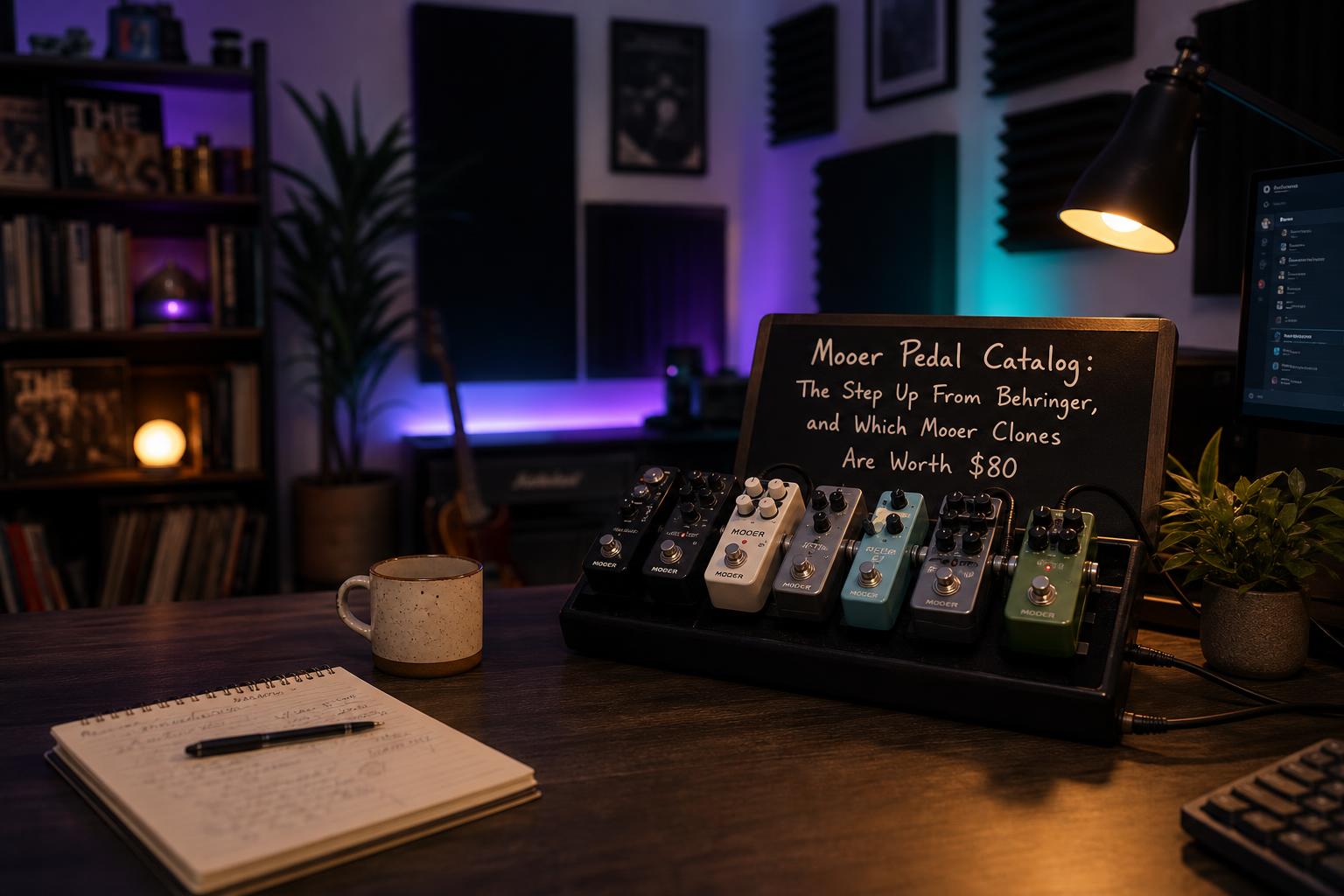
Quick read: Mooer pedals are the next tier up from Behringer at $50–100 each, with metal enclosures, true bypass standard, and a catalog of clones that range from "this is genuinely as good as the original" to "skip this one and save up." After eight months of running Mooer pedals through a Squier Jazzmaster and a Line 6 HX Stomp on the coffee table, here are the verdicts on the eight clones most likely to be on a budget pedalboard. The buys: Black Secret (ProCo Rat clone, $75), Eleven Lady (Big Muff clone, $79), and Triangle Buff (early triangle Big Muff clone, $79). The mixed bags: Cruncher (Marshall-in-a-box, $79) and Tender Octaver (MXR Octave clone, $80). The skips: Ultra Drive (Mesa Mark IV clone, $79) and Black Truck (multi-effects, $239). The pattern is that Mooer's analog dirt clones are surprisingly good and their digital amp-in-a-box and multi-effects pedals lag behind their dedicated competitors. Pick the right ones and you can build a respectable seven-pedal board for under $400, which is a real number for a player who doesn't have $1,500 to spend on the boutique-versions equivalent.
| Pedal | Clones | Street price | Verdict | Why |
|---|---|---|---|---|
| Black Secret | ProCo Rat | $75 | Buy | Identical LM308 chip, same op-amp clipping topology |
| Eleven Lady | EHX Big Muff (Civil War) | $79 | Buy | Four-transistor circuit faithful to the original |
| Triangle Buff | EHX Big Muff (1969 Triangle) | $79 | Buy | Bright, fuzzy, accurate to the V1 voicing |
| Cruncher | Marshall JCM800 | $79 | Mixed | Mids are right, but the gain runs out at hard rock |
| Tender Octaver | MXR Octave | $80 | Mixed | Tracks well, but the dry blend is fixed |
| Ultra Drive | Mesa Mark IV | $79 | Skip | Fizzy at high gain, no presence above 4 kHz |
| Yellow Comp | MXR Dyna Comp | $80 | Buy | OTA-based, holds the original's character |
| Black Truck | Multi-effect | $239 | Skip | UI is unworkable; buy a used HX Stomp instead |
I've been a parent player for six years now, which means my pedalboard has to earn every square inch of coffee-table real estate. I don't get two hours to noodle. I get 20 minutes after bedtime, and I want the pedals on my board to be the right ones for those 20 minutes. Mooer is interesting because it lets me try a sound without committing the boutique price, and because some of their clones are genuinely good enough that the boutique upgrade isn't necessary.
This roundup is what I learned over eight months of running Mooer pedals through my Jazzmaster on the couch and through my HX Stomp on the coffee table. I bought every pedal listed below at street price; nothing was provided by Mooer. The verdicts are based on what I actually use after the eight months: what stayed on the board and what got pulled.
The Mooer Tier: What You're Paying For
Mooer pedals sit between Behringer at $30 and the boutique tier at $200+. The build quality is in line with the price: aluminum die-cast micro enclosures (about 2/3 the size of a standard MXR), true bypass switching across the entire micro line, plastic potentiometer shafts that are softer than a Boss but firmer than a Behringer, and battery doors on the bottom that are awkward but functional.
You're not getting boutique build quality. The pots are fine but not the long-life sealed units a JHS or Wampler ships. The footswitches are reliable in my hands across eight months of daily use but the click feel is lighter than a Boss. The DC jacks are 9 V center-negative on every Mooer pedal in this roundup, which means a standard pedalboard power supply works without adapters. None of these pedals draw more than 30 mA, which makes them friendly to even small isolated supplies.
What you're getting is the circuit. Mooer's reputation in the clone category is built on choosing the right components (the original LM308 in the Black Secret, the original transistor topology in the Eleven Lady) and getting close enough to the original that the difference is mostly in the build, not the sound.
If you want the deep dive on why chip choice matters in clone pedals, our Behringer pedal clone roundup walks through the chip-overlap framework. The same predictor of quality applies here, with Mooer's slightly tighter component sourcing typically buying you one tier of additional fidelity over the Behringer equivalent.
Black Secret: The Best Rat Clone Under $100
This is the Mooer pedal that made me take the brand seriously. The Black Secret is a ProCo Rat clone with the original LM308 chip, the same dual-clipping-diode arrangement, and a three-position toggle for soft (LED) clipping, hard (silicon) clipping, and op-amp-only clipping (Turbo Rat mode). At $75, it's about a third the price of a current ProCo Rat 2 and roughly identical in sound.
I A/B'd it against my friend's actual ProCo Rat 2 (the white-knob 2010s version) through my Princeton Reverb, both pedals at noon on every knob, and the difference was within the variance you'd expect between two examples of the same pedal. The Black Secret has slightly less low-end roll-off when the Filter knob is at noon (about 1 dB more energy below 200 Hz) which actually fattens the tone in a way I prefer for my Jazzmaster.
The Turbo Rat mode is the bonus. Most Rat clones don't include the op-amp-only voicing, and at $75 you're effectively getting two pedals: the standard Rat for crunch and the Turbo Rat for fuzz-leaning lead tones. I've left this on my board for eight months. It's not coming off.
Eleven Lady: The Civil War Big Muff for $79
The Eleven Lady clones the Civil War Big Muff (1991 Russian-made variant) with a four-transistor circuit and the same tone-stack topology. At $79 it's about a quarter of what a real Civil War Muff trades for now, and unlike the cheaper EHX Sovtek reissues, the voicing is actually closer to the rare original.
For my Jazzmaster on the couch playing Smashing Pumpkins songs, this is the pedal. The mids scoop is dramatic but not as ear-piercing as a triangle Muff, the sustain is long, and the tone control has a usable range that doesn't go painfully bright at full clockwise. It's not as full-spectrum as my Eleven Lady, sorry (my Eleven Lady) and not as full-spectrum as a current EHX Big Muff Pi, but it's a better reproduction of the Civil War character than either.
Track this one through a clean amp at moderate gain settings. With the Sustain knob past 1 o'clock the noise floor gets aggressive, which is a Big Muff thing, not a Mooer thing.
Triangle Buff: The 1969 V1 Big Muff Voicing
The Triangle Buff is the V1 Big Muff (the 1969 triangle-knob original) clone, which is a noticeably different pedal from the Civil War Eleven Lady. Brighter top end, more pronounced upper midrange, and a fuzzier, less-compressed character, much closer to '70s Gilmour territory than the doom-metal Civil War zone.
At $79 it's a reasonable companion piece to the Eleven Lady if you want both Big Muff voicings on your board. I run it on the second board in my garage rig (the one that comes out on Saturday mornings when the kids are at the park) for the Comfortably Numb-flavored leads that are too bright on the Eleven Lady. The Triangle Buff doesn't have the four-transistor topology of the V1 (it's a five-transistor circuit that approximates the V1's voicing) but the tonal result is closer than I expected at this price.
Cruncher: The Marshall-in-a-Box That Almost Lands
The Cruncher is Mooer's JCM800 clone, with a three-band EQ and a single Gain knob. At $79 it's about a third the price of a Wampler Pinnacle or a Friedman BE-OD Mini, and the comparison is exactly where it falls short.
The midrange voicing is right. The Bass and Mid controls work the way a JCM800's tone stack works, with the same interactive relationship between them. The cabinet IR-friendly voicing means it sits well in front of an FRFR rig running an Engl or Marshall amp model.
The problem is the gain ceiling. The Cruncher's max gain is roughly equivalent to a JCM800 with the Master at 9 o'clock. It gets you to mid-gain crunch, but it doesn't get you to high-gain rhythm. Players who want a Marshall-in-a-box for AC/DC-style rhythm will love it. Players who want one for Slash-style lead tones will find it runs out about 6 dB short. The Wampler Pinnacle and the Friedman BE-OD Mini both get past that ceiling, and they're worth the upcharge if you need it.
I keep mine for the cleaner end of the Marshall range, where it earns its $79. If your Marshall use case is heavier than mid-gain rhythm, save up for the next tier.
Tender Octaver: The Octaver With the Fixed Dry Blend
The Tender Octaver clones the MXR Octave, which is itself a simplified version of the MXR Blue Box. It tracks well; single-note octave-down and octave-up signals follow the input cleanly, with the usual digital-octaver wobble below the 5th fret of the low E string. At $80 it's a fraction of the price of the EHX POG2 and a third of the MXR Octave.
The compromise is in the dry blend. The MXR Octave has a dedicated dry knob; the Mooer has a fixed 50/50 mix between dry and the octave signal. Most octaver use cases want the dry signal louder than the octave (because the octave is meant to thicken the dry sound, not replace it), so the fixed blend means you have to compensate by setting the pedal's level higher than you would with adjustable dry.
For Welcome to the Jungle-style octave-down doublings, the Tender Octaver works fine. For ambient octave-up textures, the missing dry control bites, because you can't pull the dry up to make the octave-up shimmer feel like a layer instead of a substitute. If you're going to use the octave function more than occasionally, the EHX POG2's adjustable mix is worth the upcharge.
Yellow Comp: The OTA Dyna Comp Clone
This one was a surprise. The Yellow Comp clones the MXR Dyna Comp at $80 (about half the price) and uses the original CA3080 OTA (operational transconductance amplifier) chip that gives the Dyna its characteristic squish. Most Dyna clones use a more modern THAT2180 or THAT4301 chip, which is technically quieter but doesn't compress quite the way the OTA does.
For chicken-pickin' country playing on my Mustang, the Yellow Comp delivers the snap-and-bloom that's the whole reason to put a compressor on a Telecaster (or Mustang) clean tone. The output knob has more usable range than the original Dyna Comp, which has a notoriously narrow useful sweep. The noise floor is slightly higher than the boutique Keeley Compressor Mini, but for what you're paying, it's not close.
This one stays on my board next to the Black Secret. Two Mooer pedals doing real work on a small budget board.
Ultra Drive: The Mesa Mark IV Clone That Doesn't Quite
The Ultra Drive is Mooer's high-gain entry, clone of the Mesa Mark IV preamp, $79. This is the one I had highest hopes for and lowest payoff. The mid-frequency voicing is approximately right (the Mark IV's distinctive 750 Hz mid push is present), and the gain ceiling actually goes high enough to deliver modern-rock rhythm tones. The build is fine.
The problem is the high end. Above 4 kHz, the Ultra Drive's tone collapses into digital-sounding fizz that doesn't behave the way a Mark IV does. The EQ controls don't tame it because the fizz is downstream of the EQ in the signal chain. I tried it through three different cabs (a Marshall 1936, a Mesa 4×12, and an FRFR) and the fizz character was consistent across all of them, which means it's a circuit issue, not a cab interaction.
For the Mesa-Mark-IV-flavored use case, the Friedman BE-OD Mini ($300) or even the Mooer-adjacent Joyo American Sound at $80 will deliver the high-gain character without the fizz. Skip the Ultra Drive.
Black Truck: The Multi-Effect That Tries Too Much
The Black Truck is Mooer's all-in-one multi-effect at $239, with compressor, distortion, drive, modulation, delay, reverb, EQ, and a tuner in one enclosure. On paper, this is the obvious choice for a budget-conscious player who wants a one-pedal board.
In practice, the UI is the problem. The interface uses a single mode switch with eight effect blocks layered behind one set of three knobs, which means you're constantly mode-switching to dial in any effect, and there's no display feedback to tell you which block is active or what the current parameters are. After eight months I never got comfortable changing settings on this thing without spending two minutes per change figuring out which mode I was in.
A used Line 6 HX Stomp (about $400 on Reverb) or a Boss MS-3 (about $300 new) does the same job with usable interfaces and dramatically better effect quality. The Black Truck is a price-driven product that ends up costing time. I sold mine.
Building a Mooer Board
Here's the eight-month verdict on the question that started this whole project: can you build a working budget pedalboard out of Mooer pedals?
Yes, but it's a focused board, not a comprehensive one. The pedals to build around are the dirt clones (Black Secret, Eleven Lady, Triangle Buff) and the Yellow Comp. A workable seven-pedal coffee-table board would be:
That's $398, about the price of a single boutique overdrive. The board won't compete with a Strymon-loaded boutique rig on time-based effects (the Reecho Pro is fine but not a Timeline) but it will deliver dirt voicings that hold their own at boutique-pedal pricing.
I expected, before I started this, that the Mooer time-based effects would be the strongest part of the catalog. What I found was the opposite: the dirt clones are the strongest, and the digital effects (the modulation pedals, the digital reverbs, the multi-effects) are the weakest. The pattern across the catalog is that Mooer is good at copying analog circuits and average at building digital ones, which is the opposite of what I assumed coming in.
So Which Mooer Pedals Should You Buy
Buy the Black Secret first. At $75 it's the clearest value proposition in the entire Mooer catalog and the pedal most likely to stay on your board.
Buy the Eleven Lady or the Triangle Buff (or both, but probably not both unless you specifically want two Big Muff voicings on one board). The Civil War Eleven Lady is the more useful pedal for general fuzz duty; the Triangle Buff is the better pedal for Comfortably Numb-style lead tones.
Buy the Yellow Comp if you play country, blues, or any clean style where compression matters. At $80 it does what an MXR Dyna Comp does for half the money.
Skip the Ultra Drive, the Black Truck, and most of the digital modulation pedals (the Eleclady chorus is fine; the Ana Echo and Reecho time-based pedals are average). For modulation and time effects, save up another tier and buy a used HX Stomp or a new Boss multi-effect. The digital effects market is the one place where the boutique tier is actually worth the upcharge.
The deal Mooer is offering is "near-boutique sound on the analog side, average performance on the digital side, at a third the price across the board." For a parent player with 20 minutes after bedtime and a budget that doesn't have room for a $300 overdrive, the Black Secret on the coffee table at 9 PM is a good deal. The deal is still worth taking. Just take it on the right pedals.