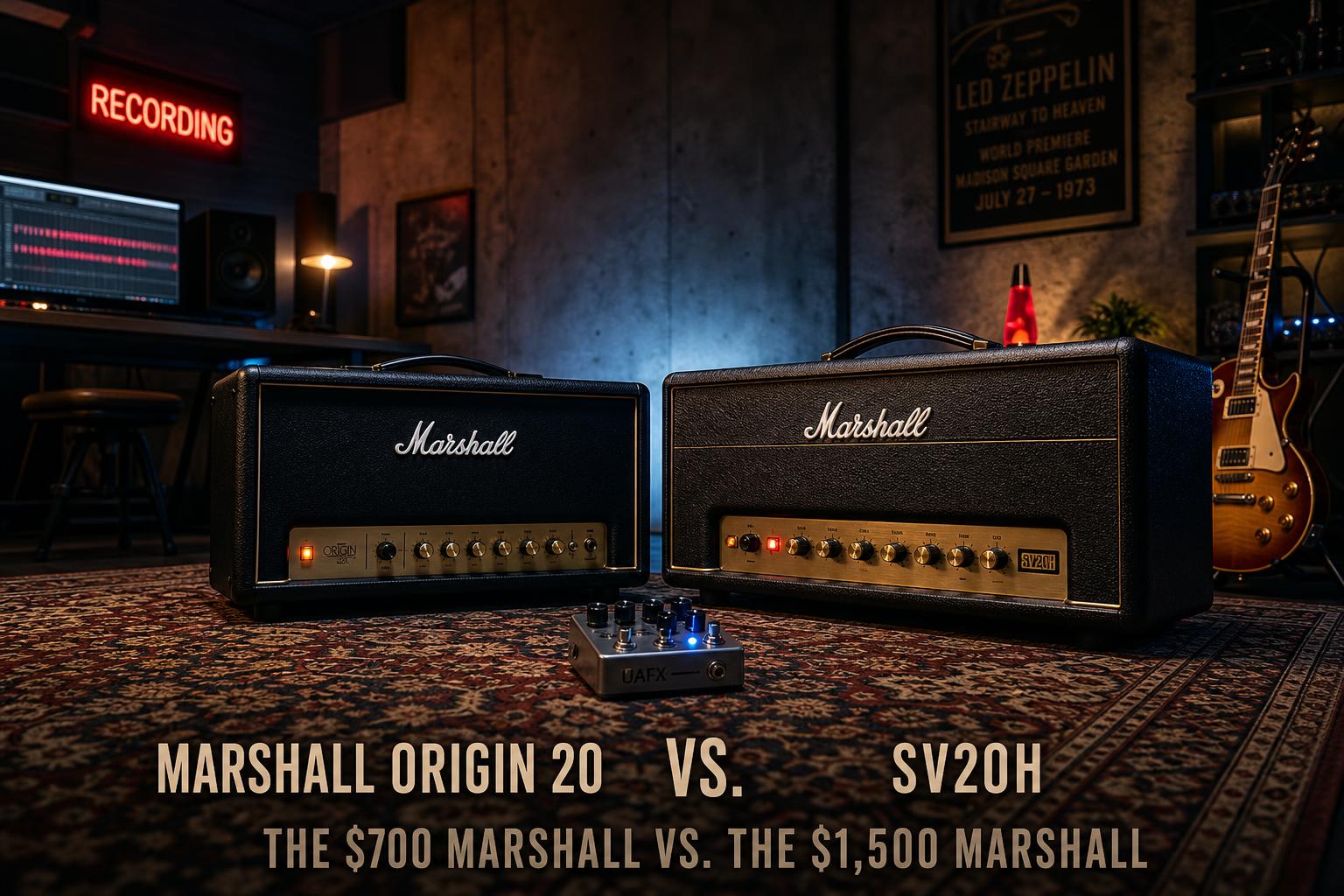
Quick read: The Marshall Origin 20 ($700 street) and the Studio Vintage SV20H ($1,500 street) look similar on paper: 20 watts, EL34s, switchable power section, Marshall on the front. They are not the same amp. The Origin is a single-channel single-knob-tone-shape circuit voiced for cleaner ground and a wider gain sweep. The SV20H is the JCM800 2203 reissue with the original two-stage cascading preamp and the 2203's tone stack, full stop. If you want the cranked-Marshall AC/DC and Van Halen sound, the SV20H is the right amp and the Origin will not get you there. If you want a clean-to-crunch pedal platform with built-in boost and a more flexible front end, the Origin is the right amp and the SV20H is the wrong shape. They are not competitors at different price points. They are different amps at different price points, and the buying decision is about which Marshall sound you actually want.
| Spec | Origin 20H | SV20H |
|---|---|---|
| Street price (May 2026) | $700 | $1,500 |
| Power section | 2 × EL34 | 2 × EL34 |
| Power scaling | 20 / 5 / 0.5 W (Powerstem) | 20 / 5 W |
| Preamp | 2 × ECC83, single channel | 2 × ECC83, JCM800 2203 circuit |
| Tone stack | Bass / Middle / Treble + Tilt | Bass / Middle / Treble (FMV stack) |
| Boost | Built-in front-panel Boost switch | None |
| FX loop | Yes, series | Yes, series |
| Voicing | Plexi-leaning, broader sweep | JCM800, fixed character |
I sold both of these out of the shop in Austin before I retired, and I still get asked the difference at least once a week. The short answer is that Marshall is doing two different things with these amps. The Origin is the budget door into the Marshall family, a flexible amp that takes pedals well and earns its keep at any price. The SV20H is a faithful reissue of a specific historical circuit. The fact that they're both 20 watts with EL34s does not make them interchangeable.
What the Origin 20 Actually Is
The Origin line launched in 2018 and was Marshall's answer to a real problem: every Marshall they sold was either a JCM800-era circuit or a Plexi-era circuit, and neither one is a great fit for a player who wants a clean platform for their pedalboard. The Origin is voiced cleaner than either. It breaks up later. It has more headroom at 20 watts than you'd expect from an EL34 amp, which is the whole point.
The preamp is two stages of ECC83, but the gain structure is set lower than the JCM800. With the Gain at noon and the Boost off, the Origin is a Marshall-flavored clean amp with a slight midrange push and a glassy top end. It will stay clean with a Strat at full volume into the high input until about Gain 1 o'clock. That's a useful range that the JCM800 circuit doesn't give you.
The Tilt knob is the part that gets dismissed and shouldn't be. It's a tone-shaping control that shifts the EQ curve from a brighter, scooped voicing (full counterclockwise) to a darker, more midrange-forward voicing (full clockwise). It is not a presence control and it is not a contour. It's a single knob that lets you move between Plexi-bright and JTM45-dark without touching the three-band stack. Used right, it's the most useful control on the amp.
The Boost is a pre-gain front-end push, switchable on the front panel and footswitchable. It adds about 6 dB of gain and a midrange bump, very much like a Tube Screamer in front of the amp. With Boost off you have a clean platform; with Boost on you have a hot Marshall lead voice without needing an external pedal.
The Powerstem switch on the back is a 20W / 5W / 0.5W three-position. Twenty watts is full power. Five watts pulls the inner pair of EL34s out of the circuit and runs single-ended at lower volume. Half a watt is a working bedroom volume, and yes, the bedroom-volume tone holds up. Marshall did the engineering on the Powerstem and it's the real deal, not a marketing toggle.
What the SV20H Actually Is
The SV20H is a 1981 JCM800 2203 in a 20-watt enclosure. That is the entire pitch, and Marshall is not pretending otherwise. The component values are the original 2203 spec. The tone stack is the original FMV (Fender-style passive midrange) stack with the original cap values. The preamp is the original two-cascading-gain-stage 2203 topology. The only thing that has changed from 1981 is the power section, which is now 20 watts instead of 100, with a 5-watt half-power mode.
That's the appeal. The original 100-watt 2203 only sounds right with the master volume at noon or above, and you cannot run a 100-watt JCM800 at noon in any room you can rent. The 20-watt version gets you the same power-tube saturation at stage volume, and on the 5-watt setting at apartment volume.
The trade-off is that you get the JCM800 circuit and only the JCM800 circuit. There's no clean platform here. The SV20H is at the edge of breakup with the master at 9 o'clock and the gain at 9 o'clock; it gets dirty fast. Above gain 11, you're in classic-rock crunch. Above gain 1, you're in Slash territory. Below gain 8, you're in the dead zone where the amp is just quiet, not clean. This is how a JCM800 works. It's not a flaw; it's the design.
The tone stack interaction is the other thing. The 2203 stack is interactive in a way modern amps aren't. The Bass and Middle controls share a frequency band; pulling one back pushes the other forward. The Treble is the master loudness control on this stack: at 0 the amp is silent, at 10 the amp is brutal. You don't dial this amp the way you dial an Origin. You pick a spot in the Treble and use Bass and Middle to balance against it.
When the Origin Is the Right Amp
You should buy the Origin 20 if any of these are true:
- Your tone is built around pedals. The Origin's clean platform is designed to take overdrives and fuzzes well. A Tube Screamer or a Klon clone in front of the Origin gives you a near-JCM800 voice with the clean Origin underneath when you turn the pedal off. That's a more flexible rig than running a JCM800 with no overdrive in front.
- You play more than one style. The Origin's gain sweep covers clean blues into mid-gain rock with the Boost engaged. The SV20H is a one-trick pony in the best possible way; the Origin is a three-trick pony.
- You're not chasing a specific JCM800 record. If you want the Highway to Hell sound or the Appetite for Destruction sound or the Use Your Illusion sound, you want the JCM800 circuit or the Silver Jubilee circuit specifically. Origin will not get you there. If you don't have a specific record in mind and just want "a small Marshall," the Origin is more flexible.
- You're working in two rooms. The 0.5W setting on the Origin is meaningfully usable. The SV20H's 5W minimum is louder than most apartment buildings will tolerate after 9 PM.
When the SV20H Is the Right Amp
You should stretch for the SV20H if any of these are true:
- You want the JCM800 sound, not a Marshall sound. The 2203 has a specific character: the midrange honk, the way the bass collapses slightly at high gain, the way palm mutes feel like they're being sat on by the power section. That character is the circuit. The Origin does not have it.
- You play classic rock or hard rock as your primary genre. AC/DC, Van Halen I and II, Slash's Appetite rhythm tone (the lead is a Silver Jubilee, but the rhythm is JCM800), Zakk Wylde's early Black Label work. These are JCM800 records. The SV20H will get you there. The Origin will get you close but the character is wrong.
- You have a clean amp already. If your pedalboard rig is built around a Princeton or a Deluxe for cleans and you want a dedicated rock amp for the dirty side, the SV20H makes more sense than the Origin.
- You will hate yourself in a year if you bought the cheaper option and the tone wasn't right. This is the honest reason most JCM800 buyers should buy the JCM800. If you know in your gut that the Origin is going to leave you wishing you'd spent more, spend more.
The Settings That Show the Difference
Here are the settings I use for each amp at the same target tone: a classic rock rhythm voice with a humbucker guitar.
The Origin needs the Boost engaged to get to the rhythm voice because the gain control alone tops out at a softer breakup than the JCM800 circuit. The SV20H gets there with the gain at 5 and no help. The Bass setting is lower on the SV20H because the 2203 stack pushes more low-end into the power section than the Origin does, and at gain 5 with Bass at 5 the SV20H goes flubby. Drop the Bass and the bottom end tightens up.
I expected the Origin to feel like a watered-down Marshall when I first played one in 2018. What I found was that it doesn't try to be a JCM800 at all. It's a different design philosophy, and judged on its own terms, it earns its $700 price. The Boost is the part that surprised me most. Marshall had every reason to make it a marketing gimmick and instead built a genuinely useful front-end voicing.
What Changes Below the SV20H Tier
The Origin is not the only sub-$1,500 Marshall. The DSL line ($600-900) is hybrid solid-state-rectifier with a master volume design that's closer to the 1980s DSL2000 amps than to anything in the Studio Vintage line. The Studio Classic SC20H ($1,500) is the Plexi 1959SLP reissue and is functionally the SV20MKII in a combo enclosure. The Origin sits at the budget door and does its job there.
If you're cross-shopping budget tube amps and not committed to Marshall, the Vox AC15C1 vs. AC30 question is a different conversation. Vox is voiced for chime and edge-of-breakup, Marshall is voiced for midrange push. They are not interchangeable amps. Don't buy a Marshall expecting a Vox.
For a deeper look at what the Studio Vintage line actually is and how the SV20H fits next to its siblings, our SV20H vs. SV20MKII vs. SV2555X breakdown covers the three Studio Vintage heads side by side. And if you're thinking about pedal pairings for either amp, our Tube Screamer settings guide has the front-end-tightener configuration that works on both.
So Which One Should You Buy
If your honest answer to "what Marshall record do you want to sound like?" is Highway to Hell, Van Halen I, or anything off Appetite for Destruction, the SV20H is the right amp and the $800 difference is worth it. If your honest answer is "I just want a small Marshall to take pedals," the Origin is the right amp and the savings buy you a decent overdrive.
The SV20H is the better amp if and only if you want what it does. The Origin is the better deal if you don't have a specific JCM800 record in mind. There is no scenario in which the Origin is "almost as good as the SV20H but cheaper." They don't sound similar enough for that to be a meaningful comparison. They sound like different amps because they are different amps.
The mistake I watched players make for 25 years was buying based on the brand instead of the circuit. Marshall has multiple sounds and the difference between them is real. Pick the one whose sound you actually want.