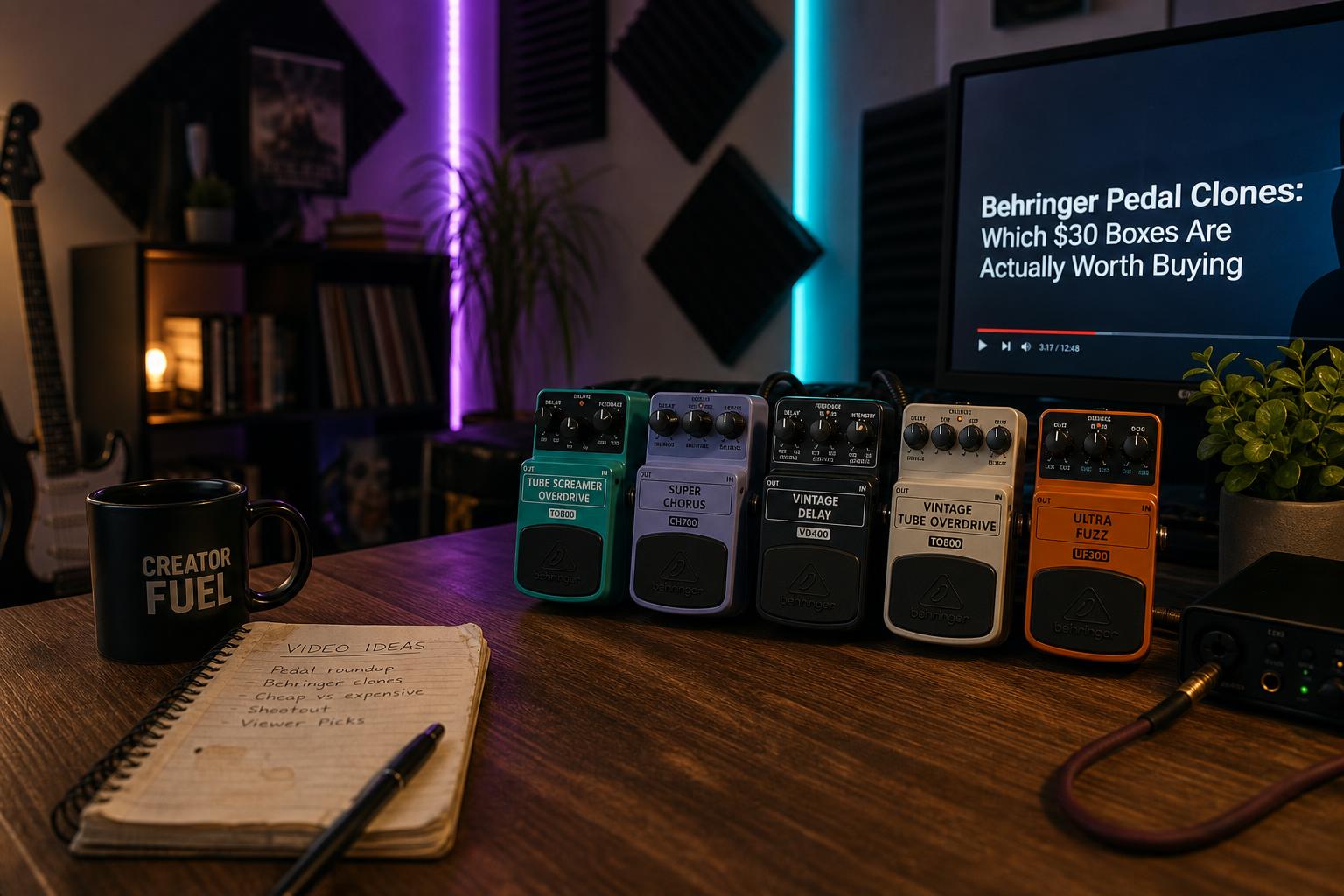
Quick read: Behringer's pedal catalog is a mix of legitimately good clones (where the chip family overlaps with the original and Behringer didn't cheap out on the surrounding circuit) and clones that miss what made the original work. The pattern is consistent: when Behringer used the same chip family as the source pedal, the clone gets within 90% of the original sound. When they substituted a different chip, the result is "an effect," not "the effect." The verdict for twelve common Behringer pedals is below. The build quality is what you'd expect at $30 (plastic enclosure, thin paint, jacks that won't survive a tour), but if you're playing through headphones at home, on a kid's first board, or carrying a budget backup rig, several of these are real.
| Pedal | Clones | Chip Overlap | Verdict |
|---|---|---|---|
| VD400 (Vintage Delay) | Boss DM-2 / Way Huge Aqua-Puss | Cool Audio V3205 (BBD) | Buy. Real BBD, real analog delay. |
| SF300 (Super Fuzz) | Boss FZ-2 / Univox Super-Fuzz | Discrete + op-amp | Buy. Three-mode fuzz at $25 is absurd. |
| TO800 (Vintage Tube Overdrive) | Ibanez TS808 | JRC4558 (same chip) | Buy if it's your first OD. Skip if you have a TS9. |
| BSY600 (Bass Synthesizer) | Boss SYB-3 | Custom DSP | Buy. Best playable bass synth under $200. |
| EM600 (Echo Machine) | Strymon El Capistan / Boss DD-7 | Generic DSP | Skip. Voicings are off; latency is audible. |
| TM300 (Tube Monster) | Boss MT-2 Metal Zone | JRC2068 (same chip) | Buy if you want a Metal Zone for $30. |
| VT999 (Vintage Tube Monster) | Mesa Triaxis-style preamp | 12AX7 tube | Mixed. Real tube but the rest of the circuit is plastic. |
| CC300 (Space Chorus) | Boss CE-2 | MN3007 BBD (same family) | Buy. Real BBD chorus, and it drifts rather than pulses. |
| UC200 (Ultra Chorus) | Newer digital chorus | Generic DSP | Skip. The CC300 exists, buy that. |
| AB100 (A/B Switch) | Generic switcher | Passive | Buy. Nothing to mess up at $20. |
| HM300 (Heavy Metal) | Boss HM-2 (legendary buzzsaw) | TA7136P op-amp (different) | Mixed. Close-ish but the high-end is wrong. |
| RV600 (Reverb Machine) | Strymon BlueSky / Boss RV-6 | Generic DSP | Skip. Voicings are flat; algorithms feel synthetic. |
This is the honest verdict on twelve Behringer pedals, ranked by whether the budget actually buys you the sound. I've spent more time with cheap pedals than I'd care to admit. My backup rig is six Behringer pedals in a soft case that cost $180 total. Some of them are surprisingly real and some of them aren't.
The Pattern: Chip Overlap Is the Predictor
Behringer's good clones and Behringer's bad clones are separated by one variable: did they use the same chip family as the original pedal, or did they substitute something cheaper?
When the chip overlaps:
- The VD400 uses Cool Audio V3205 BBD chips (same chip family as Boss DM-2 and the modern Way Huge Aqua-Puss). The analog delay sound is real because the analog delay circuit is real.
- The TO800 uses a JRC4558 op-amp clone (the same op-amp family as the TS808). The Tube Screamer sound is right because the clipping section is right.
- The CC300 uses MN3007-family BBD chips (the same family as the Boss CE-2). The chorus sound is real because the chorus circuit is real.
When the chip doesn't overlap:
- The HM300 uses a TA7136P op-amp instead of the TA7136 the original Boss HM-2 used (and Boss has since switched to digital anyway). The high-end voicing is wrong and the buzzsaw character is missing.
- The EM600, RV600, and UC200 are all generic DSP-based pedals. They have "an algorithm" but not "the algorithm"; they don't clone the source's specific voicing, they just provide a similar effect category.
This is the single rule that predicts whether a Behringer clone is worth the $30. Look at the chip. If the chip family matches the original, the clone is probably real. If the chip is generic DSP or a substitute, the clone is "in the genre" of the original but not "of the original."
The Real Ones (Buy These)
VD400 Vintage Delay
The VD400 is the surprise winner of the Behringer catalog. Real BBD analog delay using the Cool Audio V3205 (the same chip family that's in the modern Way Huge Aqua-Puss MkIII). We covered the VD400 vs. Aqua-Puss head-to-head in detail; the short version is that the VD400 sounds like an analog delay because it is one. The build quality is plastic and the switch will eventually fail, but the sound is the real thing.
What it sounds like: each repeat comes back darker and blurrier than the one before it, so the tail turns to fog rather than counting down in focus. About 600 ms maximum delay time. The modulation isn't adjustable but it's there, and it keeps the repeats from stacking into a drone.
What it's wrong for: tight slapback (the modulation gets in the way), digital-precision dotted-eighth (it's not that pedal), or anything where you need delay times above 600 ms.
SF300 Super Fuzz
A three-mode fuzz at $25. The first mode is a Boss FZ-2 voicing, the second is a Univox Super-Fuzz mid-scoop voicing, the third is a more aggressive distortion. All three modes are usable. The build is plastic and the switching is mushy, but the sound is real fuzz.
What it sounds like in mode 2 (the Super-Fuzz mode): octave-tinged scooped midrange fuzz, the sound on early Stooges records and J Mascis solos. It's a $300 pedal sound for $25.
What it's wrong for: anything that requires gentle pickup-cleanup behavior. The SF300 cleans up acceptably with the guitar volume but not as articulately as a Fuzz Face would.
TO800 Vintage Tube Overdrive
The TS808 clone. JRC4558 op-amp, symmetric clipping diodes, the same circuit topology as the original Tube Screamer. At $30, it gets within 90% of a TS808 sound. The 10% that's missing is mostly in the smoothness of the diode clipping (the TO800's diodes are slightly harsher than the originals), but at $30 it's a real Tube Screamer voice.
What it sounds like: midrange-pushed soft-clipped overdrive, about 6 dB of midrange bump, soft compression at higher gain settings. The classic blues drive sound.
What it's wrong for: if you already own a TS9, a TS808, or a Maxon OD9, the TO800 isn't going to give you anything new. This is a pedal for a player who doesn't have a Tube Screamer yet.
TM300 Tube Monster
Boss MT-2 Metal Zone clone. Same JRC2068-family op-amp, same midrange contour switching, same gain stage architecture. Behringer cloned the Metal Zone faithfully and the result is, well, it's a Metal Zone. If you want a Metal Zone, the TM300 will get you there for $30 instead of $100.
What it sounds like: heavily scooped high-gain distortion with a parametric mid control that lets you reshape the scoop. The classic 90s metal sound that everyone has opinions about.
What it's wrong for: subtle drive (it doesn't do that), or any application that doesn't fundamentally want the Metal Zone voicing.
CC300 Space Chorus
Boss CE-2 clone using MN3007-family BBD chips. The CE-2 sound is the result of the BBD circuit specifically, and the CC300 has the right BBD circuit. At $30 it's the cheapest way to get a real analog chorus.
What it sounds like: the pitch never quite settles, so chords sit slightly out of focus in a way that reads as depth rather than as wobble. The Andy Summers tone on "Walking on the Moon" and the whole early Cure guitar sound live in this pedal. Set the depth past about 2 o'clock and it stops being depth and starts being seasick, which is also a usable place.
What it's wrong for: tight, fast, modern digital chorus. That's a different effect; the CC300 is unapologetically vintage.
BSY600 Bass Synthesizer
The Boss SYB-3 clone, and possibly the most underrated pedal in the Behringer catalog. The SYB-3 went out of production years ago and used pedals run $250+. The BSY600 is $50 new and the synth voices are surprisingly close. Eleven different synth modes, an envelope follower that tracks well at low and middle range, and a wet/dry blend.
What it sounds like: bass synth voices ranging from analog square-wave growl to filtered sweep to octave-down sub. The mode 1 setting is the canonical "bass synth" sound and it's the right voicing.
What it's wrong for: high-position lead lines (tracking falls apart above the 12th fret on most modes) or hyper-precise modern synth voicings.
AB100 A/B Switch
A passive A/B box at $20. Nothing to mess up. It's a metal switch and two jacks. The build is acceptable for stationary use; not great for tour but fine for a home rig.
The Mixed Ones (Buy with Caveats)
VT999 Vintage Tube Monster
Behringer put a real 12AX7 tube in this pedal. The marketing leans heavily on that. The problem is the rest of the circuit. The tube is operating at 9V (starved-plate, not full power), the circuit around it is generic op-amp distortion, and the tube isn't doing the heavy tonal lifting. The result is a high-gain distortion pedal that has a slight tube character on top of an otherwise plastic-sounding clipper.
What it sounds like: aggressive high-gain distortion with a slight harmonic complexity in the midrange that the all-solid-state competition doesn't have.
The verdict: if you specifically want a starved-plate tube character at $40, this delivers. If you want a real tube preamp pedal, save up for an Effectrode Blackbird or a Catalinbread Belle Epoch; those have full-voltage tube circuits that operate the way tubes are supposed to.
HM300 Heavy Metal
The Boss HM-2 clone. Behringer used a different op-amp than the original, and the HM-2's signature high-end buzzsaw character (the part that makes it the sound of Swedish death metal) comes from the specific high-frequency clipping behavior of the original chip. The HM300 gets the gain structure right and the EQ controls right, but the buzzsaw character is dimmer.
What it sounds like: high-gain distortion with the HM-2 EQ contour (low and high boost, mid scoop) but without the full harshness of the original.
The verdict: if you grew up on Entombed records and you want the actual buzzsaw, save for a real HM-2. If you want a high-gain distortion pedal with HM-2-style controls and you're playing at home through headphones, the HM300 will get you 70% there for 20% of the cost. That trade is reasonable for a home rig and unreasonable for someone trying to get a specific record sound.
The Skip List (Don't Bother)
EM600 Echo Machine
A multi-mode digital delay aiming at the Strymon El Capistan / Boss DD-7 territory. Generic DSP, ten "tape echo" and "modulated delay" voicings, none of which are convincing. The latency is audible at fast settings, the modulation is unmusical, and the high-end voicings are veiled. The VD400 ($30) is a better delay pedal for a fraction of the price; if you need digital delay, the Boss DD-3T at $130 is the real entry point.
RV600 Reverb Machine
Same problem as the EM600 in the reverb category. Generic DSP with seven "modes" labeled Plate, Spring, Hall, Room, Modulate, Gate, and Reverse. The voicings are flat and the algorithms feel synthetic. A Boss RV-6 at $150 is the real entry point for digital reverb. The Mooer R7 at $100 is a better budget alternative.
UC200 Ultra Chorus
Why does this exist when the CC300 is the same price and uses real BBD? Skip and buy the CC300 instead.
Chip Overlap Tells You About the Model, Not About Your Unit
Everything above is a verdict on a design. Your box is a specific object that came off a line, and at this price the parts inside it are held to wider tolerances than the parts in a Boss pedal. That matters for some of these pedals and not at all for others, and the split is predictable.
The rule is whether the circuit sets its own character by a ratio or by a part.
Consistent, buy sight unseen: TO800, TM300, AB100. A Tube Screamer circuit sets its gain with two resistors in a feedback loop, and two resistors off the same reel drift together, so the ratio barely moves. Two TO800s are close enough that shopping for a good one is a waste of an afternoon.
Varies audibly, play it if you can: SF300. It is a discrete fuzz, which means transistor gain spread lands directly on the voice with no feedback loop to absorb it. Two SF300s in the same shop can genuinely differ in how hard mode 2 scoops and how well the pedal cleans up off the guitar volume.
Varies for a fixable reason: VD400, CC300. Bucket-brigade delay and chorus circuits have a bias trimmer inside, and it gets set by a person on a schedule. A well-trimmed VD400 has repeats that soften and blur as they die. A badly trimmed one has repeats that arrive gritty and thin from the first one, with a hiss that rises as the regeneration comes up. That is not the design failing. That is an adjustment, it is a twenty-minute job for any tech, and it is worth knowing before you write off a unit that arrived sounding wrong.
And a smaller thing that affects every pedal here: potentiometers are commonly plus-or-minus 20 percent parts, and the audio taper is a two-segment approximation whose bend point moves from part to part. So "drive at noon" in this article is a neighborhood, not an address, on any pedal at any price. Set by ear. Component tolerance and what it actually costs goes through which parts move and by how much, and why the ones people argue about are usually not the ones that matter.
The Sixty-Second Incoming Check
Cheap pedals fail in cheap ways, and nearly all of them show up in the first minute. Do this before the return window closes rather than three weeks later when you finally get to that song.
- Wiggle both jacks with a cable in. Crackle means a loose jack nut. Tighten it before you decide the pedal is noisy.
- Stomp the switch fifteen times. You are looking for a stomp that does not latch, or that double-triggers. This is the single most common failure on this whole list.
- Listen to the noise floor with the effect on and the guitar volume rolled off. Some hiss is expected at this price. A hum that changes when you turn is a grounding problem, not the pedal.
- On the VD400 and CC300, run the repeats or the depth up. Gritty, thin, and hissing from the first repeat is a bias trim, per above. Blurring and softening is correct.
- On the SF300, roll your guitar volume from 10 down to 4. It should thin out and clean up, not cut out abruptly. A unit that gates and dies is a unit with the wrong transistor lottery ticket.
Prices in this article are street as of May 2026 and this tier moves around more than most, so treat them as the shape of the deal rather than as quotes.
The Build Quality Reality
I'm not going to pretend the Behringer build quality is what you get from a Boss or a Way Huge pedal. The enclosures are plastic. The paint chips. The jacks have been known to come loose. The footswitch on my SF300 started getting flaky after about a year of casual home use.
For a touring rig, this is a problem. For a backup pedal in a soft case, for a kid's first pedalboard, for a home rig that lives in a drawer when you're not playing, the build quality is acceptable. The cost-per-sound calculation works out fine if you're not stomping on the switch a thousand times a year.
A $25 pedal that lasts two years is the same effective cost as a $100 pedal that lasts ten. Sometimes the cheap pedal is the right deal.
The Honest Recommendation
If you have $200 to spend on a starter board and you don't already own any pedals, here's how I'd allocate it:
- Behringer SF300 / $25 / fuzz
- Behringer TO800 / $30 / overdrive (or skip if you have a Tube Screamer)
- Behringer CC300 / $30 / chorus
- Behringer VD400 / $35 / analog delay
- Boss TU-3 / $90 / tuner (don't buy the Behringer tuner, the Boss is cheap and reliable and has a polyphonic mode that actually works)
That gets you fuzz, overdrive, chorus, delay, and a real tuner for under $215. It's not a pro rig. It's not going to last a tour. It is enough to play music on, learn what each pedal type does, and figure out which categories matter to you before you save up for the real versions.
For a more sophisticated approach to budget rigs that uses fewer pedals more thoughtfully, our $500 gigging rig guide puts together a small board with a couple of mid-tier pedals instead of a full Behringer collection. Both approaches work. The Behringer route is the cheapest entry; the mid-tier route is the longer-term investment.
The pedals you buy when you're 14 are not the pedals you'll be playing through at 30. They're the pedals that teach you what you actually want, on a budget that lets you keep playing while you figure it out. That's the deal, and the deal is still worth taking.