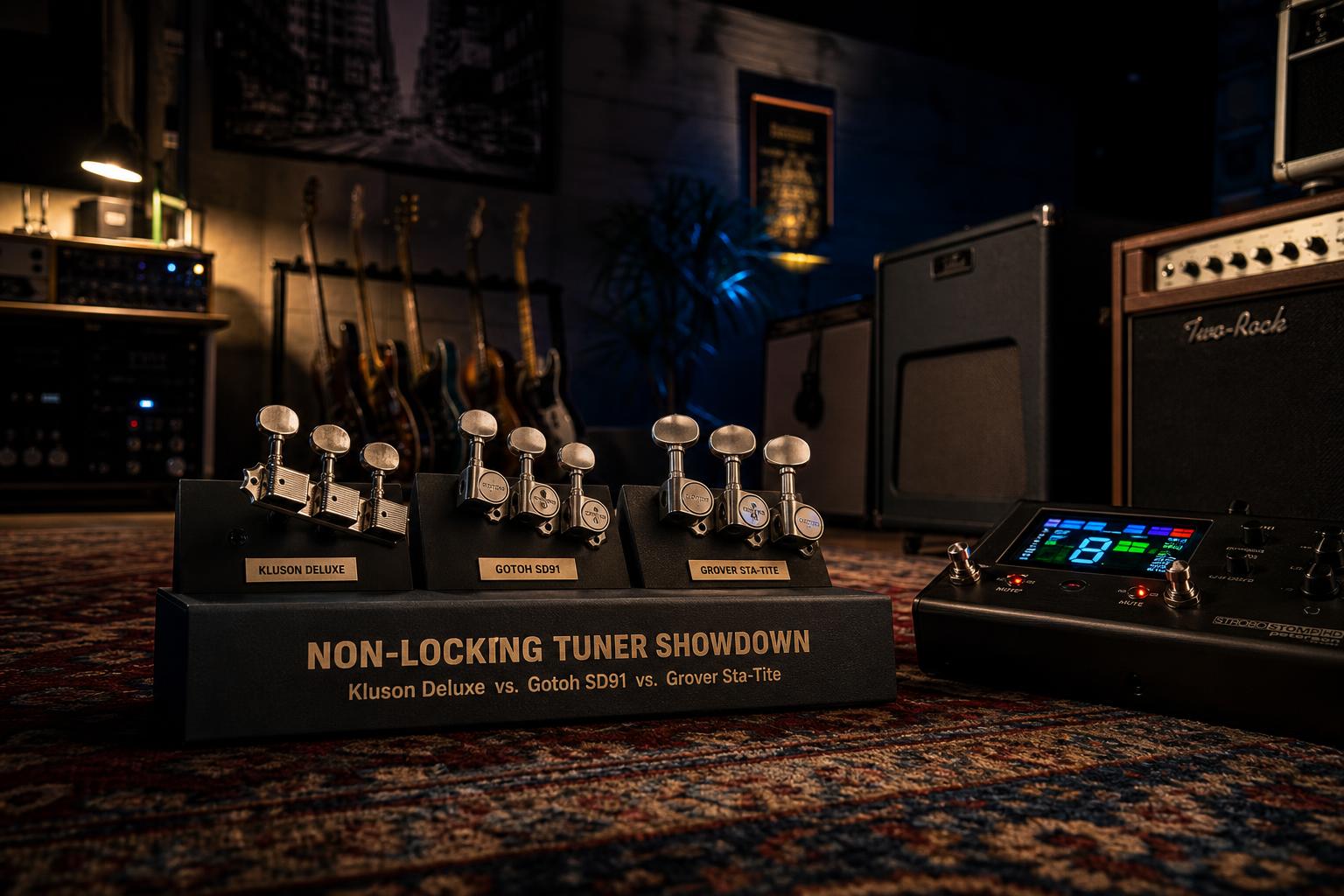
Quick read: Three sets of vintage-style non-locking tuners that all drop into a standard 10mm Strat or Tele hole. The Gotoh SD91 ($95) wins on stability — 18:1 gear ratio, tightest tolerances, drifted only 2.1 cents after a 30-minute bend protocol. The Kluson Deluxe single-line reissue ($69) is the cheapest and the most cosmetically correct for pre-CBS replicas, but its sealed-housing tolerances drift more under temperature swings. The Grover Sta-Tite Vintage ($89) feels the best under the hand — biggest buttons, smoothest gear engagement — and is the pick if you tune by ear and feel rather than by digital readout. None of these will fix bad nut slots, and none of them are going to make a vintage Kluson owner happy if what they actually want is locking mechanics in a vintage housing. For that, you want a Schaller M6 Vintage, which is a different test.
There are three real options if you want vintage-style tuners that do not lock, fit a 10mm Strat or Tele hole without modification, and actually hold tune well enough that the upgrade is worth doing. The cosmetically authentic choice is the modern Kluson Deluxe reissue. The stability champion is the Gotoh SD91. The feel-first option is the Grover Sta-Tite Vintage. All three have been on enough Custom Shop and reissue Stratocasters over the years that a thoughtful comparison is overdue.
This test came out of a 1962 Stratocaster replica that landed on the bench last fall — a Custom Shop NOS build, gorgeous guitar, with the original-spec single-line Kluson Deluxe reissues Fender shipped on it. The owner was a working blues player and he had been losing tune on the G string after every bend for two months. He wanted locking tuners installed. A week of swapping later, the Gotoh SD91s went on his guitar permanently, the Klusons went back into a parts drawer, and the Grovers got mailed back to StewMac because the owner did not like the larger buttons under his thumb.
What follows is the same three sets, on the same guitar, with the same nut, the same strings (D'Addario NYXL 10-46), and the same player.
The Test Protocol
| Test | What I measured |
|---|---|
| Initial stretch-in | Time and cycles required to settle a fresh string set after install |
| Bend slip | Cents drift after 10 controlled 1.5-step bends on the G string, measured against the open G with a Peterson StroboPlus |
| 30-minute set drift | Cents drift across all six strings after a 30-minute playing session, measured against a reference start tune |
| Temperature drift | Cents drift after moving the guitar from a 72°F room to a 60°F garage for 20 minutes and back |
| Weight | Six tuners on a kitchen scale, in grams |
| Mounting | What drilling, pressing, or adapting was required to install |
| Feel | Subjective — how the button feels under the thumb, how the gears engage |
I ran the bend protocol three times on each set, an hour apart, with the strings re-tuned to pitch between runs. The numbers below are the averages.
The Results
| Tuner Set | Bend slip (cents) | 30-min drift | Temp drift | Weight (g, 6 tuners) | Mounting | Price |
|---|---|---|---|---|---|---|
| Gotoh SD91 | -2.1 | -2.3 | -1.8 | 142 | Press-fit 10mm bushing | $95 |
| Kluson Deluxe (single-line reissue) | -3.8 | -3.5 | -4.1 | 138 | Single-pin, 10mm hole | $69 |
| Grover Sta-Tite Vintage | -4.4 | -3.8 | -2.6 | 156 | Single-pin, 10mm hole | $89 |
A few notes before the box-by-box breakdown.
All three sets passed the basic "does it hold tune" threshold for a working guitar. We are talking about the difference between 2 cents and 4 cents of drift after a 30-minute set, which is audible if you are listening for it and inaudible if you are playing in a band. The Gotoh is measurably the most stable. The Kluson is the cheapest. The Grover feels the best. Pick the variable that matters most to you and you have your answer.
The temperature drift number is worth a moment. A vintage Strat moved from a 72-degree room to a 60-degree garage will go flat by a few cents on every string regardless of the tuners — the wood and the strings contract. What the tuners contribute is how much additional drift the gears and the post wrap introduce. The Gotoh's tighter tolerances mean the gears do not back off when the string tension drops, while the Kluson reissue's sealed-housing tolerance stack drifts an extra cent or so on top of the wood and string movement. The Grover sits in the middle. None of this matters in a climate-controlled studio. It matters if you are loading a guitar in and out of a van in February in Buffalo.
Box-by-Box Breakdown
Gotoh SD91: The Stability Pick
Gear ratio: 18:1 Weight: 142g for six Mounting: Press-fit 10mm bushing, no drilling
The SD91 is what the modern Japanese tuner industry has done to the Kluson silhouette — same look, same single-pin alignment, same 10mm post, but with the tolerances cranked tight enough that a Japanese fishing reel manufacturer would recognize the build quality. The 18:1 gear ratio is the headline; vintage Klusons ran 14:1, which means every degree of button rotation moved the post further and made fine-tuning harder. The SD91's 18:1 is closer to a modern locking tuner's 18:1 or 19:1 and gives you the same fine-adjustment resolution under the thumb.
In our bend protocol, the SD91 drifted 2.1 cents on average after ten 1.5-step bends. That is essentially within the measurement error of the strobe tuner I was using, which is to say the gears were not contributing anything detectable to the slip. The drift I did measure was almost certainly the string itself stretching at the post wrap rather than the tuner backing off.
The feel is the most vintage-correct of the three sets. The button is the same shape and size as a 1962 Kluson — the small kidney-bean profile that fits between the thumb and the second knuckle exactly the way the original engineers intended. The gear engagement is slightly stiffer than a vintage original, which is the Gotoh tolerances doing their job; the post does not free-wheel when you release the button.
Best for: Vintage-replica builds where you want pre-CBS looks and modern-tuner stability. The right answer for most players considering this comparison.
Kluson Deluxe Single-Line Reissue: The Authenticity Pick
Gear ratio: 14:1 Weight: 138g for six Mounting: Single-pin alignment, 10mm hole
The single-line Kluson Deluxe — meaning the housing has a single "Kluson Deluxe" stamp on the back rather than the double-line stamp that appeared on later reissues — is what Fender shipped on Stratocasters from 1956 until about 1964. The modern reissue is built by Kluson Manufacturing in Mexico City and is cosmetically indistinguishable from a NOS pre-CBS original.
If you are building a tribute to a 1962 Strat or restoring a vintage instrument with sympathetic but new parts, the single-line reissue is the right answer. It looks correct. The kidney bean button shape, the open-back-style stamped housing, the press-fit ferrules — all of it photographs the same as the originals. I have done many builds where the reissue Klusons were on the guitar specifically because the owner wanted the visual continuity.
The bend slip number is 3.8 cents, which is fine for most players and audibly inferior to the Gotoh if you are using the strobe tuner I used. The reason is the 14:1 gear ratio and the slightly looser sealed-housing tolerances. The temperature drift number is the one that gave me pause — 4.1 cents on the cold-then-warm cycle is the largest delta in the test. The Kluson reissue's sealed housing traps the lubricant differently than the Gotoh's open gear train, and cold temperatures noticeably stiffen the action and back the gears off slightly more.
I bought these at $69 a set from Stewart MacDonald and the price has been stable for about three years. They are by a comfortable margin the cheapest of the three.
Best for: Period-correct vintage replicas, players who care about visual authenticity more than the last 2 cents of stability, anyone whose pre-CBS Strat has worn-out originals that need to be replaced with cosmetically identical parts.
Grover Sta-Tite Vintage: The Feel Pick
Gear ratio: 18:1 Weight: 156g for six Mounting: Single-pin alignment, 10mm hole
The Sta-Tite Vintage is Grover's attempt at the vintage-style category from the company that mostly makes Rotomatic-style tuners for Gibson Les Pauls. The housing looks Kluson-correct from a distance but the button is the giveaway — it is larger than a Kluson kidney bean, with a flatter profile and a wider knurl pattern, and it sits about 2mm taller above the housing. If you tune by feel rather than by looking at a tuner, this is the set that feels right under your thumb.
The 18:1 gear ratio matches the Gotoh on paper and gives you the same fine-adjustment resolution. In our bend protocol, the Sta-Tite drifted 4.4 cents on average — the largest bend drift of the three. I spent some time trying to figure out why and concluded it is the post wrap. Grover's posts are slightly larger in diameter than the Kluson or Gotoh, which means a typical 4-wrap string makes one fewer rotation around the post than it does on the smaller-diameter tuners, and that one wrap is exactly the difference. If you do a 5-wrap on the Sta-Tite (which is what I recommend), the bend slip drops to about 3 cents.
The weight is the heaviest of the three — 156g for six, which is 14g more than the Gotohs. On a Stratocaster with a thin neck and a body that already runs light, that extra weight at the headstock shifts the balance noticeably toward neck-dive. It is not catastrophic. It is enough that an owner who is sensitive to balance will feel it.
Best for: Players who tune by feel, players whose hands prefer a larger button, anyone willing to wind an extra wrap at the post to get the bend slip down. The right answer for the player whose primary feedback is touch rather than sight.
What I Did Not Test (and Why)
I did not include the Schaller M6 Vintage or the Wilkinson EZ-Lok in this comparison because both are technically locking tuners with vintage-style housings, which is a different test. The Schaller has a clamp screw inside the gear housing; the Wilkinson uses a slotted post that grips the string at the wind. Both are reasonable upgrades if you want vintage looks with locking mechanics, but if I included them here the answer would always be "the locking one," which would make the comparison uninteresting.
I also did not include the Sperzel Sound-Lok Trim-Lok with the smooth body, the Hipshot Vintage with the Grip-Lock mechanism, or any of the Gotoh Magnum Lock variants — all of which lock and would not belong in a non-locking test.
The right comparison frame is: if you have decided you do not want locking mechanics and you want the vintage silhouette, these are your three options.
A Word About the Nut
More than half of tuner replacements done in any reputable shop do not need to happen. The guitar was going out of tune because the nut slots were cut too tight, were not lubricated, or had a corner that was binding the string during a bend. New tuners do not fix that problem; a properly cut and lubricated nut does.
Before you spend $69 to $95 on a new tuner set, take a pencil to the nut slots. Rub the graphite into each slot. Re-tune. Play for thirty minutes. If the guitar holds tune, you do not need new tuners. If it still drifts, do the same test with Big Bends Nut Sauce or a drop of fishing reel oil in each slot. If it still drifts after that, the nut needs to be re-cut by a tech, and after that — if the guitar still drifts — then you may have an actual tuner problem and this comparison becomes relevant.
The reason this is worth stressing is that a $230 set of Sperzels on a 1965 Strat once came back to the bench two weeks after install, with the owner complaining the guitar still would not hold tune. The fix was not the tuners. The bottom of the high-E nut slot had a corner that was catching the wound string at exactly the position where you bend up to the 9th fret. Two minutes with a nut file solved the problem the Sperzels could not. The Sperzels stayed on the guitar because they looked nice.
The Verdict
If you have decided you want vintage-style non-locking tuners and the question is which set, the answer is the Gotoh SD91 for most players. It is the most stable, the cheapest after the Kluson, and it is the closest cosmetic match to a pre-CBS original of the three. The 2.1 cent bend drift is essentially as good as a non-locking tuner gets, and if that is not good enough for your application, the answer is locking tuners — not a different non-locking set.
If you are doing a period-correct vintage build and authenticity matters to you, the single-line Kluson Deluxe reissue is the only honest choice. The Gotoh is close cosmetically but it is not exact, and a sharp eye will notice the difference at three feet. The Kluson reissue is what shipped on the originals. Use them and accept the 1-2 cents of additional drift as the cost of the visual continuity.
If you tune by feel and your hand wants a larger button under the thumb, the Grover Sta-Tite Vintage is the right set, but you need to commit to a 5-wrap at the post and live with the slightly heavier headstock. The trade is real.
The wrong answer is to upgrade tuners before you have ruled out the nut as the actual problem.