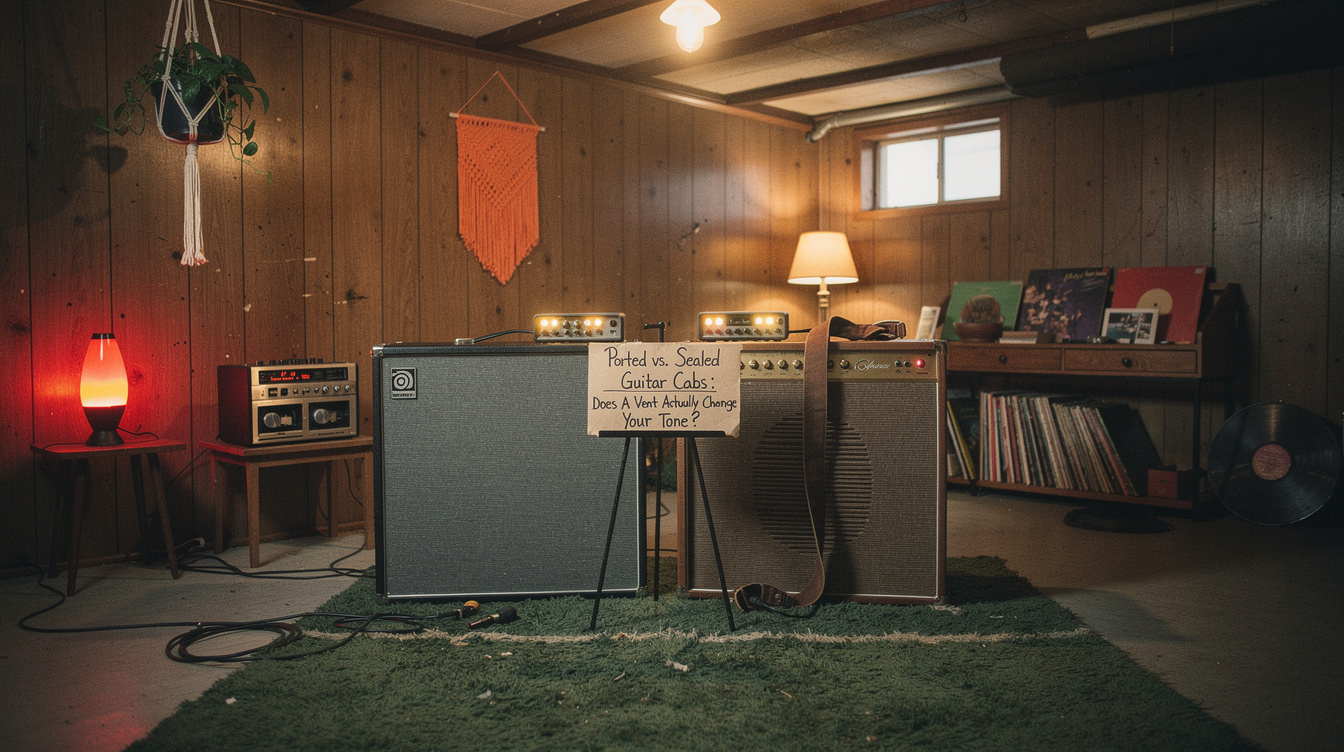
Most guitar cabs come in two kinds. Sealed, like a 4x12. Or open-backed, like a Fender combo. You rarely see a ported guitar cab, the kind with a tuned vent on the front or back. There is a reason for that. A port does a specific job, and that job is not usually what a guitar wants. Here is what a vent does and when it earns its place.
The Short Answer
| Sealed | Ported | Open-back | |
|---|---|---|---|
| The air behind the speaker | Trapped, acts like a spring | Mostly trapped, vented at one tuned note | Free, radiates into the room |
| Low end | Tight and focused | Extended but looser | Soft and spread out |
| Best at | Punch, palm mutes, high gain | Deep bass extension | Roomy clean and crunch |
| Common in guitar | Yes, most 4x12s | Rare | Yes, most combos |
A sealed box is the default for a reason. A port solves a problem guitar mostly does not have.
What a Port Actually Does
Picture the air inside a sealed cab. The speaker cone pushes into it. The air pushes back. That trapped air works like a spring. It damps the cone and keeps the low end tight. That is the sound of a closed 4x12. The low end thumps you in the chest instead of spreading around the room.
A port changes that. It is a tuned tube or slot cut into the box. At one specific frequency, the air in that port moves in step with the cone and reinforces it. You get more output down low, and the bass reaches lower than the sealed box could. This is how bass cabs and hi-fi speakers get their deep low end. It works. For bass.
For a guitar, the math points the other way. The low E sits around 82 Hz. The speaker rolls off below that anyway. A guitar speaker is voiced for the midrange, not the basement. So a port tuned down into the lows is reinforcing a region the guitar barely uses. You can read more about how box size sets that resonance in the cabinet volume guide.
Why Guitar Players Skip the Port
A port adds low end at one note. That is the catch. Hit the tuned note and the cab booms. Hit the notes on either side and the girth is gone. That is not low end. That is a resonance. On a single power chord it can sound huge. Across a riff it sounds uneven.
Sealed gives you even low end across the whole neck. Open-back gives you air and spread. Both behave the same no matter what note you play. A guitar mostly wants that consistency more than it wants depth. The open-back versus closed-back tradeoff is really a choice between spread and punch, and a port does not fit cleanly into either.
The Time I Tried It
I built a small 1x12 once. Sealed. It sounded boxy and a little honky. I figured the fix was more low end, so I cut a port in the back to open it up. I expected fuller, deeper bass.
What I got was a bump. One note bloomed and boomed. The rest of the low end stayed thin. Worse, palm mutes lost their tightness. They went from a fist to a flabby thud. The port did not add low end. It added a lump at one frequency and loosened everything around it. I plugged the hole and went back to sealed. The boxiness, it turned out, was the box being too small, not the box being sealed. That is a size problem, not a venting problem.
When a Vent Is Worth It
There are two honest cases.
- A small sealed cab that sounds boxy. If the box is too small, its resonant peak sits too high and you get that honk. A port can lower that peak and open the cab up. Here the vent is fixing a specific flaw, not chasing depth.
- A small speaker you want to sound bigger. A ported 1x12 can give a single speaker more low-end bulk for recording or small gigs. You trade tight bass for size. If you know that going in, it is a fair trade.
Outside those two, sealed or open-back is the safer pick. Most boutique and factory guitar cabs land there for the same reason.
If You Play a Modeler
This whole thing becomes a menu choice. The cab IR carries the sealed-versus-open character, so you pick the impulse and you are done. Want the tight sealed thump. Load a closed-back 4x12 IR. Want the open spread. Load an open-back combo IR. Same difference in sound, no saw, no glue, no plywood. Ported IRs exist too, and the same caution applies. The boomy bump is in the capture.
What to Do
If you are buying or building, start sealed for punch or open-back for air. Skip the port unless you are fixing a boxy small cab or you want one small speaker to sound bigger and you accept looser bass. A port is a tool for extending low end. A guitar does not live down there. Most of the time, the sealed box you already have is the right answer.