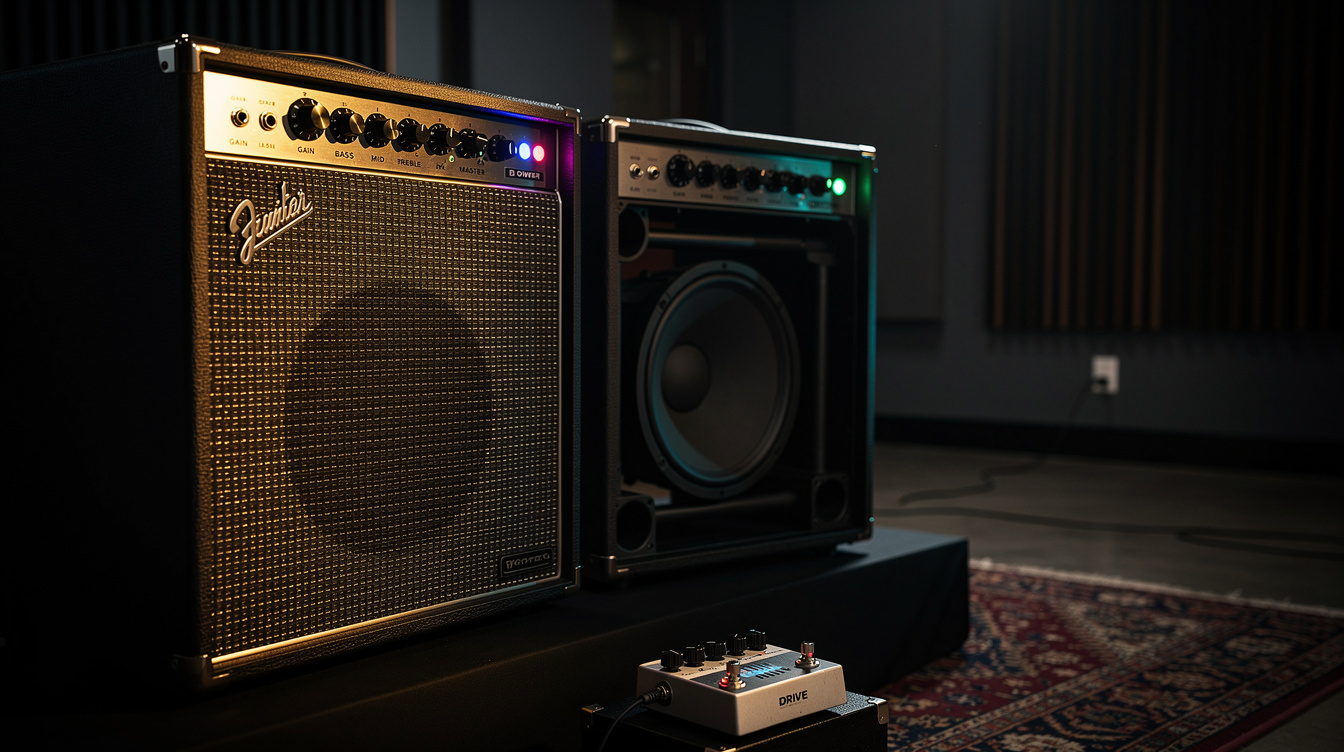
Two guitarists can run the same amp head into the same speaker and get noticeably different tones for one reason: one cab has a sealed back and the other doesn't. The cabinet is not a passive box that the speaker happens to live in — it's a tone-shaping component as consequential as the speaker itself. Here's exactly what the open-back versus closed-back choice does to your sound, and how to pick the right one.
The Short Answer
| Open-Back | Closed-Back | |
|---|---|---|
| Low end | Looser, rolled-off | Tight, extended, bigger |
| Dispersion | Wide, room-filling, 3D | Narrow beam, directional |
| Feel | Airy, spacious, "breathes" | Punchy, focused, in-your-face |
| Best for | Cleans, classic rock, blues | High-gain, metal, tight rhythm |
| Typical format | Combos, 1x12 / 2x12 | 4x12, sealed 2x12 |
Closed-back = tight and big. Open-back = airy and spacious. That's the headline. The rest of this post is why, and what it means for your rig.
Why the Back Panel Changes Everything
A speaker cone moves air on both sides. The front pushes the sound you hear; the back pushes an equal and opposite wave inside the cabinet.
In a closed-back cab, that rear wave is sealed inside the box. The trapped air acts like a spring, controlling the cone's motion and reinforcing the low frequencies. The result is bass that's both tighter (the air spring stops the cone overshooting) and bigger (the rear energy isn't allowed to cancel the front). This is the single biggest reason a sealed 4x12 sounds enormous and a small open-back combo sounds, by comparison, polite.
In an open-back cab, the rear wave escapes — and at low frequencies, where the wavelengths are long, the escaping rear wave wraps around and partially cancels the front wave. That cancellation rolls off and loosens the deep bass. What you lose in low-end authority you gain in openness: the cab radiates into the room from front and back, producing a more three-dimensional, spacious sound that surrounds the player.
The Surprise: Open-Back Sounds Bigger to the Player
You'd expect the cab with more bass to sound bigger. In the room, standing in front of it, the closed-back wins. But to the player standing over the amp, an open-back combo often sounds larger and more enveloping — because it's spraying sound off the back wall and filling the space behind you, while the closed-back fires its beam straight out front and past your knees. This is a recurring point of confusion: a player auditions a closed-back cab, stands right next to it, decides it sounds thin and beamy, and never realizes that six feet out front, on-axis, it's a wall of tight low end. Where you stand changes the verdict.
Dispersion: The Beam Problem
Closed-back cabs beam. The high frequencies fire out of the speaker in a narrow cone — roughly a flashlight pointed straight ahead. Stand directly in front of a 4x12 on-axis and the treble can be brutally harsh, like an ice pick; step off to the side and it goes dark and muffled. This is why mic placement on a closed-back cab is so fussy, and why so many players think their 4x12 is "too bright" when really they're just standing in the beam.
Open-back cabs disperse far more widely. The sound spreads out instead of beaming, which makes them more forgiving to stand near and easier to fill a small room with — but also means they bleed all over a stage and into other microphones, which is exactly why sound engineers at loud shows tend to prefer the controllable closed-back. For the off-axis harshness on either type, the speaker itself matters too; the Celestion speaker showdown covers how different drivers tame or exaggerate that top end.
Which One for Your Genre
The genre conventions exist for acoustic reasons, not just tradition:
- Fender cleans, blues, country, indie → open-back. These tones live on the spacious, airy quality and don't need crushing low end. A blackface combo is open-back by design, and its three-dimensional shimmer is half of why it sounds the way it does.
- Classic rock, AC/DC-style crunch → either, leaning open-back for the room-filling Marshall-into-a-combo sound, or closed-back 4x12 for the stadium beam.
- High-gain, metal, djent → closed-back, essentially always. Tight palm mutes need controlled low end and a focused upper-mid beam for the pick attack. Run a high-gain tone through an open-back cab and the looser bass turns to flub and the chug loses its punch.
- Bass guitar → almost always sealed or ported closed designs; open-back cancellation would gut the low end entirely.
On a Modeler, It's the IR
If you're going direct or running a modeler, the cabinet is an impulse response (IR) — a captured fingerprint of a real cab and mic. The open-back/closed-back split survives the move to digital completely intact. An open-back IR carries the rolled-off, airy low end; a closed-back IR carries the tight, extended bass and the forward beam.
The practical upshot: choose the IR type before you fuss with anything else, because it sets the low-end and presence balance more than any single EQ move. A common modeler mistake is reaching for an open-back IR out of habit on a metal patch and then fighting flubby low end with EQ — when swapping to a closed-back 4x12 IR fixes it in one move. The FRFR vs. guitar cab guide gets into how these IRs translate to different playback systems.
Making the Call
If you play mostly clean and crunch and want a tone that breathes and fills a room, open-back is your home — and most combos already are. If you play high-gain or you need a tight, focused, controllable low end that survives a loud stage, closed-back is non-negotiable. And if you split your time, the honest answer is that this is one of the few tonal decisions where owning both — or, on a modeler, keeping one good IR of each type loaded — genuinely earns its keep. The cab isn't a box the speaker sits in. It's the speaker's other half.