The Three Flavors of Dirt
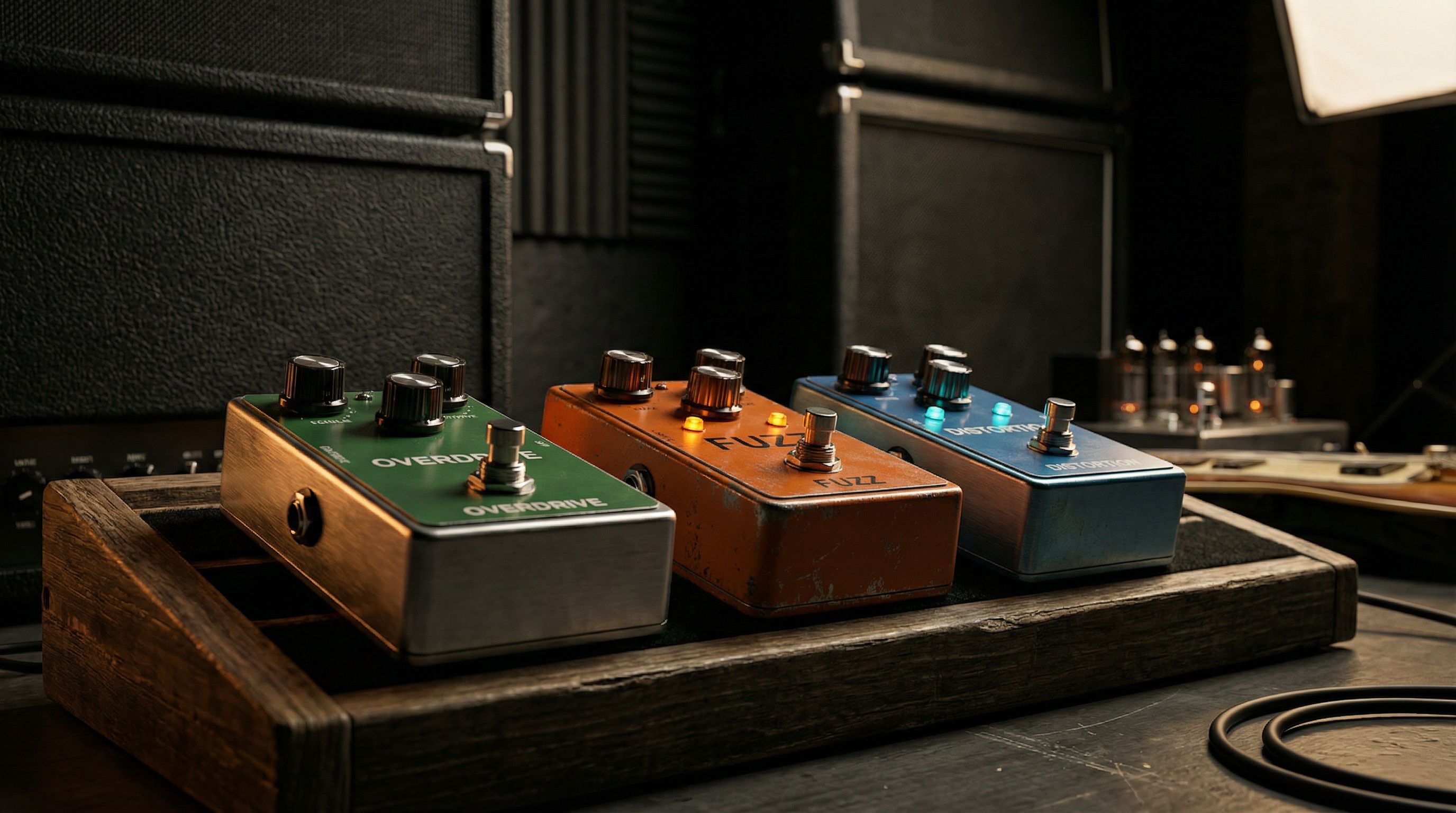
Overdrive, distortion, and fuzz all add dirt to a guitar signal. They all make an amp sound like it's working harder than it should. But the way they dirty things up is fundamentally different, and that difference shapes how a tone responds to touch, how it sits inside a mix, and which musical contexts let it do its best work.
The distinction comes down to clipping architecture. Each of the three gain types clips the guitar's waveform differently, producing a different overtone profile, a different dynamic feel, and a different palette of usable sounds. Understanding those architectures changes how you build tones, stack drives, and sculpt sounds on a modeler.
The Physics: How Clipping Works
One concept underpins everything here: clipping. It's the mechanism behind all distortion, and the type of clipping is what separates a singing overdrive from a buzzing wall of fuzz.
A guitar produces an electrical signal: a smooth, rounded waveform. When that signal gets amplified beyond what a circuit can cleanly handle, the peaks of the waveform get "clipped" off. Instead of graceful, rounded crests, you get flattened or squared-off tops.
That clipping generates additional harmonics (overtones that weren't present in the original signal), and those harmonics are what we perceive as dirt, grit, crunch, saturation.
The three types of clipping:
- Soft clipping: the waveform peaks are gently rounded off, like a hillside worn smooth
- Hard clipping: the waveform peaks are sharply chopped flat, a cliff face
- Transistor saturation: the entire waveform gets mangled and squared off, something primal and unruly
Each produces a different overtone profile, a different feel under the fingers, and a different palette of usable tones.
Overdrive: Soft Clipping
Overdrive uses soft clipping to gently round off the signal peaks, emulating the natural breakup of a tube amp being pushed past its comfort zone. A good overdrive feels less like an effect and more like the amp itself opening up, leaning into the note.
How It Sounds
The quality to listen for is touch sensitivity. Pick lightly and the tone stays shimmering, nearly clean. Dig in and the drive pushes back with more grit, more overtone complexity. At low gain, overdrive adds a subtle crunch that cleans up when you roll back the guitar's volume knob. At higher settings, it thickens and saturates but still retains the essential character of the instrument and, crucially, the player's dynamics.
The sonic texture sits somewhere between a well-aged Burgundy and fresh linen. There's a translucence to it, a sense that the original signal is still visible underneath the saturation, the way you can see the grain of oak through a thin stain. This is why blues and classic rock players gravitate toward overdrive. It follows the hands.
The Technical Side
Soft clipping circuits typically route diodes into the feedback loop of an op-amp. Because the diodes sit in the feedback path, the clipping happens gradually and symmetrically. The transition from clean to clipped is smooth, with no hard boundary where the tone suddenly changes character.
Soft clipping produces predominantly even-order harmonics (octaves above the fundamental), which the human ear perceives as pleasing. This is the same overtone profile that tube amps produce when pushed, which is exactly why overdrive pedals were designed to simulate that amp-on-the-edge-of-breakup sweetness.
Famous Overdrive Pedals
Ibanez TS808 / Tube Screamer. The most influential overdrive ever made. It boosts the midrange, rolls off the bass and treble, and adds mild soft clipping. It's not really a standalone distortion; it's designed to push an already-cranked amp into sweeter, more vocal breakup. That midrange hump cuts through a band mix like nothing else. A simple circuit with an outsized legacy.
On the Helix, this is the Scream 808 block. On the Quad Cortex, look for TS808 captures or the built-in Tube Screamer model.
Klon Centaur. A transparent overdrive that adds grit without imposing its own tonal signature the way a Tube Screamer does. At low gain, it's practically a clean boost with just a touch of hair, barely there, but immediately missed when it's gone. At higher gain settings, it's a smooth, open overdrive that preserves the guitar's natural voice.
On the Helix, this is the Heir Apparent block. The Quad Cortex has numerous Klon captures available.
Boss BD-2 Blues Driver. Sits in that compelling space between a Tube Screamer and a transparent drive. Grittier and more open in the midrange than a TS, with a bit more edge and snarl. The tone has a slightly unpolished quality, like a building with exposed brick rather than a plastered wall. Loved by indie and alternative players for exactly that roughness.
Timmy. The poster child for transparent overdrive. Minimal EQ coloring, just clean gain that lets the guitar and amp speak for themselves. If the goal is more of what's already there, just dirtier. That's the Timmy ethos.
When to Use Overdrive
- Blues and classic rock: overdrive into a clean or edge-of-breakup amp is the foundation of the genre's vocabulary
- As a boost: a Tube Screamer with the gain low and level high pushes a dirty amp harder without imposing much of its own character
- Stacking: overdrive before a higher-gain stage tightens the low end and adds sustain, sculpting the signal before it hits the next stage
- Country: mild overdrive paired with a compressor gives you that gritty-clean hybrid tone, the Telecaster's natural habitat
Distortion: Hard Clipping
Distortion uses hard clipping to aggressively chop the signal peaks flat. Where overdrive gently rounds the waveform like a potter smoothing clay, distortion drops a guillotine. The result is more gain, more sustain, and a more compressed, aggressive tone that commits fully to its intentions.
How It Sounds
Distortion is thicker, heavier, and more saturated than overdrive. It's also less dynamically responsive. The hard clipping compresses the signal more, which means the gap between picking softly and picking hard narrows considerably. The tone stays consistently heavy regardless of playing approach.
This isn't a flaw. For the styles that call for it, that consistency is the entire point: every palm-muted chug landing with the same authority, every sustained note ringing out without fading into polite silence.
The Technical Side
Hard clipping circuits place diodes from the signal path to ground. The signal gets clipped abruptly whenever it exceeds the diode's forward voltage, with no gentle transition, no gradual rounding. The waveform jumps from rounded to flat almost instantaneously, creating a more squared-off wave.
Hard clipping produces a mix of even and odd-order harmonics, with a stronger emphasis on odd-order harmonics, which sound harsher and more aggressive to the ear. More upper-order partials, more complexity, more bite. The overtone structure is literally different from overdrive.
Famous Distortion Pedals
Boss DS-1. One of the most-produced pedals in history, and unfairly dismissed by those who haven't spent time dialing it in properly. Straightforward hard-clipping distortion with a tone knob that sweeps from dark to bright. Kurt Cobain used one. Steve Vai used one, modified. It sounds surprisingly good when the urge to max everything is resisted.
On the Helix, this is modeled as part of the distortion category. On the QC, DS-1 captures are everywhere.
ProCo RAT. A versatile distortion that can range from light crunch to near-fuzz levels of saturation, and that range is what makes it quietly indispensable. The filter knob (which works backward, counterclockwise for brighter) is the secret weapon. Roll the filter back for a dark, thick chunk that's extraordinary for rhythm work. Open it up for a searing, articulate lead. At low gain with the filter rolled back, it's almost an overdrive. Maxed out, it's borderline fuzz. Four decades on professional boards and counting.
MXR Distortion+. The distortion pedal that Randy Rhoads used with Ozzy. Simple controls, aggressive clipping, and a midrange character that cuts through a loud band. Primitive by modern standards, but that simplicity is part of its charm; sometimes constraints are a gift.
Boss HM-2. Turn every knob to the right. That's the setting that defined an entire subgenre of Stockholm death metal: a chainsaw buzz, extreme and specific. The tone has the texture of corrugated steel, all serrated edges and no curves. It carved out its own world.
When to Use Distortion
- Hard rock and metal: distortion provides the sustained aggression these genres demand
- Punk: a distortion pedal into a clean amp is the fastest path to that angry, buzzy urgency
- High-gain rhythm tones: the compression of hard clipping keeps palm mutes tight and consistent
- When you need sustain: the extra compression means notes ring out longer, singing instead of decaying
Fuzz: Transistor Mayhem
Fuzz is the oldest and most extreme form of guitar distortion, and there's something almost philosophical about that. The first deliberate dirt tone was also the most radical. It doesn't just clip the waveform; it essentially squares it off entirely, creating a thick, buzzy tone that sounds like a broken amplifier. Because the original fuzz tones literally came from broken amplifiers.
How It Sounds
Fuzz is fat, wooly, buzzy, and alive in a way that no other gain type manages. Low notes become thick and subby, almost synth-like, closer to a Moog than a Marshall. High notes turn searing and sustained. Chords become a glorious, complex wall.
I expected fuzz to be the least interactive of the three gain types: the most saturated, the most compressed, the least responsive. What I found was the opposite. Vintage fuzz circuits are notoriously sensitive to what comes before them in the signal chain, to the guitar's volume knob, even to the temperature of the room. Rolling the guitar's volume from 10 down to 7 on a good fuzz doesn't just reduce volume; it transforms the tone entirely, revealing textures from slight grit to full-on saturated bloom. That responsiveness through the volume knob is wider than most overdrives offer through pick dynamics.
The Technical Side
Fuzz circuits use transistors (either germanium or silicon) to amplify the signal until the transistors saturate, meaning they physically cannot amplify any further and the waveform gets squared off almost completely. Unlike diode clipping (used in overdrive and distortion), transistor saturation affects the entire waveform, not just the peaks. Everything changes.
Germanium transistors produce a softer fuzz because they saturate more gradually and their clipping characteristics are slightly asymmetrical. They're also temperature-sensitive. Old germanium fuzzes genuinely sound different on a cold morning versus a warm afternoon. The tone on a July sidewalk has a looser, saggier quality than the same pedal in a January rehearsal room.
Silicon transistors produce a brighter, more aggressive fuzz with tighter low end. More consistent and reliable, which is why most modern fuzz pedals use silicon. Less temperamental, more predictable. A fair trade, depending on one's relationship with chaos.
The overtone content of fuzz is extraordinarily rich, dense with both even and odd harmonics across a wide spectrum. This is why fuzz sounds so thick and can venture into synth-like, almost otherworldly territory.
Famous Fuzz Pedals
Dallas Arbiter Fuzz Face. Hendrix's instrument within an instrument. A simple two-transistor circuit that produces a fat, round fuzz that cleans up beautifully with the guitar's volume knob. The original used germanium transistors; later versions switched to silicon. The germanium version has a saggy, spongy quality; the notes don't start instantly, they bloom, the way a bowed cello note swells before it settles. The silicon version is brighter and more aggressive, tighter in the low end.
On the Helix, the Triangle Fuzz and Arbitrator Fuzz blocks cover Fuzz Face territory.
Electro-Harmonix Big Muff Pi. The wall-of-sound fuzz. Four clipping stages in series create a massively saturated, sustaining fuzz with a distinctive midrange scoop. David Gilmour, Billy Corgan, Jack White, Dan Auerbach have all built worlds with variations of this circuit.
The Big Muff's midrange scoop is both its greatest gift and its deepest challenge. Solo, it sounds enormous and enveloping. In a band mix, that scooped midrange can make the guitar vanish entirely. Many players pair a Big Muff with a Tube Screamer to push the mids back in, a classic marriage of two pedals compensating for each other's tendencies.
On the Helix, the Industrial Fuzz and Triangle Fuzz blocks approximate Big Muff territory.
Zvex Fuzz Factory. Five knobs that interact with each other in unpredictable, occasionally maddening ways, producing everything from gated, sputtery decay to oscillating feedback drones. Not for players who want predictable outcomes. For players who want a conversation with their equipment.
Tone Bender. The British fuzz that influenced everything from The Beatles to Led Zeppelin. Jimmy Page's early fuzz tones were Tone Bender-based: more aggressive and brighter than a Fuzz Face, with a nastier, more confrontational edge. Less round, more teeth.
When to Use Fuzz
- Classic rock and psychedelic: Hendrix, Gilmour, Cream-era Clapton, the entire sonic vocabulary of the late '60s
- Stoner rock and doom: Big Muff territory, thick and sustaining and monolithic
- Alternative and indie: Smashing Pumpkins, The Black Keys
- Lead tones that need to soar: fuzz provides virtually infinite sustain, notes that hang in the air
- When the tone needs to react to the volume knob: fuzz responds to volume-knob cleanup like no other effect
How They Respond to Dynamics
This is the most important practical distinction between the three gain types, and the factor that should guide the choice more than any other:
Overdrive has the widest dynamic range. Play softly and it's nearly clean. Dig in and it breaks up, pushes back. The picking hand controls the amount of dirt. There's a constant dialogue between player and circuit. This makes overdrive the most expressive option through pick attack and the reason it dominates blues, jazz-rock fusion, and classic rock.
Distortion has a narrower dynamic range. Light picking still carries dirt, and hard picking carries more, but the compressed nature means less control over the grit through playing dynamics alone. The gain knob sets a zone and the tone stays there. For modern rock and metal, that consistency is exactly the point.
Fuzz has a unique, almost paradoxical dynamic response. With the guitar volume on 10, it's fully saturated, thick, committed. But roll the volume down and the character transforms dramatically, from full fuzz to a chimey, slightly broken clean tone with just a pinky finger. This volume-knob cleanup is the secret weapon of fuzz, and it's why players like Hendrix could cover such an astonishing range of tones with a single pedal always engaged.
Stacking Drives: Combining Gain Types
The real depth in gain-shaping comes from combining types. Many of the most celebrated tones in recorded music come from stacking two or more drives together, each contributing something specific to the blend.
Classic Stacking Combinations
Tube Screamer into Cranked Amp. The most common drive stack in the history of the instrument. The TS doesn't provide much gain on its own; it pushes the amp's preamp harder while adding its signature midrange bump. The amp provides most of the dirt; the TS shapes it, focuses it, gives it that vocal quality. The foundation of blues-rock tone from the 1980s onward.
Klon into Tube Screamer into High-Gain Amp. A modern high-gain staple. The Klon-style boost adds a touch of grit and tightens the low end. The Tube Screamer further sculpts the midrange. The amp's high-gain channel provides the saturation. Three stages, each doing one job well.
Tube Screamer into Big Muff. Solves the Big Muff's midrange scoop problem elegantly. The TS pushes the mids back in, making the fuzz cut through a band mix. Billy Corgan famously used this combination, and once you hear it, you understand why.
Overdrive into Distortion. A mild overdrive before a distortion pedal acts as a compressor-boost, tightening the signal going into the distortion and resulting in a more focused, articulate high-gain tone. The first stage sculpts, the second stage saturates.
Stacking on Modelers
On a Helix or Quad Cortex, stacking drives is as simple as adding multiple drive blocks in series. The principles remain the same:
- Lower gain first, higher gain second
- Use the first stage for tone-shaping: mid boost, low-end tightening
- Use the second stage for your primary dirt character
- Watch your levels: each gain stage adds volume, so adjust output levels to avoid clipping your amp model's input too hard (unless that's the sound you're after)
For more on drive placement and the full effect order, see our complete guide to signal chain order. And because a drive pedal's whole job is to push the preamp, where you plug it in changes everything — our breakdown of overdrive in the effects loop vs. the front of the amp explains why dirt out front sings and dirt in the loop buzzes.
A practical Helix stack for modern rock:
- Heir Apparent (Klon): Gain at about 8 o'clock, Level at about 2 o'clock (clean boost with slight grit)
- Scream 808 (Tube Screamer): Gain at about 9 o'clock, Tone at about 1 o'clock, Level at around noon (mid push)
- Amp model: with the gain at moderate settings, letting the drives do the heavy lifting
Overdrive Into Clean Amp vs Distortion Into Clean Amp
This distinction shapes which gain type serves a particular context best:
Overdrive into a clean amp gives the drive pedal's character married to the amp's clean headroom. The amp stays clean; all the dirt comes from the pedal. This works because overdrive's soft clipping sounds musical at any gain level: responsive, dynamic, retaining touch sensitivity.
Distortion into a clean amp gives the distortion pedal's character with the amp's clean headroom. This works, but it can sometimes sound thin or buzzy in isolation, because the hard clipping is doing all the work without the compression of a tube amp helping smooth the edges. Many players find distortion pedals sound better when the amp is at least slightly cooking.
Boost into a dirty amp: using a clean boost or low-gain overdrive to push an already-overdriven amp gives the amp's natural distortion character with more sustain and saturation. Many players prefer this because amp distortion sounds and feels more dimensional than pedal distortion alone. The amp does the clipping; the boost just gives it permission to go further.
The sweet spot for many players is overdrive into a slightly dirty amp. The amp provides a foundation of warmth and compression, the overdrive adds its character on top, and the two interact in a way that responds to dynamics, one that feels like the instrument is listening back.
Finding These Tones on Your Modeler
Line 6 Helix Drive Blocks
The Helix has an extensive drive library. Here's a quick reference:
Overdrive models:
- Scream 808: Ibanez TS808. The go-to mid-boost overdrive.
- Heir Apparent: Klon Centaur. Transparent with a touch of grit.
- Stupor OD: Boss SD-1. Similar to TS but with asymmetrical clipping.
- Valve Driver: Chandler Tube Driver. More amp-like overdrive with a rounder attack.
- Tone Sovereign: Analogman King of Tone. Versatile, dual-channel drive.
Distortion models:
- Minotaur: closely voiced distortion with a mid-forward character
- Deranged Master: Dallas Rangemaster-style treble boost into distortion
- Wringer Fuzz: not exactly a fuzz despite the name, more of an aggressive distortion
- Megaphone: scooped distortion with a particular aggression
Fuzz models:
- Triangle Fuzz: EHX Big Muff (triangle knob version)
- Industrial Fuzz: EHX Big Muff (op-amp version, more aggressive)
- Arbitrator Fuzz: Arbiter Fuzz Face
- Thrifter Fuzz: gated, sputtery fuzz for experimental tones
Quad Cortex
The Quad Cortex's strength is its capture system: captures of virtually every famous drive pedal, profiled from real hardware. A captured Klon Centaur profiled from an actual original, responding like the real circuit.
For modeled drives, the QC's built-in models cover the essentials. But the capture library is where the QC truly shines for drive tones, with thousands of community-uploaded captures of every overdrive, distortion, and fuzz imaginable.
Practical Settings Tips
Overdrive Settings (Starting Point)
- Gain: Start at about 9 o'clock and work up. For a boost into a dirty amp, keep gain low (below about noon).
- Tone: Start at around noon. Struggling to cut through a mix, nudge it up. Harsh, roll it back.
- Level/Volume: This determines how hard the next stage gets hit. For boosting an amp, crank it. For standalone drive, set it to unity.
Distortion Settings (Starting Point)
- Gain/Distortion: Start at around noon. Distortion pedals have more gain on tap, so maxing it out is rarely necessary.
- Tone: Start at around noon and cut to taste. Many distortion pedals get harsh with the tone above about 2 o'clock.
- Level: Set to unity or slightly above for solos.
Fuzz Settings (Starting Point)
- Fuzz/Sustain: Start high, about 2 to 3 o'clock. Fuzz sounds best when the transistors are fully saturated; backing off the fuzz knob often sounds thin rather than cleaner. Use the guitar's volume knob to clean up instead.
- Tone: Start at around noon. Big Muff-style fuzzes are remarkably sensitive to the tone knob; small adjustments yield dramatic changes.
- Volume: Set to taste. Fuzz pedals can be startlingly loud, so the volume may need to come down to stay at a reasonable level.
The Golden Rule
Regardless of gain type: use less gain than you think you need.
Most players dial in far too much, which kills note definition, muddies chords, and buries the tone in fizz. Especially on modelers, where gain is essentially free (no noise floor penalty), it's tempting to push everything to the right. The best dirt tones have enough gain to sustain notes and add overtone richness, but not so much that individual notes blur together into an indistinct smear. If you can't hear each note in a chord clearly, there's too much gain. Back it off, turn up the volume to compensate, and listen to how much better the tone sits in a mix.
Recommendations
For players just starting to explore gain types: begin with a single overdrive into a clean or edge-of-breakup amp model, and spend a week learning how it responds to pick dynamics and volume-knob adjustments before adding anything else. The relationship between soft clipping and touch is the foundation everything else builds on.
For players already comfortable with drive pedals: try the RAT. It covers more ground than any single pedal in this article (from overdrive territory to fuzz territory) and it rewards the kind of patient knob-turning that reveals a circuit's full personality. Pair it with a Tube Screamer in front for one of the most versatile two-pedal dirt sections available.
For modeler users stacking drives: the Heir Apparent into Scream 808 into a mid-gain amp model is a reliable starting template. If you want to hear this approach in a specific context, our SRV tone on Helix guide walks through the classic Screamer-into-Fender pairing step by step. From there, swap the second drive for a Triangle Fuzz or Industrial Fuzz to hear how completely the character changes while the gain-staging logic stays the same.