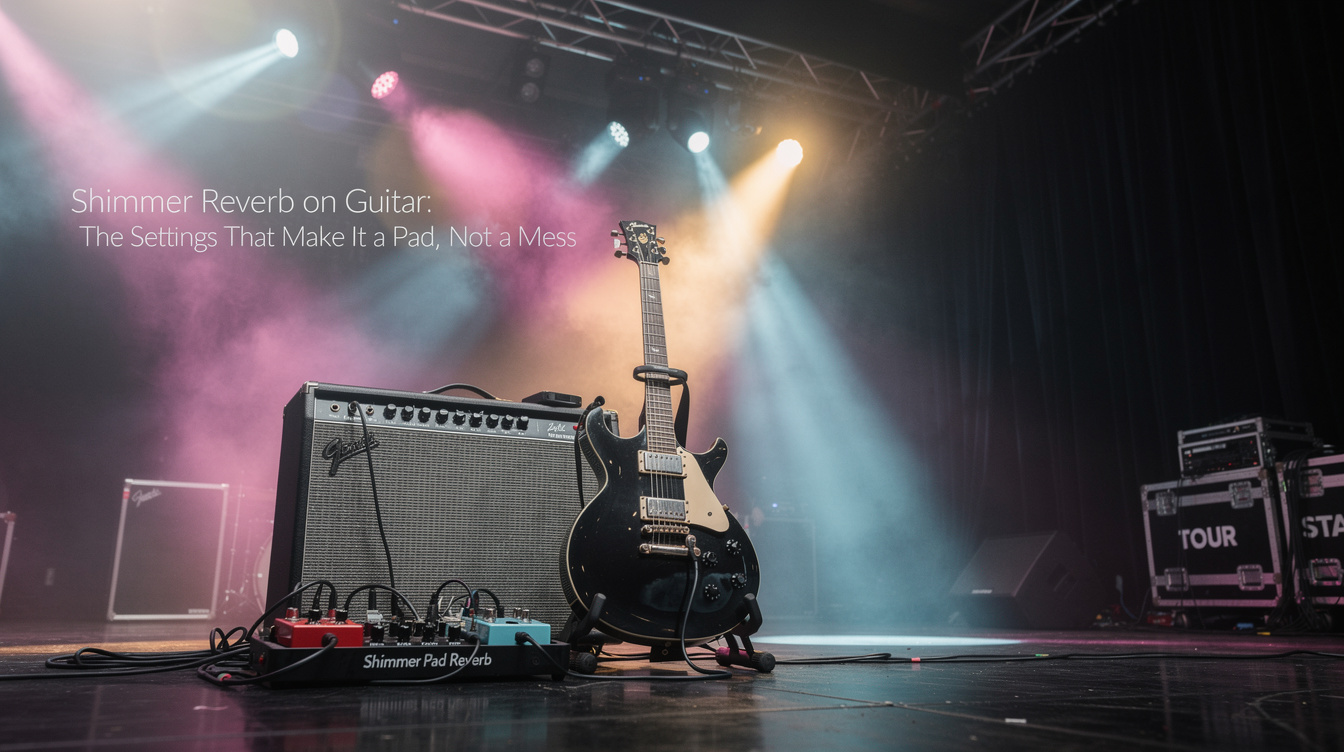
There's a sound at the front of a lot of worship songs that isn't quite a guitar and isn't quite a keyboard — a held chord that seems to rise as it hangs, brightening into something closer to a choir than a string. That's shimmer reverb. It's a long reverb with a pitch-shifter quietly stacking octaves into the tail, and when it's set right it does the thing every pad is supposed to do: it fills the room without anyone noticing where the sound is coming from.
When it's set wrong, it does the opposite. The octaves pile up, the chord disappears into a bright fog, and you spend the whole bridge wondering why the band sounds smaller the louder you get. Shimmer is one of the easiest effects to overdo, because the setting that makes it impressive in your headphones at home — mix all the way up — is the exact setting that makes it useless on a Sunday. So let's get the numbers right.
Shimmer Settings at a Glance
These are starting points for a slow, held-chord pad. Lower the mix before you raise it; that's the whole game.
| Platform | What to use | Pitch | Decay | Mix | Low cut |
|---|---|---|---|---|---|
| Helix / HX Stomp (build) | Dual Pitch → Searchlights or Hall | +12 (voice 1), pitch mix ~30% | 7-8 s | 25-35% | ~200 Hz |
| Helix / HX Stomp (model) | Reverb with shimmer/pitch param | Octave, intensity low-mid | High | 25-35% | ~200 Hz |
| Strymon BigSky | Shimmer machine | Shift +12, Shimmer knob ~9-11 o'clock | Decay 1-2 o'clock | Mix ~9-10 o'clock | Low end down |
| Quad Cortex | Pitch (Octave) → Hall/Plate reverb | +12, mix ~25% | Long | 25-35% | ~200 Hz |
| Pedal (EHX, etc.) | Dedicated shimmer mode | Octave | Long | Blend low | — |
What Shimmer Reverb Actually Is
A normal reverb takes your note and scatters it into hundreds of reflections that decay over time. Shimmer adds one step: as those reflections regenerate, a pitch-shifter lifts a copy of them up an octave, and that octave gets fed back in to be reverberated again. Each pass climbs a little higher, so the tail doesn't just sustain — it ascends. Stack enough of it and a single held chord turns into a slow upward bloom, like the chord is being sung back to you an octave higher by a room full of people.
The effect was more or less invented in the studio. Brian Eno and Daniel Lanois were chaining an Eventide harmonizer into a reverb in the 1980s, and the upward-pitched regeneration became a signature of the records they touched — including the ambient guitar beds on U2's bigger songs. Sigur Rós built a whole catalog on it. By the time the Hillsong and Bethel sound arrived, shimmer was already part of the vocabulary, which is why it reads as "worship" to so many ears even though it started as art-rock studio trickery.
The important part for us: shimmer is a pitched reverb. That makes it a cousin to a few other tail tricks worth knowing — gated and ducking reverb shape the tail's level, reverse reverb shapes its direction, and shimmer shapes its pitch. If you've read the reverb types guide, think of shimmer as a hall with a harmonizer living inside it.
The Settings That Keep It a Pad
Here's the part I had to learn the slow way. I assumed more shimmer meant more of that upward bloom, so for a long time I ran the wet mix high — half wet or more — because in the practice room, alone with in-ears, it sounded enormous. Then I'd get on stage and the chord would vanish. People couldn't tell what I was playing; they could only tell that something bright was happening. What I found was that the octave content, when it's loud enough, doesn't sit under the fundamental — it sits on top of it and covers it. The fix wasn't a better reverb. It was turning the mix down to about a third and letting the decay run long instead.
So the order of operations is backwards from what feels natural:
- Mix: 20-35%, and that's the ceiling. This is the single most important number. The dry chord has to stay clearly the loudest thing. Shimmer is a halo around the note, not a replacement for it. If you can't hum the chord back while the effect is running, the mix is too high.
- Decay: long — 7 to 8 seconds, or 1 to 2 o'clock on a pedal. Counterintuitively, a longer decay at a lower mix sounds bigger and cleaner than a short decay cranked wet. The long tail gives the octaves time to stack gently instead of slamming in all at once.
- Low cut inside the reverb: around 200 Hz. Pitched-up octaves stacking in the low end is where mud comes from. Roll off the bottom of the reverb (not your dry guitar) so the shimmer lives in the upper register where it belongs.
- High cut: 6-8 kHz if it's getting glassy. Shimmer can climb into an icy, brittle region. A gentle high cut keeps it sounding like a choir instead of a smoke detector.
- Pre-delay: 20-40 ms. A little pre-delay keeps the attack of your chord articulate before the wash arrives, so the listener hears the chord land then bloom.
Set those, play one held chord, and let it ring out completely before you touch anything. If the chord is clear for the first second and then opens into a rising pad, you're there. The room needs to breathe — and a tail it can hear through is what lets it.
Octave, Fifth, or Both?
Most shimmer defaults to an octave up, and there's a good reason to leave it there. An octave is the same note name as what you played, so it reinforces the chord instead of adding a new tone. It works in every key and on every chord quality, major or minor, and it never sounds "wrong."
Adding a fifth (+7 semitones) is the next temptation. It brightens the texture and adds a bell-like sparkle — more obviously "produced." But a fixed fifth is a fixed interval, and a fixed interval doesn't care what chord you're playing. On a clean major progression it's gorgeous. On a minor chord or through a key change, that hard fifth can rub against the harmony in a way that's subtle but unsettling, like a singer who's a hair sharp. My rule: octave-only is the default that ships every Sunday. The fifth comes out for a specific song that stays planted in a major key and wants to feel huge. When in doubt, fewer pitches.
On the Strymon BigSky
If you're on pedals, the BigSky's Shimmer machine is the reference. It's been my pad on a Pedaltrain for years, and the settings that work live are humbler than the demos suggest: Shift set to +1 octave, the Shimmer knob only to about 9 or 10 o'clock, Decay around 1 to 2 o'clock, and the Mix kept down near 9 o'clock so the dry signal stays in charge. Pull the low end down in the parameters so the octaves don't muddy. The BigSky will happily go to a wall of bright noise; the trick is not letting it. The Walrus Slö vs. BigSky comparison covers how the two boxes handle shimmer-style textures differently if you're choosing between them.
On the Helix and HX Stomp
You've got two paths, and I'd start with the build because it teaches you what shimmer is made of.
The build: Drop a Dual Pitch block (in the Pitch/Synth category) first. Set Voice 1 to +12 semitones and leave Voice 2 at 0 (or set it to +7 if you want the fifth). Pull the Mix on the pitch block down to around 30% — this controls how much octave you stack in, and it's a separate lever from the reverb mix. Then add a long reverb after it: Searchlights is the Line 6 original built for big ambient swells, but a plain Hall or Cave works too. Decay high (7-8 s), reverb Mix 25-35%, Low Cut ~200 Hz, High Cut ~7 kHz, a touch of Pre-Delay. Pitch into reverb means the octave gets reverberated and sustains, which is the bloom you're after.
The model path: Newer HX firmware includes reverbs with built-in pitch and dense, modulated character — try Searchlights, Plateaux, or Ganymede and look for a pitch or intensity parameter. These are quicker to dial but give you a little less say over exactly how much octave is stacking. Either way, the mix and low-cut discipline above is identical.
One DSP note for HX Stomp owners working inside the block limit: the model path costs you one block; the build costs two. If you're already tight, the single shimmer-capable reverb model is the efficient call. (For the bigger which-box question, the HX Stomp vs. Helix LT for worship breakdown gets into how much headroom each one gives you.)
On the Quad Cortex
Same logic. Drop a Pitch block set to an octave up with the mix around 25%, then a long Plate or Hall reverb behind it, decay long, mix low, low end filtered. The Cortex's reverbs are dense and clean, so if anything you'll want the pitch mix slightly lower than you'd expect — it stacks fast.
Where It Goes in the Chain
Shimmer is an ambient effect, so it lives at the end of the chain, after your drive and delay, usually in the same neighborhood as your main reverb. The one decision worth making on purpose: delay before shimmer means your repeats also get pitched up and bloom — beautiful for a sparse, slow part, chaos for anything busy. If you want the delay to stay clean and only the held chords to shimmer, put a separate shimmer reverb late and keep it off your rhythmic delay. The Edge-style dotted-eighth delay and a shimmer pad are two different jobs, and trying to make one block do both is how you end up with mush.
When Not to Use It
This is the part the demos never cover. Shimmer is a held-chord effect. It needs sustain and space to bloom, which means the moment your part starts moving — eighth notes, a strummed pattern, anything rhythmic — the tails stack faster than they decay and every note smears into the last one. The result is loud and impressive and completely illegible.
So treat it like a swell you turn on for a moment, not a tone you leave running. Bring it in for the soft open, the breakdown, the last chorus pad where the band drops out and one chord needs to hold the whole room. Then pull it back when the song moves again. The best compliment a pad ever gets is that nobody noticed it was there — they just noticed the room felt full. If they're noticing the shimmer itself, it's too loud, and the fix is almost always the same: turn the mix down, let it breathe, and trust the long tail to do the work.