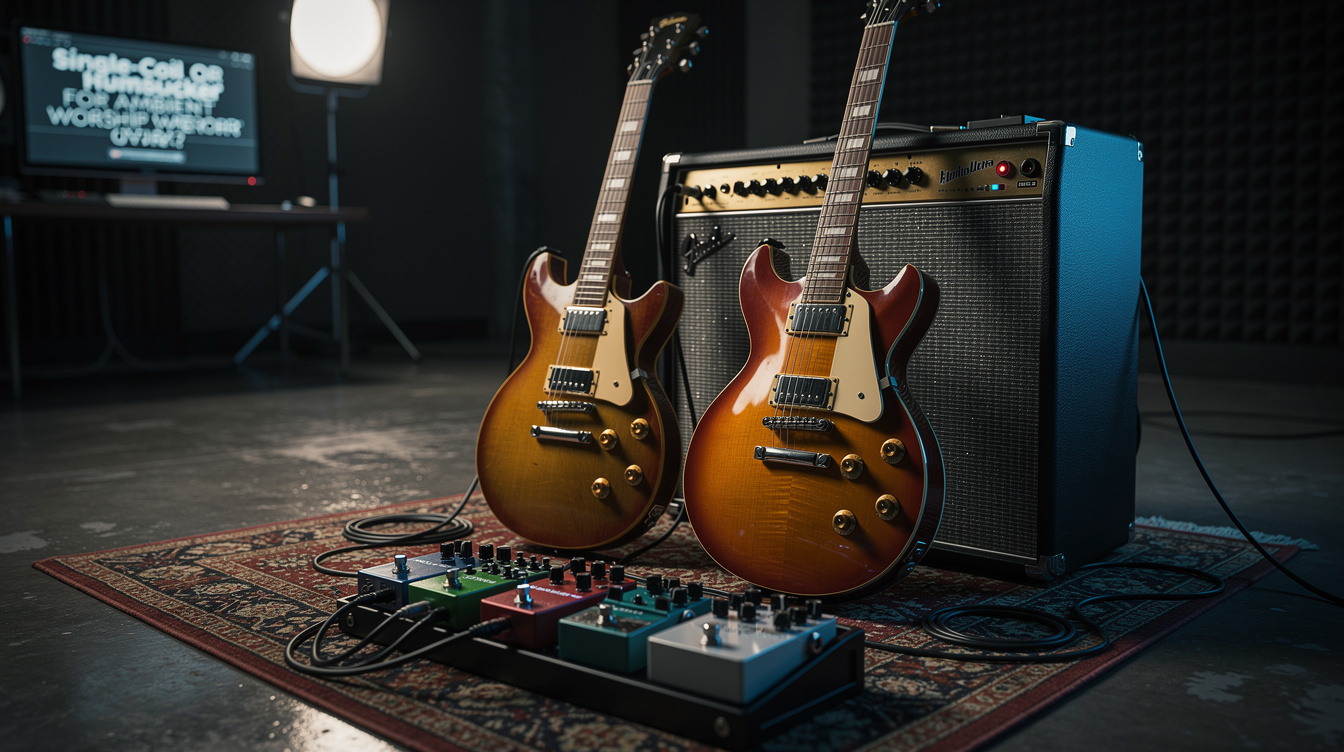
Play a suspended chord, let it ring, and drown it in a long hall reverb at a high mix. Do it with a single-coil, then do it with a humbucker. The two do not sound like the same guitar with more or less output — they behave differently inside the wash, and the difference decides which one belongs on which ambient job. This is the question underneath every worship patch that ships a separate single-coil and humbucker version: not which pickup is better, but what each one does once the reverb takes over.
The Short Answer, by Job
| Ambient job | Single-coil | Humbucker |
|---|---|---|
| Chordal pads, held suspensions | Stays legible — you hear the strings inside the wash | Thickens; can go opaque under a long decay |
| Sustained single-note swells | Thins as the note decays | Holds the note — body and output carry it |
| Arpeggios under delay + reverb | Note separation survives | Notes blur together sooner |
| Dark, foggy atmosphere | Needs help (tone rolloff, compression) | Native — fills the room |
| Bright, present ambience | Native — chimes above the wash | Needs help (reverb low cut, bass trim) |
If most of your ambient playing is chordal — the modern worship pad, the ringing suspended shapes — a single-coil keeps it readable. If it's sustained melodic swells, the humbucker holds each note through the decay. Most players do both across a set, which is why the real answer is usually "the guitar you have, adjusted," and the second half of this post is how to adjust either one.
What Actually Happens Under the Reverb
I went in expecting the humbucker to be the obvious ambient choice. More output, more body — surely it fills a big reverberant space better, and surely the single-coil thins out and vanishes under a heavy wash. Half of that was right. The humbucker does fill the space. But under a long hall at a high mix, playing a full chord, it was the humbucker that lost the plot first — the wash went from a chord to a fog, and I couldn't tell you what notes were in it. The single-coil, the pickup I expected to disappear, kept the chord legible. You could still hear the individual strings living inside the reverb.
Here's why, and it's not mysterious. A long, high-mix reverb accumulates energy in the low mids — that's what makes a wash feel large. A humbucker already carries more low-mid weight than a single-coil. Under a sustained chord, those two sources of low-mid stack, and the buildup swallows the definition. The single-coil brings less to that pile, so the reverb's low-mid buildup has room to sit without erasing the note separation.
So the trade is real and it cuts both ways. On a single note, that same humbucker weight is exactly what you want — the note has more to give as it decays, and it sustains through the tail of the reverb where a single-coil has already gone quiet and glassy. The single-coil is a better chord under reverb; the humbucker is a better swell. There's a quality to a humbucker swell held under a long decay that a single-coil can't quite reach — it feels like the note is being placed in the room rather than sprayed across it.
Making the Humbucker Behave
You don't switch guitars mid-set. If you're on a humbucker and your ambient chords are turning to fog, the fix is to stop the low-mid stacking — not to strip the pickup's body.
- Low cut on the reverb, 200–300 Hz. This is the whole game. It stops the wash from accumulating low-mid energy, so a sustained chord stays legible while keeping its size. Most pedal and modeler reverbs label this "low cut," "low damp," or offer a pre-reverb EQ. If you take one thing from this post, it's this control.
- Pull the bass back a little at the amp or preamp — an hour or two on the dial. You're carving room for the reverb, not thinning the guitar.
- Favor the neck pickup, tone near full, and if your guitar has a coil split, split the neck humbucker for chordal sections. A split humbucker gives you much of the single-coil's clarity, then you rejoin it for swells. That's the closest thing to having both guitars.
Making the Single-Coil Behave
The single-coil rarely needs help with clarity under reverb. It needs help with body — otherwise a swell can go glassy and thin as the note decays, present but weightless.
- Roll the tone knob back to about 7 or 8. Softening the very top gives the note somewhere warmer to decay into, so the tail of a swell doesn't turn to ice. This costs nothing and it's the first thing to try.
- A light compressor before the reverb. Evening out the dynamics lengthens the swell and gives the reverb a steadier signal to work with — the note sustains into the tail instead of falling away. This is the least expensive way to get a single-coil to hold like a humbucker.
- Let the reverb do the size. Resist adding low end at the amp to "fatten" a single-coil; that's the humbucker's problem in reverse. Keep the guitar clear and let the space be large.
The Setting That Works on Both
Whatever's in your guitar, the low cut on the reverb around 200–300 Hz is the move that keeps an ambient chord from turning to mush. It's more effective than shortening the decay, because it preserves the size and restores the legibility at the same time — you keep the long, oceanic tail without the low-mid opacity that eats the chord. The same principle keeps a worship tone from turning harsh or muddy once it leaves your headphones and hits the room, which is its own front-of-house problem worth reading up on.
If you're still deciding which pickup position to reach for before the reverb ever enters the picture, our pickup position guide covers the neck-versus-bridge choice, and why overdrive sounds different with humbuckers covers the other place these two pickup types diverge hardest. The reverb just makes the difference impossible to ignore.