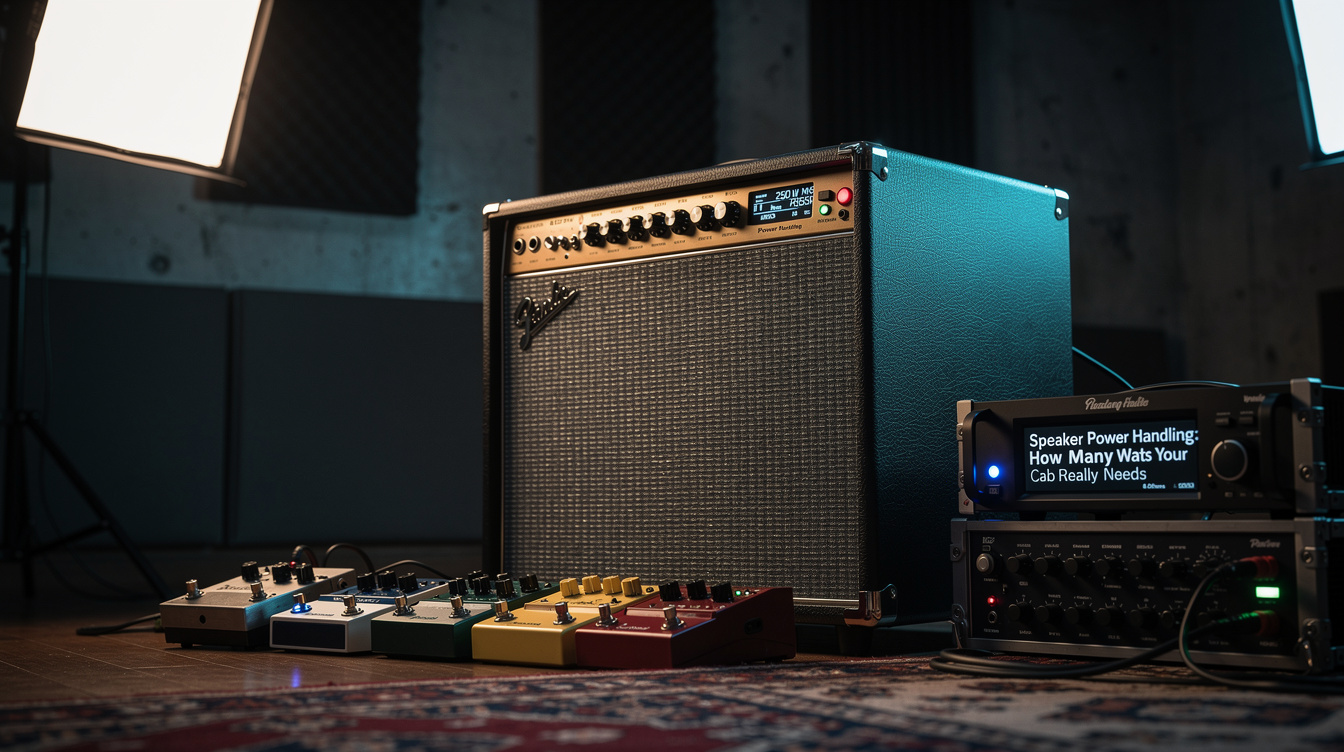
The amp says 50 watts, the speaker says 65, and you're standing in the shop wondering whether that's a problem. The short version: that pairing is fine. The longer version is more interesting, because the "right" speaker wattage isn't just about not breaking anything — it's one of the biggest levers on whether your tone stays clean and tight or grinds and compresses the way the classic records do. Here's how to size a speaker for safety and for the sound you want.
The Short Answer
| Speaker Rating vs. Amp | Result | Use When |
|---|---|---|
| 2x amp or more | Stays clean, lots of headroom, stiff | You want clean and loud |
| ~1.5x amp | Clean with a little give at the top | Versatile default |
| ≈ equal to amp | Breaks up earlier, more compression | You want speaker grind |
| Below amp | Early breakup, but real damage risk | Vintage tone, low volume only |
Rate the speaker at least as high as the amp; go higher for clean headroom, closer for vintage breakup. The rating isn't just a safety number — it's a tone decision.
Why You Give a Margin
A guitar amp's rated wattage is roughly its clean output, but it can peak well above that — a tube amp especially, where transient peaks and the way the power supply sags can push instantaneous output far past the nameplate figure. If your speaker is rated right at the amp's clean rating, those peaks are leaning on it hard.
That's why the conventional advice is a 1.5–2x margin: a 50-watt amp into a 100-watt-plus cab. The speaker never gets near its limit, it stays clean and tight, and it just faithfully reproduces whatever the amp sends it. For clean players, loud players, and anyone running a lot of low end (where cone excursion is greatest and the danger of mechanical damage is highest), this margin is genuinely protective, not just cautious.
The Surprise: More Watts Isn't Better
Here's what catches people out. They assume the higher-rated speaker is the upgrade — more is better, right? — and then the amp sounds stiffer and more sterile than they expected. That's not a defect. A high-wattage speaker has a heavier cone and a more rugged voice coil, which is exactly what lets it handle power without breaking up. The flip side of "handles power without breaking up" is "doesn't break up" — and speaker breakup is a huge part of what makes a guitar speaker sound like a guitar speaker.
A great deal of classic-rock tone is a relatively low-powered speaker being driven into cone breakup — the cone and surround flexing and distorting, adding a vocal, compressed grind on top of the amp's own distortion. The Celestion Greenback is the textbook example: rated around 25 watts, it starts to give and "cry" when pushed, and players have chased that sound for sixty years. Put a 100-watt speaker in its place and the grind vanishes — cleaner, tighter, and, to a lot of ears, more boring. The Celestion speaker showdown gets into how different drivers trade headroom for that breakup character.
Speaker Breakup Is a Feature
So the rating is really a clean-vs-breakup dial:
- Want clean, loud, tight, with strong bass? Rate the speaker high — 1.5–2x the amp — so it never breaks up and just delivers the amp's tone at volume. This is the right choice for clean players, bass-heavy tones, and high-headroom amps.
- Want vintage grind and feel? Choose a speaker that breaks up earlier — often a lower-rated, lighter-cone design — and accept that you're pushing it. This is a tonal choice, and at sane volumes a modest mismatch (a 25-watt-ish speaker under a small amp cranked to where it sings) is exactly how those tones are made. This is the speaker-side cousin of where your amp's breakup comes from: power-amp and speaker saturation are both volume-dependent, dynamic sources of dirt.
The catch on the breakup side is real damage. Driving a clean, loud, bass-heavy signal into a speaker rated well below the amp risks a burned voice coil (thermal) or a torn cone (mechanical). Guitar amps rarely sit at rated continuous power, so a small mismatch is usually fine — but a big one, played loud and clean, is how speakers die. Breakup at the edge: good. Clean abuse past the limit: bad.
Two Things People Confuse
Multi-speaker math. In a cab, the ratings add up. Four 25-watt Greenbacks make a 100-watt 4x12; two 75-watt speakers make a 150-watt 2x12. The load shares across the speakers in standard series/parallel wiring, so the cab handles the sum.
Power handling is not impedance. Watts and ohms are separate specs. Sizing the wattage correctly does nothing about matching impedance — you still have to match the cab's ohm rating to the amp's output (especially critical for tube amps, where a bad impedance match can damage the output transformer). Don't let a correct wattage lull you into ignoring the ohms.
On a Modeler
If you're running a modeler into an FRFR speaker or headphones, speaker power handling in the guitar sense doesn't apply. The modeled cab is an impulse response that already captures a real speaker's behavior — including its breakup — at the level it was captured, and there's no real guitar speaker in the path to damage by mismatching watts. (Your FRFR has its own power rating, but that's a PA-speaker spec, not a guitar-speaker breakup question.) Power handling is purely a real-power-amp-into-real-speaker concern.
Making the Call
If you want clean headroom, want to play loud, or run a lot of low end, rate the speaker 1.5–2x your amp and it'll stay tight and reliable. If you want vintage grind and feel, choose a speaker that breaks up — accept that you're pushing it, keep the volume sane, and don't run it clean and loud for hours. And always match the impedance separately; the watts and the ohms are two different jobs. The "right" wattage isn't the biggest number you can buy. It's the one that breaks up where you want it to — or doesn't.