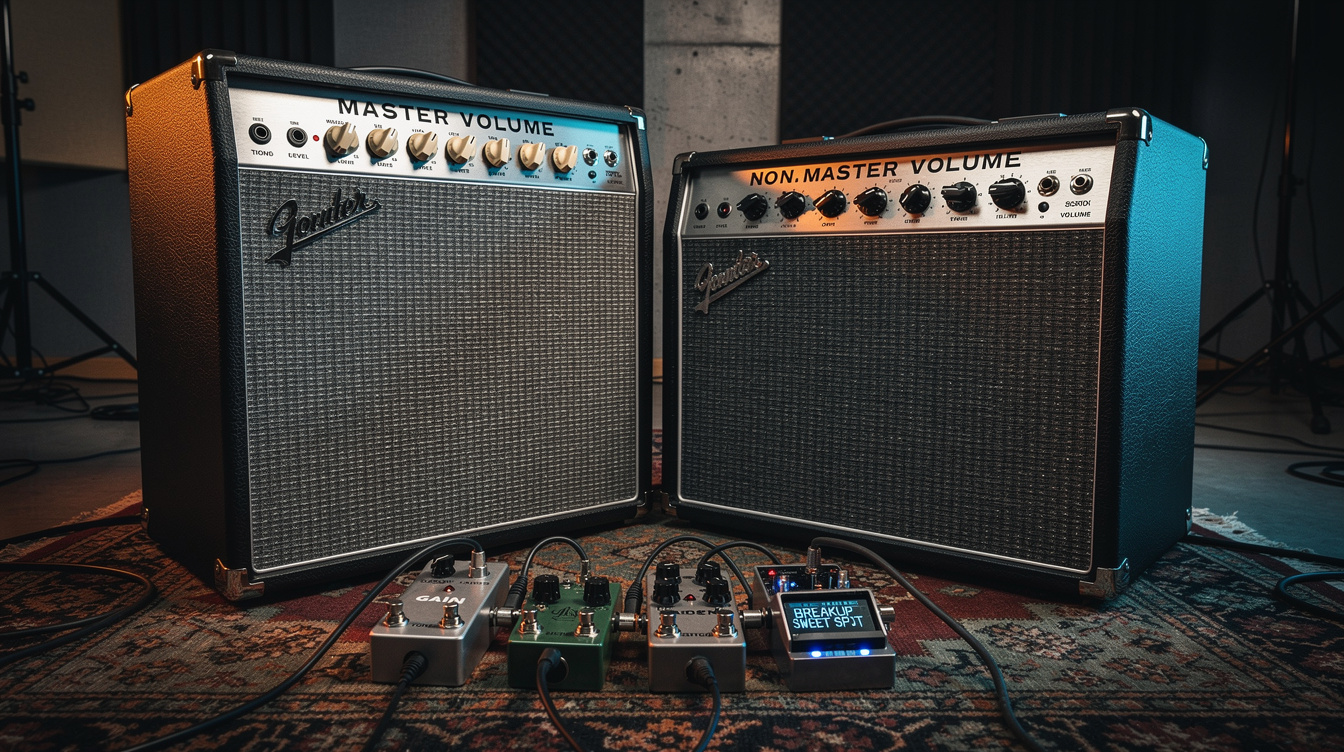
Two amps can have the exact same preamp and the exact same power tubes and still feel completely different to play — because one has a master volume and the other doesn't. The master volume changed where amp distortion comes from and when you can hear it, and misunderstanding it is the single most common reason players can't get a good dirty tone at a volume their neighbors will tolerate. Here's what the control does, where your breakup is actually generated, and how to get it without standing in front of a wall of sound.
The Short Answer
| Non-Master Volume | Master Volume | |
|---|---|---|
| Controls | One Volume knob | Gain/Drive + Master |
| Distortion source | Mostly power tubes + output transformer | Mostly preamp tubes |
| Breakup at low volume | No — needs to be loud | Yes — crank gain, lower master |
| Feel | Dynamic, touch-sensitive, "blooms" | More compressed, consistent |
| Typical examples | Vintage Fender Bassman, plexi Marshall | JCM800, Mesa, most modern amps |
The gain knob makes the dirt. The master volume decides how loud the dirt is. That one sentence resolves most of the confusion. The rest of this post is the why.
How a Non-Master Amp Distorts
A non-master amp — a tweed Bassman, a blackface Deluxe, a plexi Marshall — has a single Volume control per channel. That knob sets how hard the preamp drives, and because there's nothing throttling the signal afterward, it also sets how hard the power section gets hit.
Turn it up and the stages clip in sequence. The preamp tubes start to break up first, but the sound those amps are loved for — the springy, three-dimensional grind that reacts to how hard you pick — comes mostly from the power tubes and the output transformer saturating near full output. That's a high-volume phenomenon. There's no way to get the output section working hard without the speaker also working hard. It's why a cranked plexi is one of the best sounds in rock and also why you can't have it in an apartment.
How a Master Volume Amp Distorts
A master volume amp splits the job in two. A Gain (or Drive, or Preamp) knob sets how hard the preamp clips, and a separate Master knob sets the output level feeding the power amp.
This lets you run the preamp gain high — generating plenty of distortion in the preamp tubes — while keeping the master low so the power section stays relatively clean and the room stays quiet. Marshall's master-volume models arrived in the mid-'70s (the JMP 2203/2204) for exactly this reason, and nearly every high-gain amp since is built on the idea. The trade-off: the distortion you get is preamp distortion, which is more compressed and more consistent at any volume, but doesn't have the dynamic bloom of a power section that's genuinely cooking.
The Surprise: The Master Volume Isn't the Distortion Knob
Here's the thing most players get backwards. Set the gain low and the master high, and a master-volume amp gets loud and mostly clean — not dirty. It only starts to grind at the very top, when the master is feeding enough signal to push the power tubes into clipping. Set the gain high and the master low, and you get a thick, distorted tone at conversation volume. The master moves the level; the gain moves the dirt. If you've been turning the master up looking for more distortion and only finding more volume, this is why — you were reaching for the wrong knob.
Preamp Distortion vs. Power-Amp Distortion
These two flavors of breakup are the heart of the whole discussion, and they sound and feel different:
- Preamp distortion is generated in the small signal tubes (usually 12AX7s) before the master volume. It's available at any output level, it's more saturated and compressed, and it's what most modern high-gain tones are built on. Predictable and tight.
- Power-amp distortion is generated in the big output tubes (EL34, 6L6, EL84) and the output transformer when they're driven near their limit. It's looser, more touch-sensitive, and it "blooms" — notes swell and react to pick attack in a way preamp gain doesn't replicate. It only happens loud.
The dynamic, vocal quality players describe in a cranked vintage amp — the sense that the amp is responding to them rather than just amplifying — is power-amp behavior. You can stack a great overdrive in front of a clean amp and get plenty of distortion, but you won't get that feel until the output section is working. That distinction is also the foundation of gain staging: where in the chain the clipping happens shapes the entire character of the tone.
Getting Breakup Without Going Deaf
If your amp's best tone lives at a volume you can't use, you have real options — none of which is a knob on the amp:
- Attenuator or reactive load. Sits between the amp and speaker, soaks the power-amp output as heat, and lets you crank the amp while the speaker stays quiet. A reactive load preserves the feel better than a purely resistive one — see reactive vs. resistive attenuators for the difference, and the limits of attenuating into lower wattage for how far you can push it before the tone collapses.
- Power scaling. A circuit that lowers the voltage to the power tubes, so they distort at lower output. Power scaling vs. an attenuator compares the two approaches.
- A lower-wattage amp. A 5- or 15-watt amp reaches power-tube saturation at a fraction of a 50- or 100-watt amp's volume. This is the simplest fix and why low-wattage amps exploded in popularity.
- A master-volume amp. If you mostly want preamp distortion and don't need the power-amp bloom, this is the path of least resistance.
On a Modeler
A modeler hands you both distortion sources as separate parameters, which makes the whole thing concrete. The Drive (or Gain) control is your preamp clipping. The Master parameter on the amp block emulates the power amp, and a Sag parameter models how the power supply reacts under load — turning both up adds the compression and bloom of a cranked output section at any listening level, which is the one thing a real amp can't do without volume. If your modeled high-gain tone sounds stiff and lifeless, it's usually because the Master and Sag are sitting low and you're hearing pure preamp gain. Push them and the amp starts to breathe. This is the same lever we pulled in the clean headroom guide — Drive, Master, and Sag are the three knobs that decide where and how an amp breaks up.
Making the Call
If you play at home or in the studio and want a usable dirty tone at any volume, a master-volume amp (or a modeler) is the obvious answer. If you chase the dynamic, touch-sensitive feel of a power section at full song — and you have an attenuator or a small enough room — a non-master amp will give you something a master volume never quite does. And if you already own a non-master amp you love but can't turn up, the fix isn't a different amp. It's an attenuator or a load box. The amp was never the problem; the volume was.