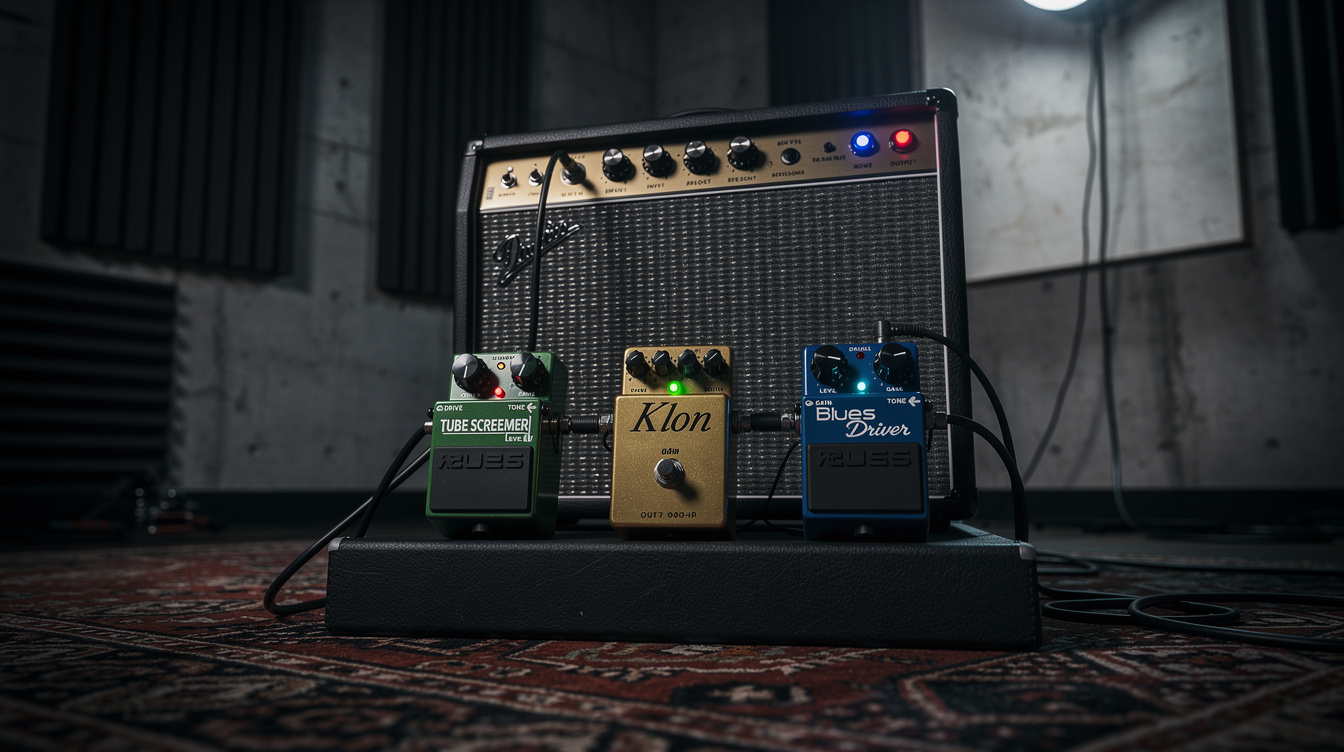
Start Here: Three Pedals, One Amp
The Tube Screamer, Klon Centaur, and Blues Driver are three different answers to the same question: how do you push an amp without losing what makes it good? Here's the short version before the full breakdown.
| Tube Screamer (TS808/TS9) | Klon Centaur / Clone | Blues Driver (BD-2) | |
|---|---|---|---|
| Tonal character | Warm, compressed, mid-forward | Open, present, layered clean+dirt | Raw, gritty, relatively flat EQ |
| Gain range | Low crunch to thick OD | Clean boost to medium OD | Clean crunch to aggressive OD |
| Midrange profile | Strong hump around 700-800Hz | Slight upper-mid presence, no big hump | Flatter; less colored than TS |
| Transparency | Low; circuit heavily colors tone | Medium; clean signal blends with dirt | Medium; less EQ coloring than TS |
| Street price | $100-$130 (TS9), $180+ (TS808 reissue) | $50-$250 (clones), $500+ (used Centaur) | $70-$90 |
Five things to know before you buy:
- The Tube Screamer's mid-hump is a feature, not a flaw; it cuts through a mix. But it will change your sound more than the other two.
- The Klon isn't "transparent." It has a specific high-frequency shimmer. It's just more open-sounding than a TS because it blends clean signal with dirt.
- The Blues Driver is the rawest of the three. Less compression, less coloring, more bite.
- All three work best when used to push an amp that's already at or near its natural breakup point.
- "Best" depends entirely on what your amp already does. Start with the amp. Then choose the pedal.
Three pedals. Same amp. Same guitar. Same settings on the amp, same volume in the room. The only variable is what's in front of the amp. This is the only way to hear what a drive pedal actually does.
The amp in this case is a 1969 Marshall Super Lead, non-master-volume, run at a level that's right at the edge of breakup. One notch louder and it goes. The guitar is an SG Standard. No tricks, no tweaks. Plugged in.
The question isn't which pedal is best. The question is: what does each one do to the amp, and when would you want that?
What Does the Tube Screamer Actually Do to an Amp?
The Tube Screamer has a reputation that occasionally obscures what it's actually doing. It's not just "adding overdrive." It's applying a specific EQ shape to the signal before it hits the amp, and that EQ shape is baked into the circuit regardless of where you set the knobs.
The midrange hump is centered around 700-800Hz. The low end starts rolling off below 300Hz. The high end softens above 4kHz. Those aren't settings; that's the circuit. Every TS808, every TS9, every clone shares that fundamental behavior. What the knobs do is determine how much of it you hear.
Into the Marshall: the low end tightens up immediately. The low-string flub that a hot non-master-volume amp can produce disappears. The midrange gets pushed forward. Notes sustain longer. Single-note lines become more forward in the mix.
The tradeoff is character. The Tube Screamer has a very specific personality, and if that personality doesn't match what you're playing, no amount of knob adjustment fixes it. It's a TS. It sounds like a TS.
Settings sweet spot:
- Drive: About 8-9 o'clock (keep it low; you're pushing the amp, not the pedal)
- Tone: Around noon
- Level: About 2-3 o'clock (this is the boost part; level high, drive low)
At these settings, the TS isn't really distorting much on its own. It's boosting a mid-shaped signal into the amp's front end, and the amp's preamp tubes are doing the work. This is the SRV approach. Low gain, high level, let the amp breathe.
Crank the drive and you get a thick, compressed, singing overdrive. It becomes its own thing. Gary Moore used it this way. Steve Lukather. Good tone. But it's the pedal's sound now, not the amp's.
Margot's Take: Touch response and harmonic content
The Tube Screamer's asymmetric clipping does something specific to the overtone structure that I find genuinely interesting. The odd and even harmonics come out unevenly. The even harmonics are emphasized more, which is part of why the pedal sounds warmer and less harsh than a symmetrically clipping circuit like a fuzz.
Light touch on a single note: you get a controlled, slightly compressed sustain. The note blooms rather than immediately saturating. Hit the string hard: the compression catches it, levels the peak, and sustains it into a warm ribbon of sound. It's forgiving in a specific way; it's very easy to play expressively through a TS because it smooths out inconsistencies in your right hand.
The midrange hump reinforces this. Notes sit in the 700-800Hz range with an authority that makes leads easy to hear. Whether that's what you want depends entirely on what you're playing. For open, airy jazz chords, it's too present. For blues leads, it's exactly right.
Who Uses the Tube Screamer and Why?
Stevie Ray Vaughan ran a TS808 with drive nearly off and level maxed into a Dumble and a Vibroverb. The pedal's job was to hit the amp hard and add low-end tightness. The amp was already at breakup. The TS pushed it over.
Gary Moore ran drive higher, with more of the TS's own clipping in the chain. That thick, compressed lead tone on "Still Got the Blues" has the TS's fingerprints: the sustain, the warmth, the way notes hold.
Steve Lukather used them in a more stacked configuration. Gain staging. Multiple pedals building on each other.
The common thread: the TS works best when the amp is already doing something. Run it into a sterile solid-state amplifier with no character of its own and the TS's limitations become apparent. It needs a partner.
For the full deep-dive on settings and configurations, see the Tube Screamer settings guide.
What Does the Klon Actually Do to an Amp?
The "transparency" conversation has been going on for twenty years and most of it misses the point. The Klon is not transparent. It has a specific character. It just doesn't have a mid-hump the way the TS does, and that distinction gets misread as "no color."
Here's what the Klon actually does. The internal charge pump doubles the operating voltage from 9V to about 18V. That headroom means the clean signal stays cleaner longer before the circuit clips. When clipping does happen, it's softer and more gradual. The circuit also blends the clean dry signal with the overdriven signal. That mixing is the key. The fundamental note stays clean while the harmonic dirt wraps around it. The low end doesn't get compressed into the overdrive; it stays present and full.
There's also a subtle presence boost above 5kHz. This is the "shimmer" people describe. It adds a glassy, open quality to the top end. It's not a lot of boost. But it's there, and once you hear it you can't not hear it.
Into the Marshall: the amp sounds more like itself at higher volumes. The Klon doesn't change the amp's EQ character the way the TS does. Notes are more open. The low end stays intact. Chords have more harmonic clarity because the clean signal isn't being swallowed by the drive signal.
Settings sweet spot:
- Gain: About 8-10 o'clock (clean boost to light OD territory)
- Treble: Around noon (roll back slightly if your amp is bright)
- Output: Matched to unity or just above for boost applications
At low Gain settings the Klon functions essentially as a transparent boost with that presence shimmer riding on top. Push the Gain to about 10-11 o'clock and you get a light overdrive that still maintains the clean-plus-dirt blending character. Above noon on the Gain knob it starts to feel more conventional, more compressed, less open.
The most useful range for Nashville session work and clean-leaning lead tone is in the lower third of the Gain knob. That's where the character of the Klon is most pronounced.
The surprise: Running the Klon through the Marshall at moderate gain (about 10 o'clock), I expected the midrange interaction to feel noticeably different from the TS. It does, but not in the way I anticipated. The midrange is there. It's just higher. The Klon's presence boost sits above where the TS's hump lives. The TS adds weight around 700-800Hz; the Klon adds air and clarity above 5kHz. When you're A/B'ing them quickly, it's easy to hear the TS as "more midrange" and the Klon as "more transparent," but the Klon is actually adding frequency content too. It's just up where it's easy to mistake for "openness" rather than "coloring." Once you hear it that way, you can't go back to calling it neutral.
Margot's Take: The Klon under the microscope
The Klon's clean-plus-dirt blending is the most interesting thing about it from a harmonic standpoint, and it's underappreciated in most comparison reviews.
When you play a note through a standard overdrive, the overdriven circuit processes the entire signal. The fundamental gets clipped along with the harmonics. You lose some of the original note's identity. It becomes the pedal's version of the note, not just the note with grit added.
The Klon doesn't work that way. The dry signal bypasses the gain stage and gets blended back in downstream. The result is that the fundamental stays clean and full while only the overtones are getting the gain treatment. It's the difference between painting over a canvas and adding a transparent glaze. The original image stays visible through the new layer.
For touch response: light playing through the Klon stays almost clean. The clean signal dominates when you're not hitting hard. Dig in and the gain signal rises in proportion, but the fundamental never disappears under it. This makes it feel much more dynamic than a TS at similar gain settings. It breathes in a way the Tube Screamer doesn't.
Which Klon Clone Is Worth It?
The original Klon Centaur runs $500+ used. For most players, a quality clone is the practical answer.
The Wampler Tumnus is a faithful circuit interpretation. Compact, affordable around $100, captures the presence shimmer and clean blend character.
The EHX Soul Food is the budget entry point, around $50. It approximates the circuit without matching it exactly. Worth it at the price for players who want to try the concept before committing.
The J. Rockett Blue Note takes the Klon topology in a slightly different direction, adding a bit more warmth. Good for players who find the original Klon too bright.
The KTR is Bill Finnegan's own official clone of the Centaur. If you want the closest thing to the original without the original's price, this is it.
For more on settings and circuit details, see the Klon Centaur settings guide.
What Does the Blues Driver Actually Do to an Amp?
The Blues Driver is the least talked about of these three, which means it's the one most often overlooked for the wrong reasons.
The BD-2 uses asymmetric clipping (similar topology to the Tube Screamer in that respect), but the voicing is fundamentally different. Less mid-hump. More open high end. The low end doesn't roll off as aggressively. The result is a grittier, rawer sound that stays closer to the amp's natural character while still adding drive.
It's the most honest of the three. It doesn't push the midrange forward the way the TS does. It doesn't add presence shimmer the way the Klon does. It adds overdrive with relatively little EQ judgment about how that overdrive should be shaped.
Into the Marshall: the amp stays punchy and direct. The low end is less controlled than with the TS. If the amp has low-end flub, the BD-2 doesn't fix it. But if the amp sounds good clean, the BD-2 adds grit without adding a personality transplant.
The BD-2's high end is the most prominent of the three pedals. At high gain settings it can become harsh, and the tone knob needs attention here. But in the low-to-mid gain range it's the most amp-like of the three.
One specific strength: roll back the guitar's volume knob with the BD-2 engaged. The cleans up better than the TS in this scenario. The lower compression makes the dynamic range wider. You get a real range of tones from one pedal: near-clean at guitar volume 5, light crunch at 7, gritty at 10. The TS compresses the cleaning-up process; the BD-2 doesn't.
Settings sweet spot:
- Drive: About 9-10 o'clock
- Tone: Around noon (pull back to about 10-11 o'clock if using a bright amp)
- Level: At unity gain
At these settings, the BD-2 functions as a light crunch that sits just above the amp's natural clean. It has an early rock and roll grit. Not smooth blues, not modern rock. Think somewhere between a cranked tweed and a clean Marshall starting to work.
Margot's Take: The Blues Driver's raw edge
The Blues Driver has a quality that's hard to describe without sounding dismissive of the other two: it sounds slightly less refined. That's not an insult. "Less refined" in this context means you can hear the edges of the notes more clearly. The harmonic content isn't smoothed or compressed into a shape that's been optimized for sitting in a mix. It's rawer.
For touch response, the BD-2 gives you the most direct feedback of the three. When you play softly, it almost cleans up entirely. The compression is low enough that your dynamics translate directly. Play hard and it snaps into grit with a quickness that the TS's compression wouldn't allow.
The high end of the BD-2 can be a lot. On single-coil guitars (especially a Strat or Tele in a bright position), the top end can get spiky at higher gain settings. The Tone knob needs to work harder here than with the TS or Klon. Once dialed in, though, there's a presence and immediacy to the sound that the other two don't quite replicate. It's the right pedal when you want the amp to stay the amp and the dirt to feel like it's coming from the amp rather than from a carefully sculpted circuit in front of it.
Side-by-Side on the Same Amp: What Actually Changes
This is the practical part. Plugged each pedal in with matched unity gain levels so the only variable is the pedal itself. The amp stayed untouched. Same Marshall settings, same room volume.
Tube Screamer: The amp got tighter. Low strings cleaned up. The midrange came forward. Notes sustained longer. The room filled up differently. The TS pushed the amp into a zone where the mids were doing more work. Chords got a little "honkier" at drive settings above noon, which is the TS's known behavior at high gain. That mid-hump starts to feel like a midrange box around 700Hz. Low drive, high level is the way.
Klon: The amp sounded more like itself. The character of the Marshall stayed present. The presence and power section response didn't change the way it did with the TS. Low end stayed full. Notes had more air at the top. The clean signal blending through was audible; when playing open chords you could hear the fundamental staying clean underneath the drive. Surprised to find the midrange interaction more similar to the TS than expected at similar gain levels; they both add something in the midrange, just at different frequencies.
Blues Driver: Rawer. More immediate. The amp's own character came through more than with the TS, but without the openness of the Klon. Somewhere in between. Chords had more definition because the low end wasn't rolled off and the midrange wasn't hyped. Pick attack was the most audible of the three. The BD-2's lower compression means your right hand is very exposed.
Which One Is Right for Your Playing?
This is where "it depends" is an honest answer, not a dodge.
If you play blues or classic rock into a Fender-style amp: The Tube Screamer. The mid-hump complements the scooped character of a Fender clean tone. The TS fills in the middle and tightens the low end. This is the pairing it was built for. SRV, Gary Moore, Stevie Ray. Proven.
If you play country, Nashville session, or light-touch blues into a clean amp: The Klon (or a quality clone). The clean-plus-dirt blending works beautifully when you want to add shimmer and light grit without changing the fundamental character of your clean tone. It's the right tool for players who are particular about preserving their clean sound.
If you play Marshall-style amps already running hot: Either the Klon or the Blues Driver. The TS's mid-hump stacks on top of a Marshall's already-present midrange and can get congested. The Klon stays open. The BD-2 stays honest. Both work better into a naturally midrange-forward amp than the TS does.
If you want one pedal that cleans up well with guitar volume: Blues Driver. Roll the volume back and it cleans up better than the other two. Good for players who work the volume knob.
If you're pushing a tube amp's front end (the classic "boost into a cranked amp" application): Tube Screamer. Nothing does that specific job better. Low drive, high level, let the amp's preamp tubes do the work. This is what the TS was designed for.
FAQ
Is the Klon really that different from a Tube Screamer?
Yes and no. The frequency shaping is different: the TS colors the midrange heavily, the Klon adds presence in the upper register. The compression behavior is different, too. The Klon has more headroom and blends clean signal with dirt. But both are overdrive pedals doing a version of the same job. The differences matter more at low gain settings where the circuit's character is exposed. At higher gain settings they start to converge.
Can I use all three of these on the same pedalboard?
You can, but understand what you're doing. Stacking a TS into a Klon into a BD-2 is stacking EQ curves and compression on top of each other. Each pedal adds its own coloring. Use one at a time for clean comparison first. Then experiment with stacking if you need something the single pedal doesn't cover.
Does the amp matter more than the pedal?
Yes. Always. An overdrive pedal is most effective when it's pushing an amp that's already responsive. All three pedals on this list perform better into a tube amp at the edge of breakup than into a clean solid-state amp with no character of its own. The pedal is the last variable, not the first. See the signal chain order guide and overdrive vs distortion vs fuzz breakdown for context.
Do I need a TS808 or is the TS9 fine?
For most playing situations, the TS9 is fine. The TS808 has a slightly warmer, smoother character; the op-amp and diode choices differ between the two. The difference is real but subtle. If you're buying for a specific recorded tone reference, it matters. If you're buying for live playing, the TS9 does the job.
Is a $60 Klon clone worth it over the real thing?
For most players, yes. The Wampler Tumnus and the EHX Soul Food capture the fundamental character of the Klon circuit at a fraction of the price. The original Centaur has a collector value that has nothing to do with tone. Buy a good clone, put the rest toward a better amp.
For deeper dives into each pedal individually: Tube Screamer settings guide, Klon Centaur settings guide, Blues Driver BD-2 settings guide. For the broader context of how these pedals fit into a rig: overdrive vs distortion vs fuzz, signal chain order guide.