Start Here: Klon Centaur Quick Reference
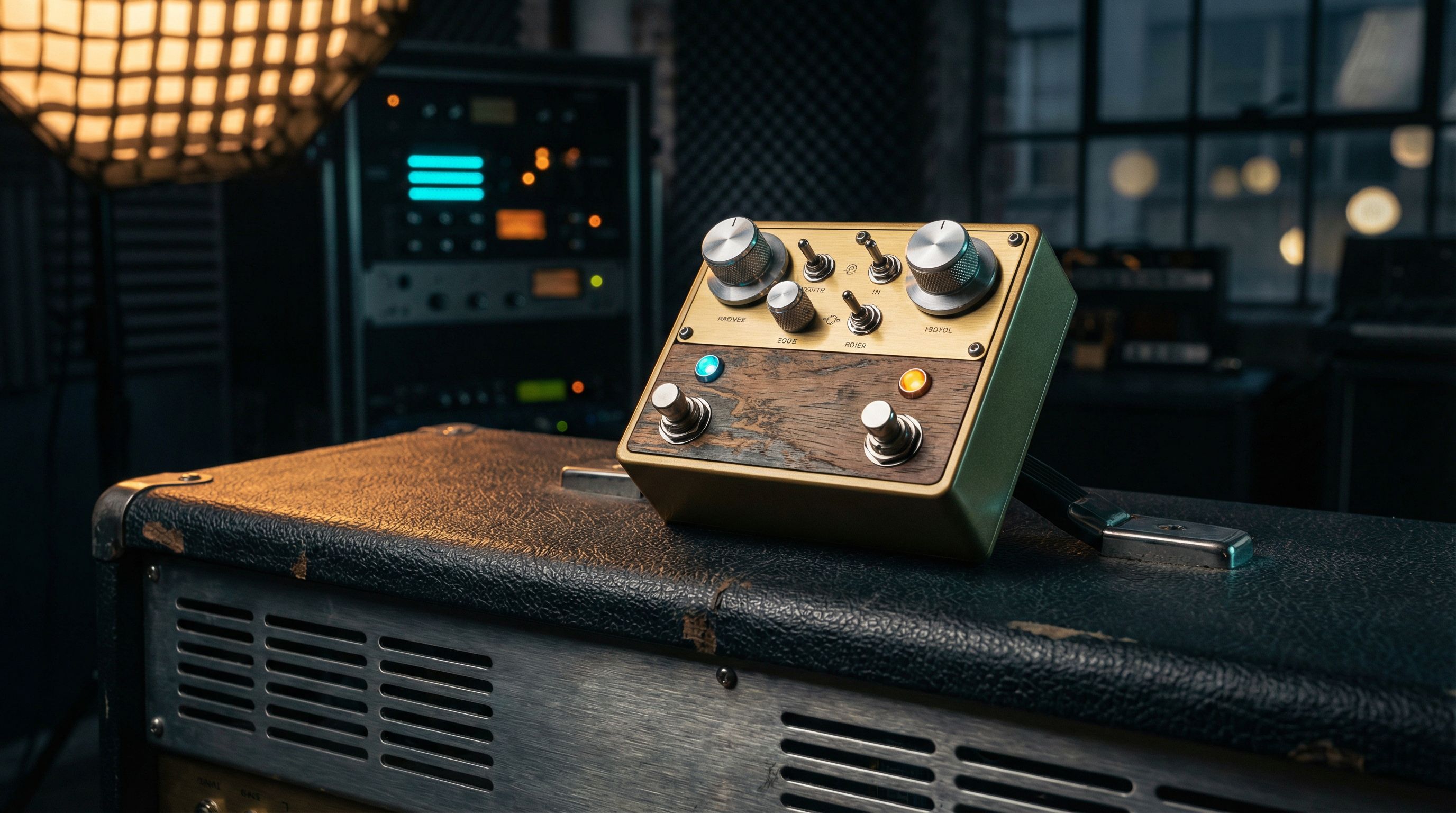
The Klon has three knobs: Gain, Treble, and Output. Here's where to begin for each use case:
| Use Case | Gain | Treble | Output |
|---|---|---|---|
| Clean Boost | About 7 o'clock (minimum) | Around noon | Output to taste (push above unity for boost) |
| Mild Overdrive | About 9–10 o'clock | Slightly below noon if bright amp | Output to taste |
| Full Drive | Around noon to 2 o'clock | Around 10–11 o'clock | Output to compensate for volume loss |
One thing before you dial anything in: the Treble knob is not a tone knob in the usual sense. It cuts harshness above 2kHz without dulling the fundamental. Most players, once they understand this, run it lower than noon. Keep reading; this changes how you use the pedal.
The Klon Centaur is one of those pieces of gear that invites more mythology than instruction. You will find forum threads, YouTube breakdowns, and magazine features, almost none of which tell you where to set the knobs. They tell you what the pedal feels like, what it does to a mix, what Bill Finnegan was thinking about when he designed it. All of that is interesting. None of it helps you on a Thursday night when you're soundchecking in a room that sounds like a parking garage.
This guide is about settings. Specific ones, with specific reasons, in plain language.
What Are the Three Knobs on a Klon Centaur?
Before anything else, the controls need clarifying, because the Klon's labels don't match the language most overdrive players are used to.
Gain works the way you'd expect: clockwise for more saturation and harmonic density, counterclockwise for less. But it's worth noting that the Klon's Gain range is relatively modest. Even at maximum (about 5 o'clock), this is not a high-gain pedal. It's a transparent-to-semi-transparent overdrive with excellent touch sensitivity. Full Gain on a Klon sounds roughly like the lower-middle range on a RAT or a Tube Screamer running hot.
Treble is the one most players misconfigure (more on that shortly). It shapes the high-frequency content of the overdriven signal, but not in the way a standard tone knob does. Counterclockwise reduces brightness above roughly 2kHz while leaving the fundamental largely intact. Clockwise adds presence and edge. Noon is roughly flat.
Output is the output level; it is not labeled "Volume" on the original, and on most clones the label follows the original. This sets the volume of the signal leaving the pedal. Unity gain varies by your amp and guitar, but on most rigs, Output between 10 o'clock and noon brings you to roughly even with your bypassed signal. Above that, you're boosting the front end of whatever comes next.
What Makes a Klon Sound Like a Klon?
This question gets asked a lot, and most answers focus on the wrong thing. People will tell you it's "transparent" or "musical" or "responds to your guitar." True statements, but useless without context.
Two specific design decisions make the Klon behave the way it does.
First, the internal charge pump doubles the operating voltage from 9V to approximately 18V. That extra headroom means the signal has more room before the op-amp clips. The result is that the clean signal blending through the circuit stays cleaner than it would on a standard 9V design, and when clipping does occur, it happens with more gradual saturation rather than the harder clipping characteristic of, say, a Tube Screamer. (For a direct comparison of how those circuits diverge in feel and EQ profile, see our Tube Screamer settings guide.)
Second, the input buffer. The Klon is not a true-bypass pedal; it has a buffer on the input stage that sits in your signal path whether the effect is active or not. This is not a bug. The buffer drives downstream pedals differently than a high-impedance passive guitar output does, and many players (I run my #1247 last in the boost slot) leave the Klon always on specifically for this reason. The buffer alone changes how your fuzz pedals and wahs interact with the rest of the chain. It's worth knowing about before you assume the pedal should be in true-bypass mode.
How Do You Set a Klon for Clean Boost?
The clean boost setting is, counterintuitively, where the Klon earns most of its reputation.
Gain: about 7 o'clock (minimum position, or just off minimum) At the lowest Gain setting, the Klon passes your signal through with very little saturation added. The character of the overdrive circuit is almost entirely absent. What you get is the frequency shaping, the buffer, and the volume boost from the Output knob. Essentially, it's a transparent boost with the Klon's EQ fingerprint.
Treble: around noon At noon, the Treble control is roughly neutral. For most guitars and amps, this is a reasonable starting point for clean boost; you're not adding brightness, not subtracting it.
Output: set to match or exceed unity This is the functional control in clean boost mode. If you want a clean volume lift to push your amp harder or cut through a dense mix, bring Output up; somewhere between 12 o'clock and 2 o'clock is common, depending on how hard you want to hit the amp's input. If you're using the clean boost to thicken your tone without a volume jump, match your unity level first and adjust from there.
One thing worth testing: with Gain at minimum and Output above unity, the Klon functions as a front-end driver for your amp. You're essentially adding clean level before the amp's preamp section. On a tube amp already pushed to the edge of breakup, this will push it over. On a clean amp, it will add presence and density without obvious overdrive. It is a different experience than stomping a boost with a colored EQ.
How Do You Set a Klon for Mild Overdrive?
The mild overdrive range (roughly Gain between 9 and 11 o'clock) is where the Klon starts doing what made it famous.
Gain: about 9–10 o'clock In this range, the Klon produces low-saturation overdrive with significant touch dynamics. Play softly and the circuit sounds nearly clean. Dig in and you get harmonic content: warm, open, without the midrange honk that defines a Tube Screamer. (That honk is a feature or a bug depending on who you ask; we break down the circuit differences in the TS comparison.)
Treble: slightly below noon if your amp is bright Here's where players leave tone on the table. Many guitarists who own a Klon run the Treble at noon because noon feels like neutral. But the sweet spot for most bright amps (a Fender Deluxe, a Vox AC15, a clean Dumble-influenced circuit) tends to fall somewhere between 9 o'clock and 11 o'clock on the Treble. In that range, the high-frequency harshness of the overdrive circuit is rolled back while the fundamental and midrange bloom remain present and intact. The pedal sounds fuller. Less like an overdrive on top of your tone, more like your tone with something added.
Output: to taste, usually around 11 o'clock to 1 o'clock Match your bypassed level first, then nudge above it if you want the slight boost that pushes the amp. On most rigs, 11 o'clock to noon is close to unity.
How Do You Set a Klon for Full Drive?
"Full drive" on a Klon is a relative term. Keep expectations calibrated.
Gain: around noon to 2 o'clock At noon, the Klon is producing moderate overdrive, harmonically rich, still relatively open in character, but clearly saturated. At 2 o'clock, you're in the denser end of the Klon's range. It does not sound like high gain. The amp's character still comes through. If you're expecting the saturation of a Tube Screamer at full Gain or a RAT at noon, the Klon at full drive will sound insufficient by comparison. That's not a deficiency, it's a different design intent.
What the full-drive setting does well: it stacks. The Klon at full Gain into a Tube Screamer, or into a modestly driven amp, produces a layered saturation with less of the boxy compression that happens when you stack two clipping circuits of the same type. The headroom design means the Klon stays open even at maximum Gain, which gives the amp room to contribute its own harmonic content.
Treble: around 10–11 o'clock At higher Gain settings, the Klon's natural harmonic character emphasizes upper harmonics. Backing the Treble off into the 10–11 o'clock range compensates for this without losing presence. Many players run it even lower (around 9 o'clock), particularly on single-coil guitars at high gain settings.
Output: adjust to compensate Higher Gain settings on the Klon tend to compress the perceived volume slightly. You may need to push Output to 1 o'clock or beyond to maintain the same stage level as your bypassed tone. Dial it in by ear relative to your clean signal.
What Do Most Players Get Wrong About the Treble Knob?
Here is the surprised discovery, the one worth testing at home tonight: the Treble knob on the Klon is not a brightness control in the standard sense. It is a harshness-removal control.
Turning it down does not dull the pedal the way turning a tone knob counterclockwise dulls most overdrives. What it does is cut a specific band of upper harmonics (above roughly 2kHz) while leaving the fundamental and low midrange largely unaffected. The pedal stays present and full-sounding with the Treble at 9 o'clock in a way that most overdrives do not. The fundamental doesn't collapse. The low-mid bloom stays intact.
The practical implication: if you've tried a Klon and found it harsh or ice-picky at normal gain settings, try backing the Treble below noon, down to 10 o'clock, then 9 o'clock. Assess whether the pedal sounds better. For a surprising number of players on bright-voiced equipment, the Klon runs best with the Treble between 9 and 11 o'clock. The pedal wasn't too bright. The Treble was just set too high.
How Do Klon Clone Settings Compare to the Original?
The setting positions translate proportionally across most well-designed clones, but some tonal and feel characteristics differ. Here's a working comparison.
| Pedal | Similarity to Original | Notable Differences | Settings Translation |
|---|---|---|---|
| Klon KTR | Highest (designed by Bill Finnegan) | True-bypass option changes buffer behavior | 1:1; same knob positions |
| Wampler Tumnus | Very high (generally considered most accurate clone) | Slightly smaller Gain range | Translate proportionally; Gain positions nearly identical |
| Archer (Tone City / others) | Moderate | Brighter character overall; can feel harsh faster | Back Treble off by about one position from where you'd run the original |
| EHX Soul Food | Moderate | Softer feel, less firm transient response | Settings translate proportionally; Gain can be pushed slightly further for similar saturation |
One note about buffers: the KTR's buffer is the most faithful to the original circuit. The Tumnus and Archer use their own buffer designs, functional but with different downstream impedance characteristics. If you're running the Klon for its buffer as much as its tone, the KTR is the only clone that replicates that specific behavior. Budget clones typically use op-amp buffers that are clean but not tonally identical.
For more on how pedal order and buffer placement affect your overall sound, see the signal chain order guide.
Is the Klon's Character "Transparent"?
The word "transparent" gets applied to the Klon so frequently that it has become almost meaningless in that context. The Klon does color your tone. It has a frequency response that favors the low midrange in the overdriven signal, a particular harmonic signature from the dual-voltage op-amp circuit, and a buffer that changes impedance downstream. None of that is "transparent" in the strict sense.
What the Klon does (and what distinguishes it from a Tube Screamer or a Blues Driver) is preserve the character of your guitar and amp while adding saturation on top of that character rather than replacing it. The distinction between how different overdrive types interact with amp character is covered in the overdrive vs distortion vs fuzz guide. The Klon belongs in the "amp-enhancing" category of overdrive. It does not impose its own voice the way a fuzz or a distortion does.
Frequently Asked Questions
Is a Klon clone as good as the original?
For practical purposes (getting a useful, great-sounding tone on stage or in a recording), yes. A well-made Klon clone like the Wampler Tumnus or the KTR produces tones that are indistinguishable from the original in most musical contexts. The original Klon Centaur carries collector value and historical significance, and the circuit's specific component tolerances may contribute to individual units sounding slightly different from one another. But the core circuit (the charge pump, the op-amp, the blend structure) is fully replicable. The KTR is the only clone designed by Bill Finnegan himself, which makes it the most accurate available. If you can't afford or locate an original, buy the KTR or the Tumnus and spend the difference on guitar time.
What is the best setting on a Klon for single-coil guitars?
Single-coil guitars tend to be brighter than humbuckers, which means the Klon's Treble control becomes more critical. Start with Treble around 9–10 o'clock rather than noon. For clean boost with single-coils, noon or just below is usually fine. For overdrive settings, the combination of a bright amp and a bright guitar can produce harshness quickly. Back the Treble to 9 o'clock and assess. Output and Gain follow the same guidelines as the main sections above.
Why does the Klon feel different from a Tube Screamer at similar gain settings?
Two reasons: frequency shaping and headroom. The Tube Screamer has a mid-forward EQ profile (it cuts bass and treble and emphasizes roughly 700Hz–1kHz) and it operates at standard 9V. The Klon passes more low-end information and runs at approximately 18V internally, which means more headroom before hard clipping occurs. The result is that the Klon feels looser and more open at similar saturation levels, while the TS feels tighter and more compressed. Neither is better; they suit different playing styles and amp types. See the Tube Screamer settings guide for a deeper dive on where each pedal shines.
Should the Klon be first in the signal chain?
The traditional recommendation is buffer-equipped pedals early in the chain, which would place the Klon near the front. But because the Klon's buffer changes the impedance that downstream pedals see, placement matters in both directions. Running a fuzz after the Klon (rather than before) is common because the Klon's low-impedance output drives the fuzz's input differently than a guitar's high-impedance output does. Some players prefer fuzz before the Klon for exactly this reason. There is no universal answer. The signal chain order guide covers the logic for placing buffers relative to wahs, fuzzes, and other impedance-sensitive pedals.
Does the Klon work well with humbucker guitars?
Yes, though the character shifts. Humbuckers are warmer and less bright than single-coils, so you can often run the Treble at noon or slightly above without harshness. The Gain range feels slightly different; the fuller low-end output of a humbucker at higher Gain settings can feel more compressed. Some humbucker players find Output needs to come up slightly to achieve the same cut as a single-coil through the same pedal. Otherwise, the settings guidelines above apply directly.