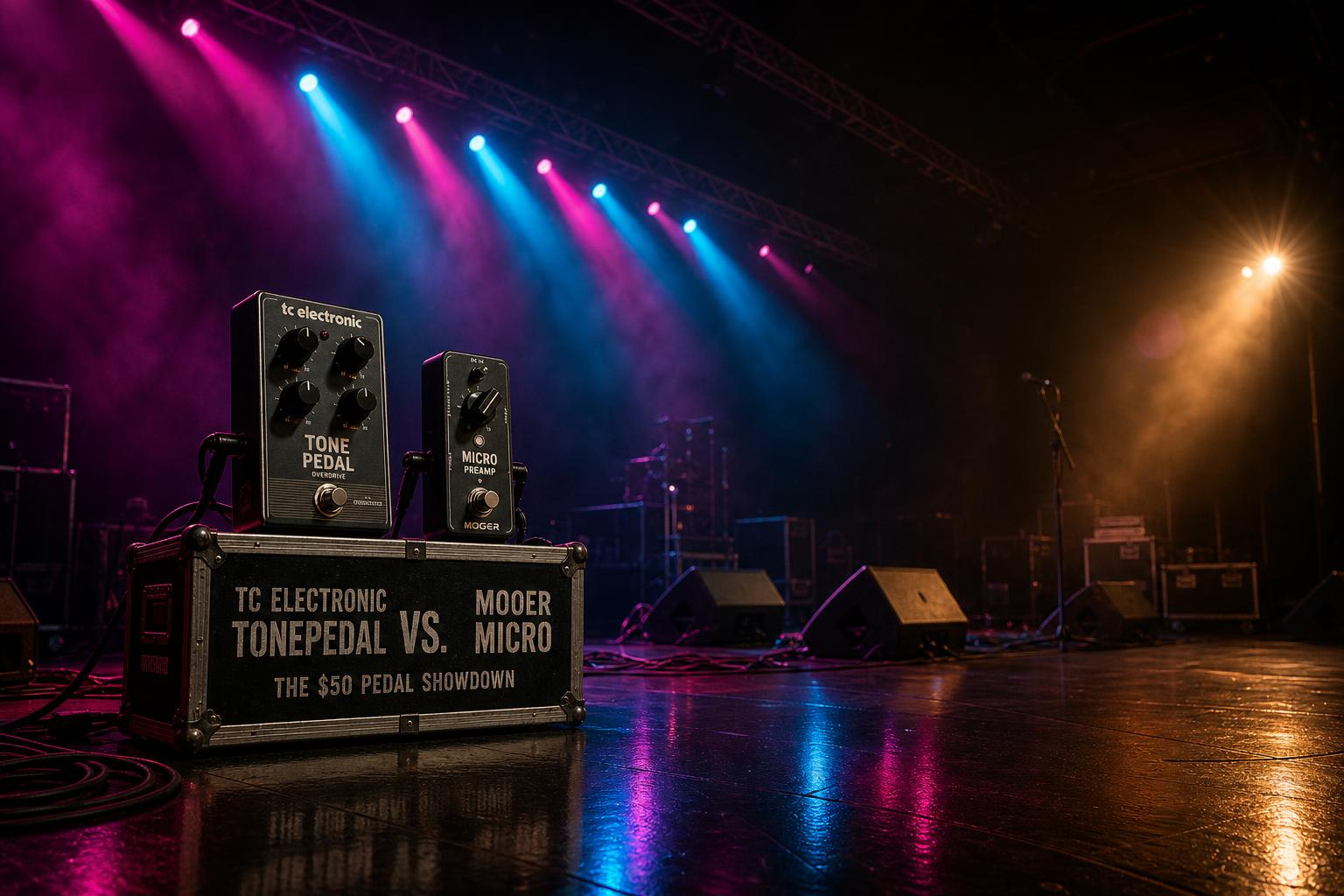
Quick read: TC Electronic and Mooer both make sub-$80 micro pedals that compete for the same square inch of your pedalboard, and they take completely opposite approaches to it. TC's strategy is digital DSP with TonePrint customization: one piece of hardware, many algorithms loaded via USB. Mooer's strategy is analog clones with the right chip choice: one circuit per pedal, no software. Buy TC if you want time-based effects (delay, reverb, chorus, pitch) at micro size with the option to load custom algorithms. The Flashback Mini ($89), the Hall of Fame Mini ($89), and the Smorgasbord ($69) are genuinely good and TonePrint editor lets you tune them to taste. Buy Mooer if you want analog dirt at micro size. The Black Secret (Rat clone, $75), the Eleven Lady (Big Muff clone, $79), and the Yellow Comp (Dyna Comp clone, $80) all hit because the chip choice is right. The lines split cleanly: TC owns time-based, Mooer owns dirt. Mixing them on the same budget board is the right move, not picking one camp.
| Category | TC Electronic Mini wins | Mooer Micro wins |
|---|---|---|
| Delay | Flashback Mini, $89; TonePrint flexibility | El Music Box, $80; analog warmth limited |
| Reverb | Hall of Fame Mini, $89; TonePrint flexibility | Shimverb Pro, $99; algorithm too narrow |
| Chorus | Corona Chorus Mini, $79; TonePrint shines | Ensemble King, $80; close, less character |
| Distortion (Rat-style) | Mojomojo, $69; too dark | Black Secret, $75; LM308 chip nails it |
| Distortion (Big Muff-style) | none in mini line | Eleven Lady, $79; four-transistor faithful |
| Compressor | none in mini line | Yellow Comp, $80; OTA-based, holds character |
| Overdrive (TS-style) | Mojomojo, $69; better than expected | Green Mile, $80; JRC4558 chip, faithful |
| Tuner | PolyTune 3 Mini, $99; strobe mode, polyphonic | Baby Tuner, $50; works but no strobe |
I've been running a hybrid micro-pedal board for about three years now (a couple of TC Electronic minis for time-based effects, a couple of Mooer minis for dirt), and the longer I run it, the more I think the "TC vs. Mooer" framing is wrong. They're not really competing for the same slot. They're each better at half the catalog, and the player who picks one camp over the other is leaving the other camp's wins on the table.
This piece is a side-by-side of where each line actually delivers, and where each falls short. I bought every pedal in this comparison at street price; nothing was provided by either company. The verdicts are based on what stayed on my board after eight months of nightly use through an HX Stomp going direct to PA. If you're already familiar with the Mooer pedal catalog roundup, this is the cross-brand sequel. The TC side is what fills the gaps Mooer doesn't.
Why These Two Brands Specifically
There's a small handful of brands competing in the $50-100 micro-pedal space: TC Electronic, Mooer, Donner, Rowin, JOYO, Hotone, and a few others. Of those, TC and Mooer are the ones that actually matter for serious budget pedalboard builds. Donner and Rowin make decent stuff at lower prices but the build quality and circuit choices are noticeably less consistent. JOYO and Hotone are closer to Mooer's level but with thinner catalogs. Behringer is its own conversation (see the Behringer pedal clone roundup for that comparison; it's more of a $30 tier than a $50-80 tier).
TC and Mooer at $50-100 are where the budget board gets interesting. Both have full catalogs across most pedal categories, both have professional build quality (metal enclosures, true bypass switching standard, real footswitches not soft buttons), and both have been in the market long enough that the products have iterated past their first-gen problems.
Where TC Electronic Wins: The Time-Based Stuff
TC's whole thing for the last decade has been DSP-based digital effects with TonePrint customization. TonePrint is a USB protocol that lets you load custom algorithms into a TC pedal. There's a free editor app where you can tweak parameters that aren't on the front panel (LFO shape, modulation depth, pre-delay, EQ curves), save the result to your pedal, and have a custom voicing that doesn't exist out of the box. It's the closest thing to a software-defined hardware pedal I've used, and on the time-based stuff it's a real advantage.
Flashback Mini Delay ($89)
The Flashback Mini has three knobs (Delay, Feedback, Effect Level) and a single TonePrint slot you can load any algorithm into. Out of the box it's a digital delay with a tape mode toggle on the back. Load a TonePrint into it and you can have a Carbon Copy-style analog modeled delay, a Memory Man-style modulated delay, a Strymon-style reverse delay, or a custom algorithm one of the TC artist roster (Andy Summers, Petteri Sariola, etc.) has uploaded.
Mooer's analog delay (El Music Box, $80) is a real BBD analog delay with the warm self-oscillation Mooer's other analog stuff has, but it's one sound, one voicing, one set of three knobs. The Flashback Mini at the same price gives you the entire delay genre via TonePrint loading. For a player who wants flexibility on a small board, the Flashback wins this slot easily.
Hall of Fame Mini Reverb ($89)
Same story. Three knobs (Decay, Tone, FX Level), one TonePrint slot, and a stock algorithm that's a competent hall reverb. Load a different TonePrint and you have a spring reverb, a plate, a shimmer, a modulated room, or a custom algorithm. Mooer's Shimverb Pro ($99) is a fixed-algorithm shimmer reverb that does one specific thing well but only that one thing.
The Hall of Fame Mini is the reverb pedal I'd put on any budget board first. It covers more ground than any single fixed-algorithm reverb under $200.
Corona Chorus Mini ($79)
The Corona is a chorus where the TonePrint difference is most audible. Stock algorithm is a clean, thin chorus that's fine for clean tones but unremarkable. Load a Vibrato TonePrint and the same hardware becomes a Univibe-style modulator. Load John Petrucci's TonePrint and it becomes a thicker, more complex chorus tuned for high-gain tones. Mooer's Ensemble King ($80) is a fixed CE-2-style chorus that does one thing well but, again, only that one thing.
For the player who likes to swap between chorus characters depending on the song, the Corona is the right buy.
Mojomojo Overdrive ($69)
The exception in the TC time-based dominance. The Mojomojo is TC's analog overdrive, a soft-clipped op-amp circuit voiced like a Klon-meets-Tube-Screamer hybrid. It's not as faithful to either reference as Mooer's dedicated clones (the Mooer Tender Octaver and Green Mile are tighter takes on those specific circuits), but it's a genuinely good overdrive that fits a slot the Mooer catalog doesn't really cover: a mid-gain transparent-ish drive that isn't a clone of any specific famous pedal.
The Mojomojo isn't TC's finest hour, but it's better than Mooer's Hustle Drive (a generic overdrive that doesn't reference any specific circuit and doesn't really commit to its own voice) and it's a useful pedal at the price.
PolyTune 3 Mini ($99)
The polyphonic tuner is the one TC product that's not really competed against anything. It tunes all six strings simultaneously; strum once and it shows you which strings are flat or sharp. The Mooer Baby Tuner ($50) is a chromatic tuner with a clip-on-style display that works but doesn't do polyphonic mode and doesn't have a strobe option. For a player who tunes between songs at gigs, the PolyTune saves real time.
Where Mooer Wins: The Dirt
Mooer's whole strategy in the dirt category is choosing the right chip and the right circuit topology for a clone. They're not trying to be original. They're trying to make a faithful version of a famous pedal at a fraction of the price. And on the dirt side, they nail it more often than not.
Black Secret ($75): ProCo Rat clone
The Black Secret uses an LM308 op-amp, the same chip in the original ProCo Rat. The clipping diodes are silicon, the tone stack is the same single low-pass topology, and the gain range matches. Side-by-side with my actual ProCo Rat 2, the Black Secret is within audible variance. The difference between two production-line Rats from different years is bigger than the difference between the Rat 2 and the Black Secret.
TC doesn't have a Rat clone in the mini line. The Mojomojo gets in the neighborhood at high gain settings but doesn't really commit to the Rat voice. For Rat-style distortion at micro size, the Black Secret is the only real choice in the budget tier.
Eleven Lady ($79): Big Muff (Civil War) clone
Four-transistor topology faithful to the Civil War (V7) Big Muff. Mooer used 2N5089 NPN transistors, which is the same family as the originals. The result is a Big Muff voice that's recognizably a Big Muff (wall-of-fuzz, scooped mids, sustain that goes for days) at a fraction of the price of the EHX original or the boutique clones.
TC doesn't have a Big Muff clone in the mini line. For Big Muff at micro size, Mooer is the only game in town under $200.
Triangle Buff ($79): early Triangle Big Muff clone
Same idea as the Eleven Lady but voiced for the earlier 1969 Triangle Big Muff: brighter, more aggressive top end, less low-end bloom. If you're a player who wants the Smashing Pumpkins Siamese Dream-era fuzz specifically (the early Triangle is what's on that record), the Triangle Buff is closer than the Eleven Lady. Both are good buys; pick the one that matches the era of fuzz you're chasing.
Yellow Comp ($80): MXR Dyna Comp clone
OTA-based circuit using the CA3080 chip, same as the original Dyna Comp. The result is a compressor with the characteristic Dyna Comp pump and the slight high-end loss the original is known for. Faithful enough that Mooer's clone is one of the budget pedals studio engineers I know have actually used on records when the original wasn't around.
TC doesn't make a compressor in the mini line. For compression at micro size, Mooer is the only choice.
Green Mile ($80): Tube Screamer clone
JRC4558 chip, same as the original TS808. Same op-amp clipping topology. Same tone stack. The voicing is a near-faithful TS808. The mid-hump around 720 Hz is in the right place, the gain range matches, and the level control has the same usable range. Slightly cleaner than a real TS808 in the highest gain settings (the diodes might be slightly different), but the difference is small.
The Mojomojo isn't really a Tube Screamer clone; it's a more transparent overdrive. If you want the specific TS808 voicing, the Green Mile is the more faithful pick.
Where Both Lines Overlap, And Which Wins
There are a few categories where both brands have a contender at micro size:
Tremolo: TC's Pipeline Tap Tempo Tremolo Mini ($99) vs. Mooer Trelicopter ($79). The Pipeline wins on flexibility (TonePrint, tap tempo) but the Trelicopter is more characterful for a lo-fi vibrato sound. Pick by use case.
Phaser: TC has no mini-format phaser. Mooer's Ninety Orange ($80) is a faithful MXR Phase 90 clone. Mooer wins by default.
Octaver: TC has no mini-format octaver. Mooer's Tender Octaver ($80) is an MXR Octave clone. Mooer wins by default.
Boost: TC's Spark Mini ($79) is a transparent clean boost. Mooer's Micro Power Booster ($60) is a similar clean boost at lower price. Both are fine; Mooer is cheaper.
A Hybrid Micro-Pedal Board for Under $500
Here's the actual hybrid board I run, with the chain order and a total. This is the board I'd recommend to a player asking "what's the most useful pedalboard I can build for under $500 that fits in a small case?"
Signal chain:
- PolyTune 3 Mini (TC), $99: tuner first, always
- Yellow Comp (Mooer), $80: compressor before drive
- Green Mile (Mooer), $80: TS808-style mid-push overdrive
- Black Secret (Mooer), $75: Rat distortion for harder rhythm
- Mojomojo (TC), $69: transparent boost or alternative drive
- Corona Chorus Mini (TC), $79: chorus pre-delay
- Flashback Mini (TC), $89: delay
- Hall of Fame Mini (TC), $89: reverb last
Total: $660. Slightly over $500, but that's eight pedals, and you can drop the Mojomojo or the Corona to land under $500. The board fits in a Pedaltrain Nano+ and runs off any standard 9V power supply.
The ratio is roughly 50/50 TC and Mooer, which is what the analysis above predicts. TC handles tuning, modulation, time-based, and the second drive. Mooer handles compression, dirt clones, and any specific-circuit tone you want.
Where Both Lines Fall Short
Honest section. Neither line is perfect at this price tier.
TC's TonePrint workflow has a learning curve. You have to download the editor, plug the pedal into your computer over USB, find a TonePrint you like (or build one), and load it onto the pedal. For some players this is a feature; for others it's friction. If you don't want to learn a software workflow, the TC time-based pedals will sit at their stock voicings, which are less impressive than what TonePrint unlocks.
Mooer's customization is zero. Three knobs, one circuit, no software. What you buy is what you have. For players who like to tweak, Mooer's pedals can feel limiting. For players who like to plug in and play, that's a feature.
Build quality is comparable but Mooer footswitches click slightly louder. Both brands use die-cast aluminum micro enclosures with reasonably good footswitches. After eight months of daily use, none of mine have failed. TC's switches feel slightly more refined; Mooer's feel slightly more positive but with a louder mechanical click. Neither is a deal-breaker.
Both brands have power supply noise issues with the wrong supply. The micro pedals draw low current and are sensitive to power supply noise. Run them off a quality isolated supply (Voodoo Lab Pedal Power 2, Cioks DC7, even a Mooer Macro Power S8) and they're quiet. Run them off a daisy chain or a cheap unisolated supply and you'll get hum from both brands. This isn't unique to budget pedals (boutique pedals do the same thing), but it's worth knowing if you're building your first board.
The Verdict
TC and Mooer don't really compete head-to-head as brands. They compete category by category, and the winners are clear: TC owns time-based effects and tuners, Mooer owns analog dirt and clones, and the Mojomojo and a couple of TC modulation pedals are the genuinely good outliers. The right move for a budget pedalboard build is to mix them: buy each pedal from the brand that does that specific category best, not commit to one brand for the whole board.
The mistake is brand loyalty in the budget tier. Picking "I'm a Mooer guy" or "I'm a TC guy" leaves the other brand's wins on the table. Both companies have spent a decade making these specific pedals and neither has a complete catalog where they win every category. Mix and match. Your board will be better for it.
For the broader budget gear philosophy (when to spend more, when to spend less, and what's actually worth the boutique markup), our Behringer vs. boutique pedal philosophy guide covers the cheaper end of the same spectrum.