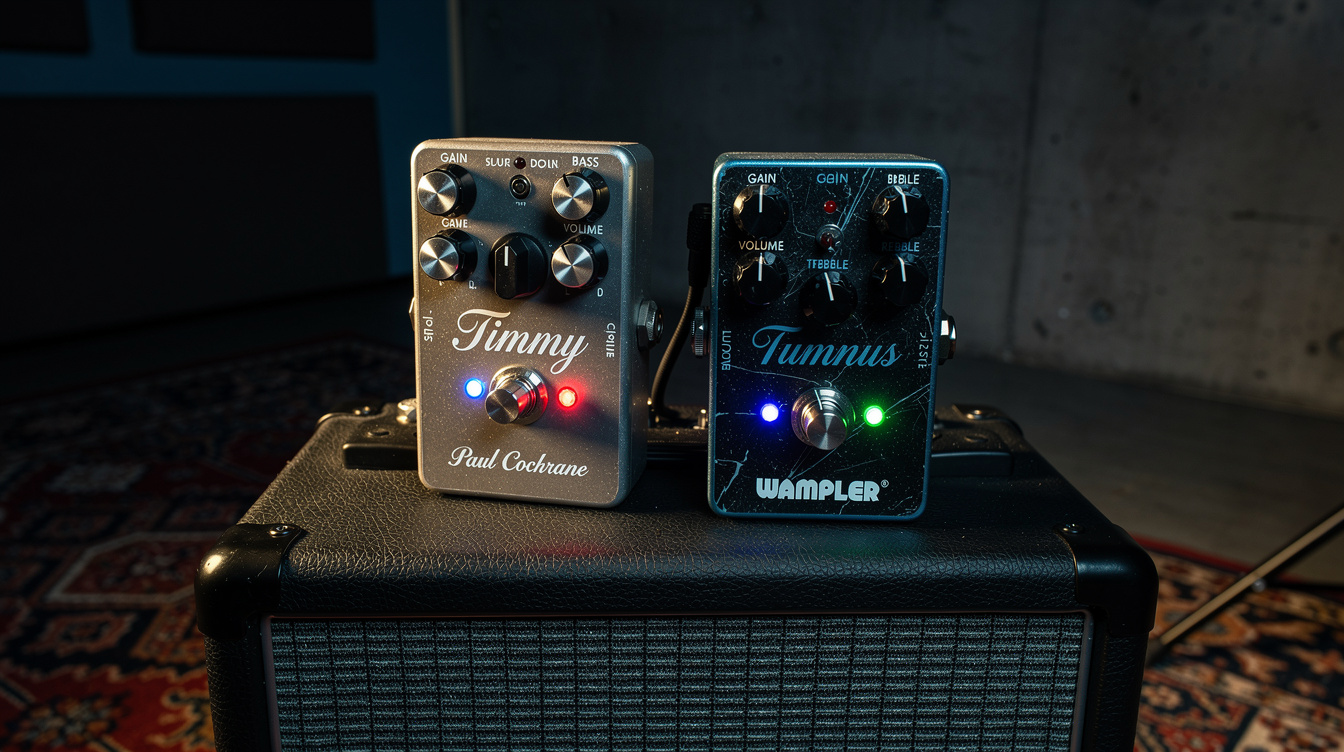
Start Here: The short version for players who need to choose between these two:
- The Timmy has a genuinely different EQ architecture. Bass cuts pre-gain, Treble boosts post-gain; the circuit shapes the frequency content going into saturation, not just the output EQ
- The Tumnus is Klon-based: a clean blend circuit, nasal mid character, and a specific bloom behavior that the Timmy doesn't share
- At very low Drive, they're close. Both produce saturation and harmonic bloom; the character differences widen as gain increases
- Choose the Timmy for stacking control. Its independent tone controls let you build precise OD stacks without frequency buildup
- Choose the Tumnus for the Klon bloom. Its clean blend creates a glassy quality the Timmy can't replicate at any setting
Quick Reference: Head-to-Head
| Parameter | Paul Cochrane Timmy | Wampler Tumnus |
|---|---|---|
| Circuit type | JFET-based, opamp clipping | Klon-clone (clean blend design) |
| EQ architecture | Bass pre-gain, Treble post-gain | Single Tone control (cuts highs) |
| Gain range | Very low to medium | Very low to medium |
| Clean blend | No | Yes (built into circuit) |
| Mid character | Relatively flat | Klon nasal mid presence |
| Stacking suitability | Excellent; EQ control helps balance | Good; Tone control is adequate |
| Price (new) | $110 MXR Timmy; ~$150 used original | $180 Tumnus; $200 Tumnus Deluxe |
| Closest character comparison | Flat-EQ, harmonically dense | Glassy, with Klon bloom |
Why "Transparent" Means Different Things on These Two Pedals
Both pedals are routinely described as "transparent overdrives," which is accurate in a limited sense; neither imposes a heavy tonal coloration at moderate settings the way a Tube Screamer or RAT does. But they're transparent in different ways, through different circuit philosophies, and those differences are audible even at low gain.
The Timmy is transparent in the sense that it adds saturation without substantially altering the frequency character of the signal. The Bass and Treble controls aren't tone shaping after the fact. The Bass cuts low-frequency content before it enters the gain stage, which controls how the clipping responds to low-end. Cutting Bass pre-gain keeps the saturation from becoming muddy on bigger chords. Boosting Treble post-gain restores presence after the gain stage has done its work. This is architecturally precise in a way that single-tone-control ODs aren't.
The Tumnus (and all Klon-based designs) is transparent in a different sense: it mixes the dry signal with the driven signal, so you're always hearing some percentage of clean guitar underneath the saturation. This clean blend creates the Klon's characteristic quality where the note feels both saturated and open simultaneously. The overdrive is happening, but the unaffected signal underneath it keeps the fundamental clear. The famous "glassy" Klon character is largely an artifact of this blend behavior.
These are different sounds. Neither is more transparent than the other. They're transparent in different directions.
Testing Both at the Settings That Actually Matter
I ran both pedals into a clean Fender Deluxe Reverb equivalent (no amp saturation, reverb off, volume where a loud conversation is possible in the room), Strat bridge pickup, volume full. Three gain settings: minimum Drive, Drive at 9 to 10 o'clock, and Drive at noon.
At Minimum Drive
At the lowest usable gain setting, the character difference is subtle but audible. The Timmy adds harmonic presence without an obvious gain character; single notes have more sustain and a slight bloom at the note's decay. The Tumnus at minimum adds a similar bloom but with a glassier quality. The clean blend is most audible here, where the saturation is lowest. Strumming a full chord through the Tumnus at minimum Drive sounds slightly wider than through the Timmy, because you're hearing the clean signal underneath the driven one.
Neither wins at this setting. What they're both doing is adding harmonic complexity without distorting the note character. Which you prefer depends on whether you want the Timmy's density or the Tumnus's glass.
At 9 to 10 O'Clock
This is the Andy Timmons setting range for the Timmy, and it's where the two pedals most clearly diverge.
The Timmy at 9 o'clock is producing obvious overdrive. Individual notes have a crunchy sustain, chords separate rather than stack, and there's a dynamic response where picking harder gets noticeably more saturation. With Bass cut slightly and Treble at noon, the frequency response stays balanced through the whole fretboard range. I didn't expect the low-register notes to stay as well-defined as they do. The 5th-fret-and-below single notes maintained separation even through the saturation.
The Tumnus at 9 to 10 o'clock has more of a Klon character: that slightly nasal, mid-forward coloration becomes audible. The clean blend is still present but less dominant than at minimum Drive. It responds well to pick dynamics; pushing harder saturates noticeably, backing off cleans up more than the Timmy does. The Tumnus bloom at this setting is more pronounced than the Timmy's. The note's harmonic complexity increases over the sustain in a way that's specific to the Klon clean-blend design.
At Noon
At noon Drive, the Timmy sounds like a medium-gain overdrive with precise EQ control. You can use the Bass cut to tighten it for single notes or back the Bass off entirely for a drier, tighter character. The Treble boost post-gain becomes more audible here. Push it and the top end of the note attacks harder. The range of sounds accessible from the EQ controls is genuinely wide.
The Tumnus at noon starts to lose the clean blend character. The drive is high enough that the saturation dominates. This is where I'd say the Timmy has an advantage: its EQ architecture is most useful at medium-gain settings, while the Tumnus's key character element (the clean blend) is most audible at low-gain settings.
The Stacking Question
Both pedals are widely used as components in drive stacks, either as the first OD in a two-pedal chain, or as a light push in front of a higher-gain stage.
The Timmy's EQ control makes it particularly useful as the first pedal in a stack. You can cut the Bass pre-gain to prevent muddiness from accumulating as you add the second drive. You can boost the Treble post-gain to compensate for the mid-hump of a TS-style second drive. The frequency shaping is essentially pre-emptive equalization for the stack, and it works.
The Tumnus in a stack is also good, but less precise. The single Tone control cuts highs only, which is a less flexible tool for managing stack buildup. The clean blend becomes part of what's being fed into the second drive, which creates a specific character. You're stacking a clean+driven signal into a distortion stage, which can produce either glassy complexity or muddy blur depending on the second pedal.
For a two-OD arrangement like the one in the Andy Timmons budget tone post, the Timmy is the more intentional tool. For a single-pedal push into an amp, the Tumnus is easier to dial in quickly.
The MXR Timmy: Important Context
Since 2020, the Cochrane Timmy has been available as a licensed compact version through MXR at $110 new, significantly less than used original Timmys ($140 to $160) or boutique alternatives. The MXR version has the same circuit and the same EQ architecture. A few differences:
- True bypass vs. buffered: The MXR version is true bypass. Original Timmys come in both versions, and the buffered version has fans who use it specifically as a signal chain buffer alongside the overdrive function.
- Size: The MXR is mini-format, which matters for pedalboard space.
- Availability: The MXR Timmy is readily available; the original is built-to-order with occasional wait times.
For most purposes, the MXR Timmy at $110 is the answer to the question "how do I get the Timmy without the used-market price fluctuation?" The circuit is the same.
Which One?
The honest decision framework:
Choose the Timmy if:
- You're building a two-overdrive stack and need frequency control over the first stage
- You want a genuinely flat-EQ character that lets the amp and guitar's natural tone dominate
- You play with a lot of register variation (neck pickup to bridge, low strings to high) and want consistent response across the range
- You're placing it in a chain where mid accumulation is a risk (multiple drives, amp with existing mid presence)
Choose the Tumnus if:
- You want the Klon bloom (the glassy, clean-blend quality) at a lower price than the KTR
- You're using it as a single-drive-into-clean-amp setup where EQ precision matters less
- You're running it into a slightly darker, naturally mid-scooped setup where the Klon's mid presence is a feature
- You already have the Timmy (or TS9) as a second drive and want something with a different character
The overlap zone: if you're running either at Drive around 9 o'clock into a clean Fender-style amp as your only drive pedal, the tonal distance between them in the mix is smaller than it is in isolation. Both work. The character differences are real but not enormous at low gain. Above Drive noon, the Timmy becomes substantially more flexible and the Tumnus becomes substantially more colored, and at that point they're clearly different pedals.
FAQ
Is the Wampler Tumnus a Klon Centaur clone? Yes, functionally. The Tumnus is based on the Klon circuit, which uses a clean-blend design (mixing driven and undriven signals) and a specific charge pump for voltage doubling. The Tumnus uses the same basic architecture. The character differences between the Tumnus and an original Klon are smaller than the character differences between a Klon-type and a Timmy-type.
What's the difference between the Tumnus and the Tumnus Deluxe? The Tumnus Deluxe ($200 new) adds a second tone control (Bass and Treble separately), which makes it more competitive with the Timmy's EQ flexibility. If the EQ architecture is your primary concern, the Tumnus Deluxe narrows the gap with the Timmy significantly.
Can I use either of these as a boost into a slightly dirty amp? Yes, both work. The Timmy at low Drive with Level high is a transparent boost with very light saturation. The Tumnus at low Drive with Level high is a Klon-style boost that adds the clean-blend glassiness even at boost settings. For a truly transparent boost, the Timmy is closer to flat. For the specific "Klon pushed into a breaking-up amp" character, the Tumnus.
At what price point does a Timmy clone make sense? At $110 new (MXR Timmy), you're buying the circuit direct. Used Timmys run $140 to $160 for the original when they appear. Between $110 and $180 (Tumnus), the MXR Timmy wins on value for the Timmy circuit specifically. Above that range, the Tumnus Deluxe's additional EQ control is worth considering.
How do both compare to a TS9 at low gain? At Drive minimum to 9 o'clock, a TS9 has more of a mid-hump character than either the Timmy or Tumnus. The Tube Screamer's color is audible even at low gain through the characteristic 720Hz peak. Both the Timmy and Tumnus are flatter. The TS9 is the right choice if you want that specific mid character; the Timmy and Tumnus are right if you don't.