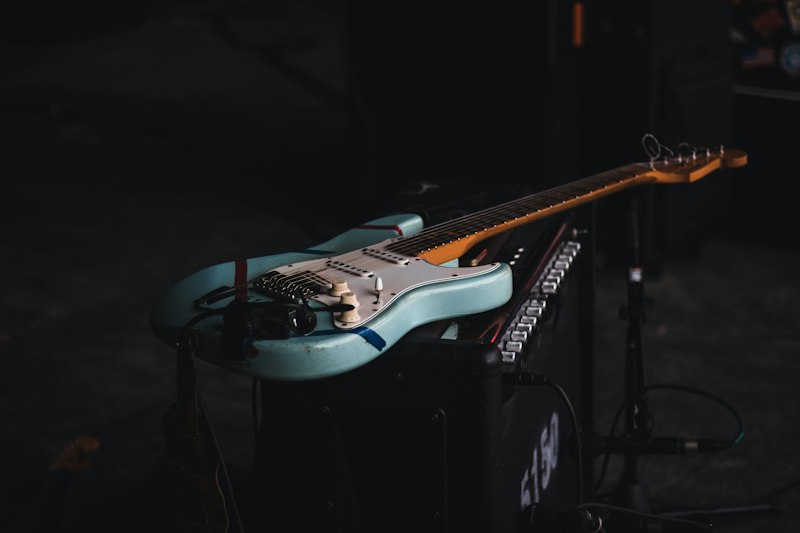
I have to disclose a bias before I write a single spec, because it'd be dishonest not to: Dookie is the reason I play guitar. I learned every song on it on a $99 Squier when I was ten. So when Marshall announced a baby-blue handwired head built around Billie Joe Armstrong's Dookie tone — their first artist signature amp in 14 years — I had a feeling in my chest I don't usually get from a press release. Then I saw the price and got my skepticism back, which is a relief, because skepticism is my whole job.
What the 1959BJA Actually Is
It's a 100-watt handwired head built on Marshall's 1959HW platform — that's the hand-wired reissue of the 1959 Super Lead, the amp everyone just calls "the Plexi." Three ECC83 preamp valves, four EL34s in the power section, single channel, no master volume, no frills. Head only, so you bring your own cab.
The twist is a factory "Dookie Mod" — Marshall's tribute to the hot-rodded gain Billie Joe's tech coaxed out of his gear during Green Day's breakthrough era. The cosmetics are the real love letter: baby-blue covering as a nod to "Blue," his first guitar, with brass and silver panel details and his signature on the front and back. It reportedly surfaced when he walked out at the 2026 Super Bowl with a blue Marshall nobody could ID.
Available today, July 21, through Marshall dealers and marshall.com. £3,099.99 / $3,999.99.
Let's Talk About the Four Grand
It's a hand-wired, point-to-point 100-watt Plexi with an artist's name on it. In tube-amp terms, $3,999 for a genuinely hand-wired 100-watter isn't a rip — a standard 1959HW isn't cheap either, and hand-wiring is real labor. If you're a collector, a touring pro who wants the actual object, or someone who's going to feel something every time you look at that blue tolex, I'm not going to tell you you're wrong. Feeling something about your gear is allowed.
But a 100-watt non-master Plexi is a specific tool. Non-master means the magic lives at volume — this thing wants to be cranked to sound like the record, which in a bedroom or a small club is a fight you'll lose. And here's the part my whole career is built on saying out loud: the tone in that box is one of the most modeled amps in history. You already own it.
How to Cop the Dookie Tone on a Modeler — Right Now, for $0
Every modeler made in the last decade has a Plexi. On Helix it's the Brit Plexi Nrm/Brt / Plexi Lead 100; Quad Cortex has the Plexiglas 100; TONEX and NAM are lousy with Super Lead captures. Not sure which block is the Plexi on your unit? That's exactly what our Helix Amp Model Cheat Sheet is for — it maps every block to the real amp it models.
The Dookie sound isn't a mystery voicing. It's a bright Plexi pushed past where it politely breaks up, with a boost hammering the front end for tightness and gain. Here's the recipe:
- Start with the Plexi model, bright input. Drive up around 7–8. Presence up, treble generous — that nasally, slightly-broken, Marshall-through-a-paper-bag snarl is a bright Plexi living past its clean headroom, not a high-gain amp.
- Boost the front end. This is the "mod." Billie Joe's gain came from slamming the input. Put an overdrive or distortion in front of the amp block — and if you want to know why that tightens and thickens instead of just getting louder, RAT vs. Tube Screamer vs. Big Muff into one amp breaks down exactly what each does to a Marshall. For punk I reach for a RAT every time (I'm predictable — my RAT settings guide has a grunge/punk starting point). A Tube Screamer tightens the low end if the Plexi's getting flubby; stacking a TS and a Klon into a Marshall is the pro move if you want gain and clarity.
- Cab: a 1960A-style 4x12 with G12-65s or Greenbacks, SM57 slightly off-center. Bright but not ice-picky.
- Turn the amp model's master/sag up, keep the channel volume where the breakup blooms. On a modeler you get the cranked-Plexi feel at any room volume — which is the one thing the real 1959BJA physically cannot do quietly. Full honesty on where the modeler wins and where the tube amp still wins lives in our modeler vs. tube amp shootout.
That's the tone. It runs into a PA at any volume, it costs nothing if you already own a modeler, and it's how I get the Basket Case sound out of an HX Stomp on a four-minute soundcheck.
Should You Care
If you want the object — the blue tolex, the signature, the hand-wired 100-watter that'll outlive us all — the 1959BJA is a beautiful, real thing and Marshall clearly built it with love. Buy it and be happy.
If you want the sound, you're closer than the price tag suggests. A Plexi block, a boost in front, and a cranked-feel master will get you 90% of the way there tonight, at PA-friendly volume, for the cost of already owning a modeler. The other 10% is in your right hand — same as it's always been. That's not me being cynical about a gorgeous amp. It's me telling a ten-year-old with a $99 Squier that the tone that made you pick up the guitar was never actually locked behind four grand.

