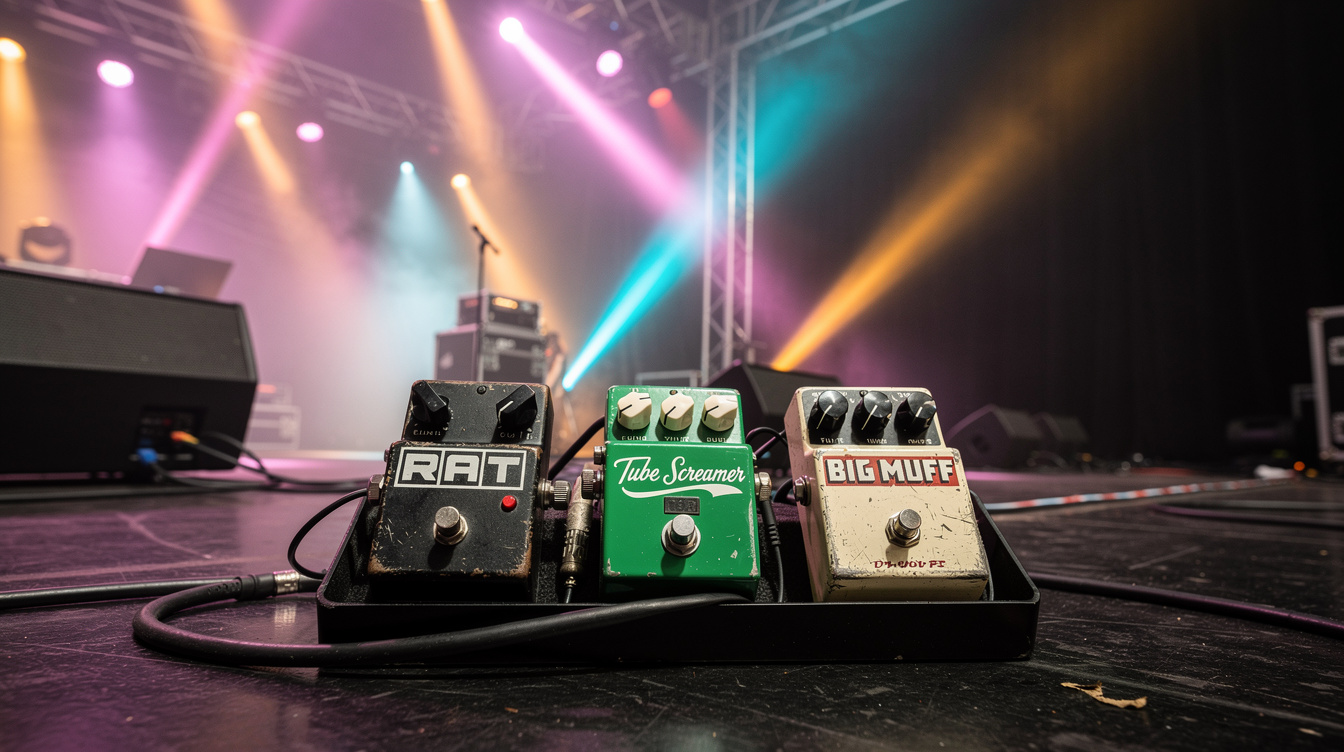
The short version: The TS808 is a mid-booster that works with your amp. The RAT is an independent distortion circuit that replaces your amp's gain stage when engaged. The Big Muff is a fuzz that obliterates the concept of controlled gain and replaces it with texture. They overlap at the edges, but they're solving three different problems.
Most shootouts compare overdrives to overdrives or fuzzes to fuzzes. This one puts three pedals in the same comparison that you'd never normally A/B: the Ibanez TS808, the ProCo RAT2, and the EHX Big Muff Pi. Different categories. Same amp. Same guitar.
Why? Because players buy one when they actually need another. And because the question "which classic distortion pedal should I get?" comes up constantly, with no editorial piece that actually sits them next to each other on identical gear.
Setup: Fender Deluxe Reverb (blackface reissue), clean, volume at 5, tone controls flat. Fender Player Jazzmaster, bridge pickup. One cable. No other effects.
The Circuit Philosophies
Before the settings: understanding how each pedal clips.
Tube Screamer (TS808): Soft-clipping op-amp overdrive. The clipping diodes in the feedback loop produce a gradual, asymmetric clip that compresses the signal before it hard-clips. The TS808 also has a fixed mid-frequency boost (centered around 720Hz) built into the filter network. This isn't a variable EQ; it's part of the circuit design. You can't turn the mid hump off.
ProCo RAT: Hard-clipping op-amp distortion. The clipping diodes are placed after the gain stage rather than in the feedback loop, producing a harder, more abrupt clip. More gain is available, and the character of the clipping is more aggressive. The Filter control is a passive tone rolloff that goes dark as you turn it clockwise (the reverse of most tone controls). More on this below.
Big Muff Pi: Two-stage transistor fuzz with clipping diodes between the stages. The Big Muff produces sustained, compressed, heavily saturated fuzz with enormous low-end and a characteristic mid-scoop. It's not trying to sound like an overdriven amp. It's its own thing.
How They Sound at Low Gain
Starting conservatively: all three at the lowest usable gain settings into the clean Deluxe Reverb.
TS808 (Drive at 8-9 o'clock, Tone at 11, Level at 2 o'clock):
This is the TS808's best trick. At very low drive, it's almost transparent; what you actually hear is the mid-frequency boost lifting the guitar's presence and the compression adding a slight sustain and warmth. It's not "clean plus some dirt." It's "your guitar, but more present and responsive."
The Deluxe Reverb at low volume came alive with the TS808 in front of it. Notes had more body. The low register didn't get muddy. The bridge pickup on the Jazzmaster (which can be harsh) sounded rounder without losing its edge.
RAT (Distortion at 8-9 o'clock, Filter at 9, Volume at 2 o'clock):
The RAT at very low Distortion does something the TS808 doesn't: it's still a distortion circuit. Even at the lowest gain setting, the clipping character is present and there's a slight texture to single notes that reads as distortion rather than overdrive compression.
Through a clean Deluxe Reverb at low gain: the RAT has a warm, slightly grainy quality. Not unpleasant; actually useful for a raw rhythm sound. But it doesn't disappear into the amp the way the TS808 does. It's always announcing itself.
Big Muff (Sustain at 7 o'clock, Tone at noon, Volume at 2 o'clock):
Low gain on a Big Muff is not really a useful setting. The circuit is designed for thick, saturated sustain. At the lowest Sustain positions, you get a flat, compressed signal that doesn't have the bloom of the TS808 or the grain of the RAT. It sounds like a gated distortion that hasn't turned on yet.
This is not what the Big Muff is for.
How They Sound at Medium Gain
TS808 (Drive at noon, Tone at noon, Level at 1 o'clock):
At medium drive, the TS808 shows its limitations. The mid-hump becomes more prominent. On a Jazzmaster with already bright single-coils, the additional mid push started to sound honky. Chords became dense in a way that wasn't quite right for clean-amp playing.
The internal structure of this pedal is optimized for the front end of a pushed amp. When you're using it in front of a genuinely clean amp at medium drive, you're hearing more of the pedal's own character and less of the amp interaction that makes it work.
Still musical. Just not its best scenario.
RAT (Distortion at noon, Filter at 10, Volume at 1 o'clock):
Medium drive on the RAT was the most versatile setting in this comparison. The clipping character at noon Distortion is aggressive enough to be a real distortion but not so saturated that single notes lose definition. Open chords had grit. Single notes sustained cleanly.
Filter at 10 o'clock (slightly open, toward bright) with a warm amp like the Deluxe Reverb is the sweet spot. The brightness balances the amp's warmth. Notes ring without becoming muddy. This setting covers blues, alternative rock, and grunge credibly.
Big Muff (Sustain at 11 o'clock, Tone at 10, Volume at 2 o'clock):
This is where the Big Muff starts to make sense. Sustain just past the halfway point: the fuzz character fills in, notes bloom and sustain with that characteristic compressed sustain, and the mid-scoop opens up the space between bass and treble in a way that sounds massive on its own.
Chords through the Big Muff at medium gain are not tight or defined; they're a texture, a smear of sound. That's the point. If you want every note to ring clearly in a chord, this is not the pedal. If you want the chord to create a wall of sound, this is exactly the pedal.
How They Sound at High Gain
TS808 (Drive at 2-3 o'clock):
The TS808 at high gain is a different pedal than the TS808 at low gain. The compression stacks, the mid-hump becomes all you hear, and the sound flattens. Notes sustain but they lose the harmonic complexity of the lower gain settings.
This is where the "Tube Screamer is for low gain" argument comes from. The pedal is genuinely less useful above noon on the Drive. That's not a flaw; it's a design constraint. Use it for what it does best.
RAT (Distortion at 2-3 o'clock, Filter at 9):
The RAT at high gain is one of the most distinctive distortion sounds in modern guitar. The hard clipping is thick and aggressive, the sustain is enormous, and the Filter at a low setting prevents the fizz that most gain pedals produce at high settings.
This is the setting that defines the RAT: the filter down (counterclockwise), the gain up. More treble, more gain; the combination is harsh on most pedals, but the RAT's filter architecture handles it. The sound is aggressive and cutting without getting thin.
Big Muff (Sustain at 3 o'clock, Tone at 9, Volume at 2 o'clock):
Maximum Sustain on the Big Muff is not more distortion. It's more compression and more fuzz character. The sound doesn't get harder; it gets smoother, more saturated, and more gated. Individual notes start to feel like they're pushing through cotton.
With Tone rolled back (toward 9 o'clock, bass-heavy) at maximum Sustain, the Big Muff becomes a doom-metal drone machine. Individual note definition is mostly gone. What you have is a sustained, textured wall.
This is either exactly what you want or completely useless depending on the song.
Where They Overlap (and Where They Don't)
| Light crunch | Rhythm rock | Lead singing | Fuzz/texture | Amp stack boost | |
|---|---|---|---|---|---|
| TS808 | ✅ Best-in-class | OK with right amp | ✅ Great | (none) | ✅ Designed for this |
| RAT | OK | ✅ Excellent | ✅ Good | Partial | Less natural |
| Big Muff | ❌ Not its territory | ✅ Wall-of-sound only | ✅ Singing sustain | ✅ Designed for this | ❌ Not compatible |
The TS808 and the RAT have real overlap in the rhythm-rock and lead territory. The Big Muff overlaps only in sustained lead sounds, and even there, the texture of the overlap is completely different (RAT is tight; Big Muff is saturated and woolly).
Which One to Buy
Get the TS808 if: You play through a high-gain amp and want a clean boost/overdrive that makes the amp respond harder. Or if you're playing blues or classic rock where mid-forward compression is the sound. The TS808 is most at home in front of a pushed amp. Through a clean amp, it's less useful than the other two.
Get the RAT if: You want one pedal that goes from light crunch to full distortion and works well through a clean amp. The RAT has the widest useful gain range of the three. It's the most versatile pedal for gigging; one knob covers the full spectrum.
Get the Big Muff if: You're playing shoegaze, doom, psych rock, or any genre where textured, sustained fuzz is the sound. The Big Muff is not a versatile pedal. It's an extremely specific tool. When it's right, nothing else sounds like it. When it's wrong, no amount of adjustment fixes it.
You can own all three. They genuinely don't overlap enough to make any of them redundant.
FAQ
Q: Is the RAT an overdrive or a distortion? A: Distortion. The circuit produces hard-clipping op-amp saturation, which classifies it as distortion rather than overdrive. Overdrives use soft-clipping configurations that interact more gently with the signal. See Overdrive vs. Distortion vs. Fuzz for the full breakdown.
Q: Can I use a Big Muff like a Tube Screamer (as a low-gain boost)? A: Not effectively. The Big Muff's circuit is designed for thick, saturated fuzz and doesn't behave like an overdrive at low Sustain settings. The compression is always present, even at low gain. If you need a boost function, the TS808 or Klon-style pedal is the right tool.
Q: Which is best for punk and rock? A: The RAT. The hard-clipping character, the wide gain range, and the filter control that lets you dial brightness independently make it the most useful for driving rhythms and leads in punk and rock contexts. The BD-2 is a close second. The TS808 is less at home in high-gain rock unless you're running it in front of a cranked amp.
Q: Do these all work on a modeler? A: Yes. The Helix, Quad Cortex, and HX Stomp all have models of all three circuits. The Scream 808 (TS808), the PLACATER (RAT), and the Muff variants are all included in Helix. Start with the settings from this guide and adjust for your amp model.
Q: Is there a "best" one for recording? A: Depends on what you're recording. For tight rhythm work that sits in a dense mix, the RAT or TS808 into a pushed amp. For ambient, shoegaze, or layered texture work, the Big Muff. The Big Muff's mid-scoop can actually be useful in a mix; it leaves space for other instruments in the 500-1kHz range.