The Rules: $500, Used Market, Complete Rig
Five hundred dollars. Used gear only. Everything you need to walk into a venue and play a set. No borrowing cables from the other band. No "just add an amp" asterisks. The budget covers the whole rig or the build doesn't count.
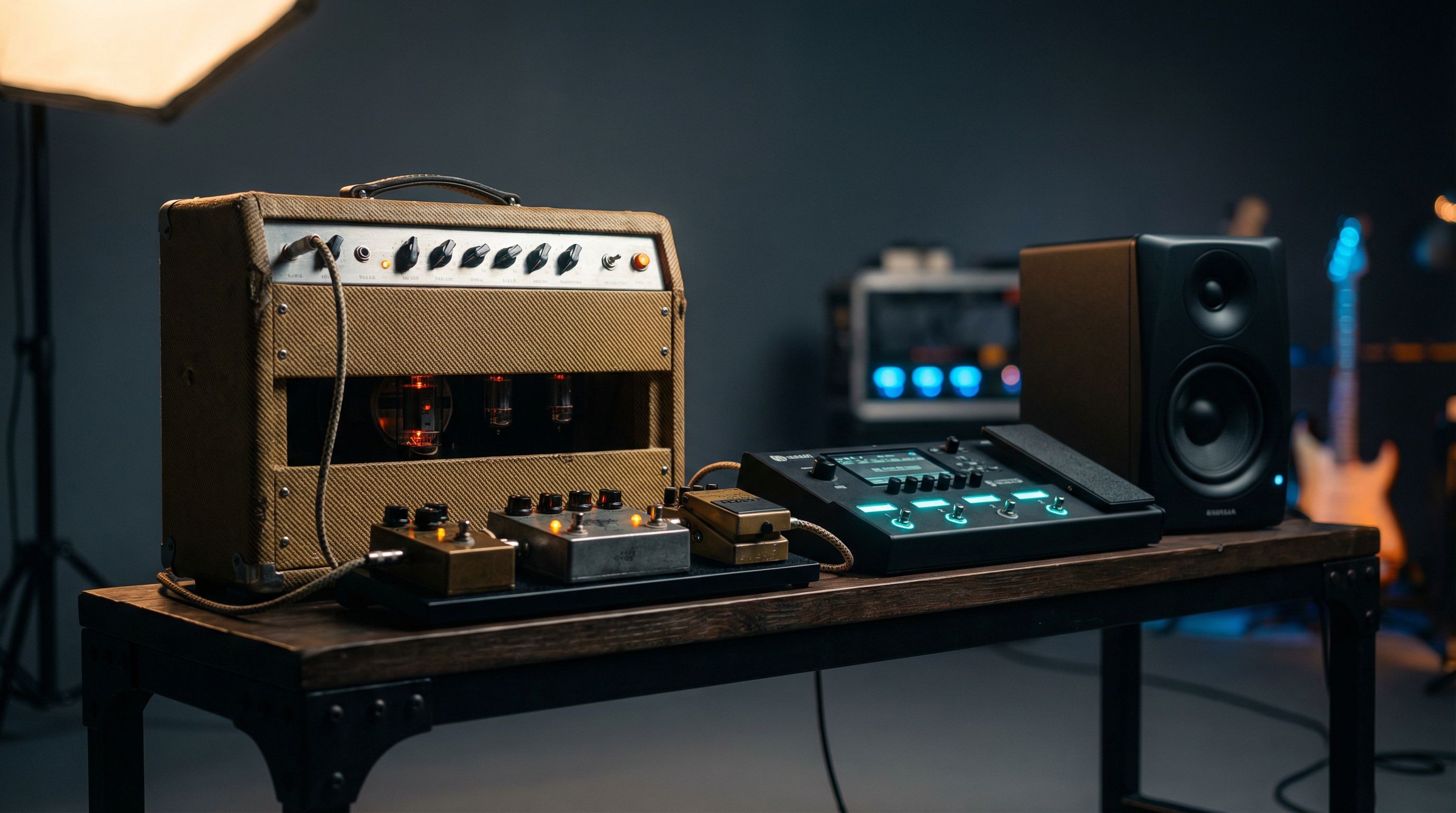
Two builds. Two completely different ideas about what a guitar rig should be. One spends the bulk of the budget on a digital modeler and skips the amp entirely. The other spends it on a guitar and a tube amp and calls it done. Both use real used-market prices from Reverb and Facebook Marketplace as of March 2026. Both have been gigged.
The only thing these builds agree on is the budget.
The Digital Route
Here's what $500 buys when you decide an amp is optional: everything else.
The centerpiece is the HX Stomp. At $270-300 used (they've finally dropped below $300 consistently -- patience pays off), it replaces the amp, the pedalboard, the cables between pedals, and most of the load-in. It IS the rig. Amp models, cab IRs, drive, delay, reverb, compression, noise gate -- six blocks handles more than enough for a full set. The same DSP engine as the $1,700 Helix Floor, just fewer blocks and fewer switches.
The Build
- Guitar: Squier Classic Vibe Telecaster -- $200 used. The alnico pickups and rolled fretboard edges make this feel like a $450 guitar because it was a $450 guitar. The Telecaster bridge pickup cuts through everything, and the neck pickup cleans up for jazz-adjacent stuff (not that I play jazz, but it's there if you need it).
- Modeler: Line 6 HX Stomp -- $280 used. Set alerts on Reverb and wait. They dip to $250 on local marketplaces when someone's upgrading to a Quad Cortex.
- Cables and accessories -- $20. One instrument cable (guitar to Stomp), one XLR (Stomp to PA). The Stomp has a built-in tuner, so skip the clip-on. Picks and a spare set of strings.
Total: $500
The math is tight. Intentionally. Every dollar that doesn't go to the HX Stomp or the guitar is a dollar that doesn't improve the sound.
The Preset That Covers 90% of a Set
One preset. Three snapshots. That's the gig.
Snapshot 1 -- Clean: Cali Texas Ch1 (the Fender model) with gain at about 3, bass at 5, mid at 6, treble around 5.5. A touch of room reverb after the cab block -- decay around 1.5 seconds, mix at about 20%. This is the verse tone, the intro tone, the "the singer is talking between songs" tone.
Snapshot 2 -- Crunch: Same amp model, gain pushed to about 5.5. A Minotaur drive (the Klon model) in front with gain at around 10 o'clock, level at about 1 o'clock. The drive adds midrange push without turning it into a different amp. Swap the room reverb for a digital delay at 380ms, two repeats, mix at 15%.
Snapshot 3 -- Lead: Minotaur drive still on, gain bumped to noon. Add a second drive block -- the Heir Apparent (a Nobles ODR-1 model) stacked in front of the Minotaur. That's six blocks total: two drives, amp, cab IR, delay, reverb. Every block accounted for, nothing wasted.
The surprised discovery: I expected the Cali Texas model to sound thin running direct to a PA without a real speaker pushing air. It doesn't. With the 4x10 cab IR and the high-cut rolled down to about 8kHz, the XLR output sounds full enough that the sound engineer at my last gig asked what amp I was running. When I showed him the Stomp in my back pocket, he laughed. Then he told me the mix was the easiest guitar sound he'd dealt with all night.
Why This Build Works
Load-in takes one trip. Guitar on your back, Stomp and cables in a messenger bag. Soundcheck takes two minutes -- plug the XLR into the snake, tune up, confirm the sound engineer has signal. The PA does the heavy lifting, which means consistent sound every night regardless of room size, stage position, or how loud the drummer plays.
For deeper modeler setup, the same approach from our guide to dialing in modeler tone applies directly here -- start with the amp model flat, get that right, then add effects one at a time.
The versatility per dollar is absurd. Three snapshots cover clean, crunch, and lead. But the same Stomp can load a completely different preset for the acoustic gig on Sunday, the worship set on Wednesday, or the weird shoegaze project your roommate roped you into. One piece of gear, infinite rigs. That's the pitch, and for $280 used, it delivers.
The Analog Route
A guitar, an amp, one cable. Maybe a pedal if the song asks for it.
The Build
- Guitar: Used Fender MIM Telecaster -- $350 is what they cost now. A 2015-2020 Player Series or Standard shows up on Reverb every week. The pickups are better than they need to be. The neck feels right. Twenty minutes of playing one tells you everything.
- Amp: Fender Champion 20 -- $75 used. Solid state. Twenty watts. Light enough to carry with one hand.
- Cable: Hosa Pro -- $12. Won't crackle. Won't fail.
- Tuner, picks, strings -- $15.
Total: $452
Forty-eight dollars left over. Keep it. Or put it toward a setup at a local shop. A properly set up guitar is worth more than any pedal.
Why Not a Tube Amp
A Blues Junior goes for $350 used. That's the whole budget before the guitar. A used Bugera V5 or Monoprice Stage Right runs $80-100, but the Champion 20 at $75 does the job without tubes to worry about. Twenty watts is enough for any room with a PA. And at this budget, reliability matters more than headroom.
The Champion 20 is not the best-sounding amp. But it takes the guitar's signal and makes it louder without adding things the song doesn't need. Plug in, set the volume, play. The Telecaster does the rest.
Settings
Volume: about 10 o'clock for practice. About 1 o'clock for a small room. The Champion's voice knob stays at noon. The tone knob on the guitar does the work.
Bridge pickup for anything that needs to cut. Neck pickup for anything that needs to sit back. Volume knob on the guitar rolled to about 7 for clean, full up for when the song gets loud. That's the entire pedalboard -- the volume knob.
I expected this to feel limiting. Playing through a $75 solid-state amp with nothing between the guitar and the speaker. What I found was the opposite. There's nowhere to hide. Every note is yours -- the attack, the dynamics, the mistakes. Roll the volume back on the Telecaster and the clean sound has this glassy clarity where you hear the pick hitting the string and the note blooming a half-second later. It made me play better because it made me listen harder.
The Optional Pedal
If you have the $48 left over, an Ibanez TS9 Tube Screamer goes for $40-50 used. Not for distortion. For a midrange push on the solo. Gain at about 9 o'clock. Level at about 2 o'clock. Tone at noon. It makes the Telecaster bridge pickup sound like it's leaning forward. One stomp and you're in front of the mix. One stomp and you're back.
That's the same Tube Screamer approach that works with amps ten times the price. Low gain, high level. The circuit doesn't care what amp it's pushing.
The Signal Chains
Digital Route
Squier Classic Vibe Telecaster --> HX Stomp (Minotaur drive --> Heir Apparent drive --> Cali Texas Ch1 amp model --> 4x10 cab IR --> Digital Delay --> Room Reverb) --> XLR out to PA
Analog Route
Fender MIM Telecaster --> Hosa Pro cable --> Fender Champion 20
With optional Tube Screamer:
Fender MIM Telecaster --> Ibanez TS9 --> Fender Champion 20
The difference in complexity is the whole point. One rig has six processing blocks inside a single unit. The other has zero. Both fill a room. Understanding where effects belong in any chain matters either way -- even if one of these chains has nothing to put in order.
What Each Rig Can't Do
Honesty about limitations matters more than enthusiasm about strengths.
The Digital Rig's Gaps
No amp on stage means no air moving behind you. Playing direct into a PA, the guitar comes from the house speakers and the monitors. For some stages, that's fine. For others, it feels like playing along to a recording of yourself. The disconnect between what your hands do and where the sound comes from takes getting used to, and some players never get used to it.
The HX Stomp has six blocks. That's enough for most things but not all things. Running two amp models simultaneously (for stereo or for switching mid-song) eats four blocks minimum -- amp, cab, amp, cab -- leaving two for everything else. Complex routing is possible but cramped. If the set needs fifteen different sounds with smooth transitions between all of them, the Stomp's three footswitches start to feel like a bottleneck.
And the learning curve is real. The Stomp's interface is well-designed, but it's still a screen, menus, and parameter lists. Building a preset from scratch takes longer than plugging into an amp and turning the knobs. If tweaking settings between songs feels like work instead of playing, that friction adds up.
The Analog Rig's Gaps
No effects. Period. No delay, no reverb, no modulation. The Champion 20 has a built-in voice switch and a basic reverb circuit, but calling either of those "effects" is generous. If the gig calls for a dotted-eighth delay or a deep hall reverb, this rig can't do it.
One sound. The Telecaster's volume and tone knobs and two pickup positions give you maybe four variations of the same fundamental voice. That's the palette. For country, blues, rockabilly, and stripped-down rock, four variations is plenty. For anything that requires significant tonal shifts within a set, it's not enough.
Volume control happens at the amp, and at 20 watts through a small speaker, there's a ceiling. The Champion 20 through a PA monitor send works, but it's adding a step and relying on the venue's system. In a room without a PA, this amp fills a coffee shop. It does not fill a 200-cap club.
Which One Is Right for You
Not "which is better." Which is right for you. Different question.
Build the Digital Rig If:
- You play different styles across different gigs. The HX Stomp can be a Fender one night, a Marshall the next, and a high-gain modern amp the night after. If your calendar has a worship set, a cover band, and an original project in the same week, versatility is worth the trade-offs.
- You value fast load-in and consistent sound. Guitar and a messenger bag. Same tone every night regardless of the room. If you play four shows a week, every minute of load-in and soundcheck you save adds up to hours per month.
- You're comfortable with a screen. The HX Stomp rewards people who enjoy dialing in sounds. If building a preset from scratch sounds fun rather than tedious, this rig will keep you busy for years.
Build the Analog Rig If:
- You play one style and play it well. Country. Blues. Roots rock. Anything where the guitar sounds like a guitar and the player does the talking. If your right hand is the most important effect on your board, this rig gets out of the way and lets that show.
- You want to play, not program. Plug in. Turn up. No menus. The time between opening the case and making music is about thirty seconds. If you pick up the guitar to play and not to tinker, nothing beats a cable and an amp.
- You'd rather spend money on a better guitar. This build puts $350 into the instrument and $75 into the amp. The one you spend eight hours practicing gets the investment. The thing that makes it louder gets what's left.
The Third Option
Build both. Not at the same time -- that's a $1,000 problem. But the Telecaster works with either rig. Start with the analog build. Play it for six months. If you find yourself wanting more sounds, sell the Champion 20 for $60 and put that toward an HX Stomp. The guitar transfers. The skills transfer. The cable transfers.
Or start with the digital build. Play it for six months. If you find yourself wishing you could just plug in and play without thinking about presets, pick up a cheap amp. The Stomp stays for recording. The amp stays for the gigs where simplicity wins.
The budget is the constraint. The philosophy is the choice. Five hundred dollars builds a rig that works either way. The question isn't what sounds better at this price. The question is what makes you want to pick up the guitar.
That's the only question that ever mattered.