Skip to content
Fader & Knob
Signal Chain

3 Signal Chains Every Beginner Guitarist Should Know

You don't need 20 pedals. These 3 simple signal chains cover 90% of the tones you'll ever need.

Fader & Knob||6 min read
beginnersignal-chaingetting-started

You Don't Need a Giant Pedalboard

Scroll through any guitar forum or Instagram feed and you'll see pedalboards with 15, 20, sometimes 30 pedals. It's intimidating. It also gives beginners the wrong impression that you need a wall of effects to sound good.

You don't. The vast majority of guitar tones in recorded music come from simple signal chains with three to five elements. Master these three chains first, and you'll have the foundation to cover nearly any musical situation — from a quiet jazz gig to a full-volume rock show.

Each chain below works with real pedals or modeler blocks. The principles are identical either way.

Chain 1: The Clean Machine

Guitar → Compressor → Amp (clean) → Reverb

This is your foundational clean tone. Country, jazz, R&B, pop, worship, funk — any style that needs a clear, articulate guitar sound starts here.

Why This Order

The compressor goes first because it evens out your picking dynamics before the signal hits the amp. Quiet notes come up, loud notes come down. The result is a polished, consistent clean sound where every note in a chord rings out at a similar volume.

The amp is set clean — no breakup, no crunch. It's just providing volume and its natural EQ character. A Fender-style clean, a Vox clean, whatever flavor you prefer.

Reverb goes last because it adds space and dimension to the already-clean signal. Reverb before the amp would work too (the amp is clean, so order is less critical here), but placing it after ensures the cleanest, most defined reverb tail.

What Each Effect Does

  • Compressor: Squeezes your dynamic range. Notes sustain longer, picking sounds more even. Set it subtly — you shouldn't hear it working, just feel the consistency. Think of it as invisible polish.
  • Reverb: Simulates the sound of a room, hall, or plate. Without reverb, clean guitar sounds dry and lifeless in most contexts. A short room reverb works for funk and country; a longer hall reverb works for ambient and worship.

Try It On

John Mayer's clean arpeggiated parts use exactly this approach — a compressed Fender clean with a touch of reverb. Simple, effective, and endlessly versatile.

Chain 2: The Crunch Machine

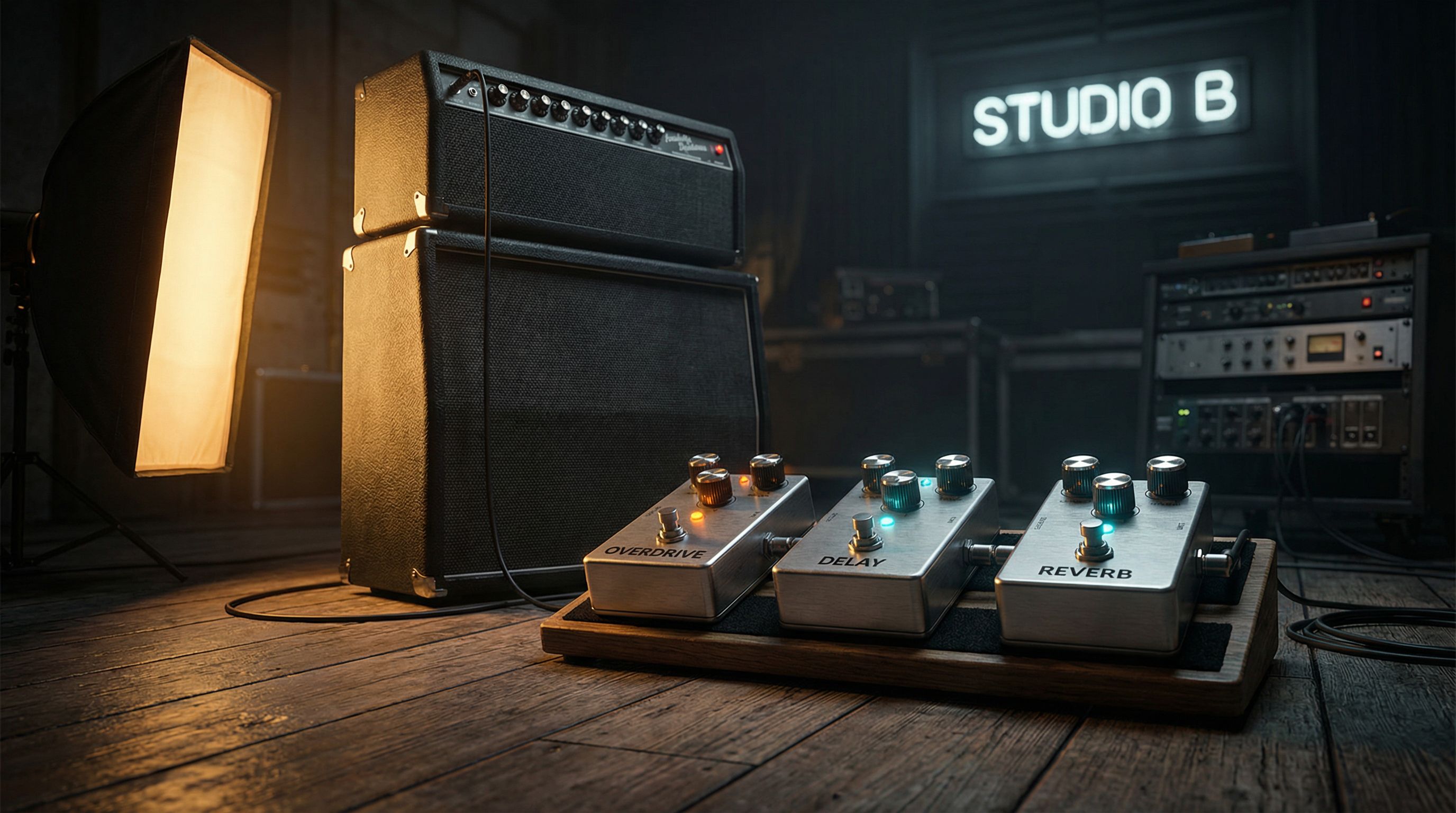
Guitar → Overdrive → Amp (edge of breakup) → Delay → Reverb

This is the workhorse chain for blues, classic rock, indie, and any style where you want a warm, crunchy tone that responds to your picking dynamics.

Why This Order

The overdrive goes before the amp because it's designed to push the amp's front end harder. An overdrive pedal adds harmonic content and a midrange push to your signal, which makes the amp break up more musically. Think of it as turning your amp up louder without actually turning the volume knob.

Delay comes after the amp because you want the delay to repeat the distorted signal cleanly. If you put delay before the overdrive, each repeat would get distorted individually, creating a mushy, undefined mess. Delay after dirt keeps repeats clear and rhythmic.

Reverb goes last, after the delay. This places the entire signal — dry guitar plus delay repeats — into a reverberant space. It sounds natural, like a band playing in a room.

What Each Effect Does

  • Overdrive: Adds warm, natural-sounding distortion that responds to your pick attack. Pick lightly and it cleans up. Dig in and it crunches. This dynamic response is what separates overdrive from distortion.
  • Delay: Repeats your signal after a set time interval. A single repeat (one "slapback" echo) at 100-200ms adds depth and width. Multiple repeats at longer times create rhythmic patterns. Start with 2-3 repeats at 350ms for a versatile rock delay.
  • Reverb: Same as Chain 1, but now it's adding space to a dirtier signal. Use less reverb here than on a clean tone — too much reverb with overdrive gets washy fast.

Try It On

This is the chain behind countless rock songs. Keith Richards, Angus Young, Gary Clark Jr. — the details differ, but the structure is the same: drive into amp, time effects after.

Chain 3: The High-Gain Machine

Guitar → Noise Gate → Distortion → Amp (high gain) → Delay → Reverb

This is your metal, hard rock, and heavy tone chain. Tight, aggressive, and defined even at extreme gain levels.

Why This Order

The noise gate goes first — before the distortion — because high-gain tones amplify everything, including noise. A gate at the front of the chain silences your signal when you stop playing, eliminating the hiss and buzz that comes with extreme gain settings. Without it, every pause between riffs fills with unwanted noise.

Distortion goes before the amp and adds heavily clipped, saturated gain. Unlike the overdrive in Chain 2, distortion reshapes the signal aggressively. Some players use the amp's own high-gain channel instead of a distortion pedal, or they stack both for even more saturation.

Delay and reverb follow the same logic as Chain 2 — after the gain stage, to keep repeats and reverb tails clean and articulate. For high-gain tones, use shorter delay times and lower mix levels. A subtle delay adds depth without muddying the tone. Same for reverb — a short, low-mix room reverb gives life to the sound without drowning it.

What Each Effect Does

  • Noise Gate: Cuts your signal below a threshold you set. When you're playing, the gate is open and the signal passes through. When you stop, the gate closes and silence. Essential for high-gain tones. Set the threshold high enough to kill noise but low enough that your sustain doesn't get chopped off.
  • Distortion: Heavy, saturated clipping with lots of sustain. Unlike overdrive, distortion doesn't clean up much when you back off your volume. It's always aggressive.

Try It On

Metallica, Foo Fighters, Architects — any modern heavy tone uses this structure. The specific gain level and EQ change, but the chain architecture stays the same: gate, dirt, amp, time effects.

The Common Thread

Notice the pattern across all three chains: gain-shaping effects go before the amp, time-based effects go after it. This is the fundamental rule of signal chain order, and it applies whether you're running three pedals or thirty.

Once you're comfortable with these three chains, you can start experimenting. Add a wah before the overdrive in Chain 2. Put a chorus between the amp and the delay. Stack two overdrives. But build from these foundations first. A simple chain that you understand will always sound better than a complicated one that you don't.

Key Terms

Signal Chain
The path your guitar signal travels from pickup to speaker. Every pedal, amp, and effect in the chain processes the signal in sequence.
Effects Loop
An insert point between an amp's preamp and power amp stages. Allows time-based and modulation effects to process the signal after distortion for cleaner results.
Gain Staging
The practice of managing signal levels between each stage of the chain to avoid unwanted noise or clipping while maintaining optimal tone.
Preamp
The first amplification stage in a guitar amp. Shapes the tone and adds gain/distortion before the signal reaches the power amp.
Power Amp
The final amplification stage that drives the speaker. Adds its own coloration, compression, and saturation at high volumes (power amp distortion).
Headroom
The amount of clean volume an amp or pedal can produce before it starts to distort. More headroom means a louder clean tone before breakup.
Tone Stack
The EQ circuit in an amplifier (bass, mid, treble controls). Different amp designs place the tone stack at different points in the circuit, affecting how EQ interacts with gain.
Overdrive
A mild form of distortion that simulates a tube amp being pushed past its clean headroom. Adds warmth, sustain, and harmonic richness.

Related Posts