Move a speaker toward a wall and its low end gets louder. Not "kind of," not "if you listen hard" — measurably, several decibels, in the exact frequency range where a guitar starts to sound boomy. Most of us learn this by accident: the cab sounded fine in the middle of the room, you tucked it into the corner to get it out of the way, and suddenly the bottom turned to mush. That's the boundary effect, and once you understand it, room placement stops being where the cab happens to fit and becomes another knob you get to turn.
What's Actually Happening
A speaker radiates sound in every direction, including down and backward. When the cab sits out in free space, those low frequencies just keep going. Put a hard surface nearby — a floor, a wall — and the energy heading that way reflects back toward the room. Because low frequencies have long wavelengths, those reflections arrive close enough in time to the direct sound that they line up in phase and add to it. More surfaces, more reinforcement.
Acousticians describe this in "spaces." Out in the open, a speaker radiates into full space. One boundary nearby (just the floor, say) cuts that to half space, and the lows get roughly 3 dB louder. Two boundaries — floor and a wall — is quarter space, louder still. A corner, where two walls and the floor all reinforce at once, is eighth space, and it's the single boomiest spot in any room. None of this touches the highs; their wavelengths are too short for the reflection to stack the same way. So the effect isn't "louder," it's "louder and darker, from the bottom up."
For a guitar cab the affected region sits very roughly between 60 and 200 Hz, depending on the cab and the room. That's the warmth band — and also where palm mutes get their chunk and where boom lives. Push it and a clean chord gains a lovely thickness. Push it too far and the low-mids swell into a one-note hump that swallows pick attack and turns tight muting into porridge.
Why Some Cabs Care More Than Others
Here's the part the speaker-spec sheets don't tell you: not every cab reacts to the wall the same way.
| Cab type | Sensitivity to wall distance | Why |
|---|---|---|
| Open-back combo or cab | High | Radiates significant energy out the back, straight at the wall |
| Rear-ported cab | High | The vent fires low frequencies rearward through the port |
| Sealed, front-firing cab | Low | Energy leaves the front; the wall only couples to its general low end |
| Front-ported cab | Low–moderate | Port fires into the room, not the wall |
An open-back cab is essentially aiming a chunk of its low end at whatever is behind it. Slide it toward the wall and you're changing how that rearward energy folds back into the room — the tone shifts a lot, and not subtly. A rear-ported cab does the same thing through its vent. This is the same wall-distance behavior that makes a ported vs. sealed cab decision matter in the first place, and it's why the open-back vs. closed-back question is really also a placement question. A sealed, front-firing 4x12 is the steady one in the room: it still gains some bottom near a wall, but it sounds recognizably like itself wherever you put it.
So the practical read: if your cab is sealed and front-firing, placement is a gentle trim. If it's open-back or rear-ported, placement is a major tone control, and leaving it jammed against a wall by default is leaving a big EQ move on the table without deciding to.
Placement as a Tone Control
Stop thinking about distance from the wall as logistics and start thinking about it as a sweep.
- Against the wall / in a corner: maximum low end and warmth. Useful when you want a small cab to sound bigger, or a thin clean to gain body. Risky for high-gain — the boom collides with low-tuned palm mutes.
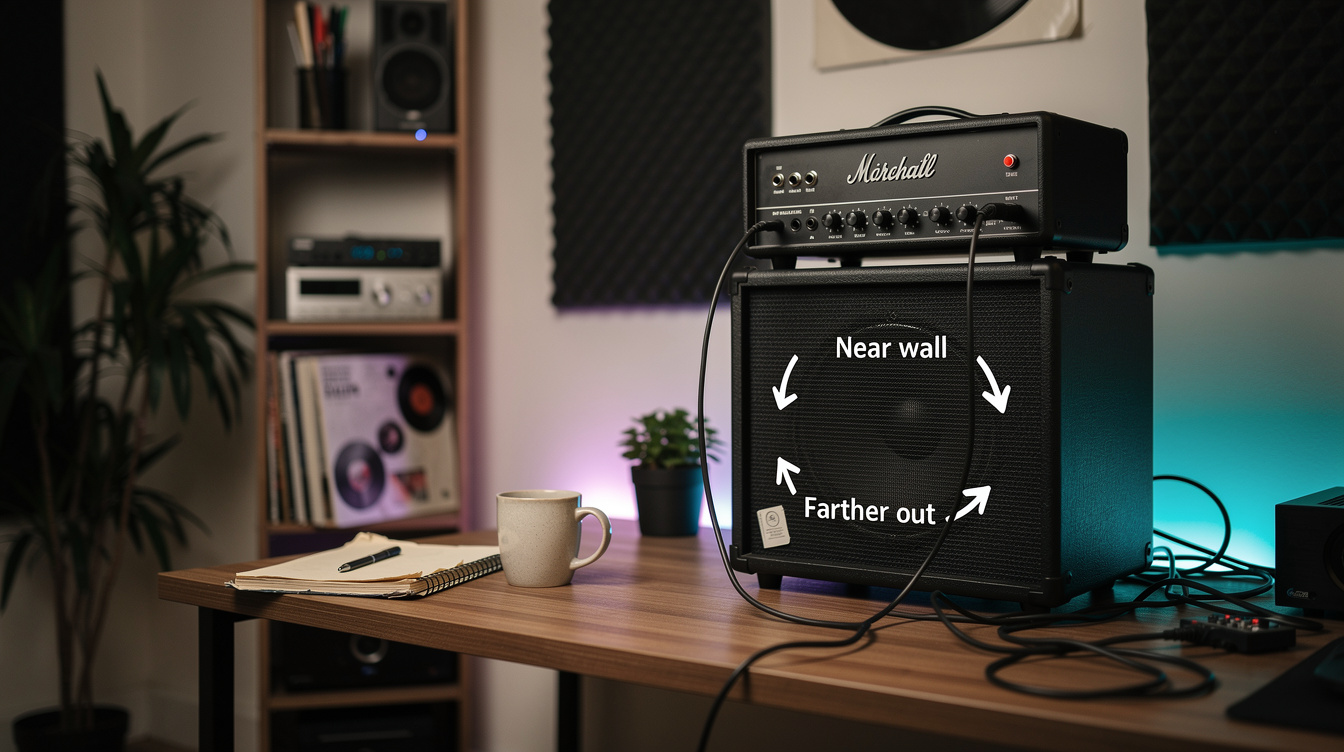
- A foot or more off the wall: the low-mid hump relaxes, the attack tightens, notes separate. This is usually the sweet spot for anything with gain or anything you want to stay articulate.
- Out in the room, away from every surface: the leanest, most neutral version of the cab. Sometimes too lean on its own — but it's the honest baseline before the room adds its color.
The test takes thirty seconds: play a low palm-muted riff, slide the cab from the wall out to a foot or two, and listen to the bottom tighten as you go. You're not imagining a difference; you're hearing the boundary let go of the lows.
The Part I Didn't Think Applied to Me
I came at this assuming it was a problem for people with real amps. I record everything in the box — plugins, impulse responses, headphones, no cab pushing air at anyone. Boundary loading sounded like physical-world trivia, the kind of thing that matters if you stand in front of a 4x12 in a band room and irrelevant if your whole rig fits in a backpack.
Then I tracked a friend's actual cab for an afternoon, set it in the corner of my room because that's where there was floor space, and spent an hour fighting a low-mid boom on the recording that no plugin EQ could fully clean up without hollowing the tone. The room had stamped itself onto the signal before the mic ever heard it. And once I noticed the mechanism, I started hearing it everywhere — including in the room my monitors live in. My desk was against a wall, the monitors a few inches off it, and they were quietly hyping the same 80-to-120 Hz region every cab does near a boundary, which meant I'd been mixing the bass light to compensate without knowing it. The boundary effect doesn't care whether you push air with a tube amp or listen on headphones-adjacent near-fields. It gets you at whatever point real speakers meet a real room. For me that point was the mix, not the stage — but it was there the whole time.
That changed how I think about room and IR decisions generally. The IR captures a cab in a room; the second you play it back through speakers in your room, your boundaries add a second layer on top. You can't escape the room. You can only decide where the speaker stands in it.
What To Do About It
If you play a real cab in a real room: don't default to the wall. Pull it out a foot, play, and let your ears pick the distance the way you'd pick a tone-knob setting. Corner-load on purpose when you want a small rig to feel huge; pull it forward when you need palm mutes to stay tight.
If you mic a cab: place it for tone before you place the mic, and get it off the walls unless the boom is the sound you want. EQ after the fact can shave a buildup, but it can't un-smear the room's reflections, so a cleaner source always wins.
If you're FRFR or full-range: the wall is only half the story — the floor is the other boundary, and how high and how tilted the cab sits changes the lows just as much. That side lives in the FRFR cab placement guide, and between the two you've got both surfaces covered.
And if you're entirely in the box, like me: the cab in your IR already has its room baked in, but the speakers you're listening on don't — so treat your monitor placement with the same respect you'd give a cab, because it's doing the exact same thing to your low end. Wherever the air actually moves, the boundary is there, waiting to add bass you didn't ask for. Decide where the speaker stands, and you've decided how much.