You Have Already Decided on Line 6. Now Pick the Right Box.
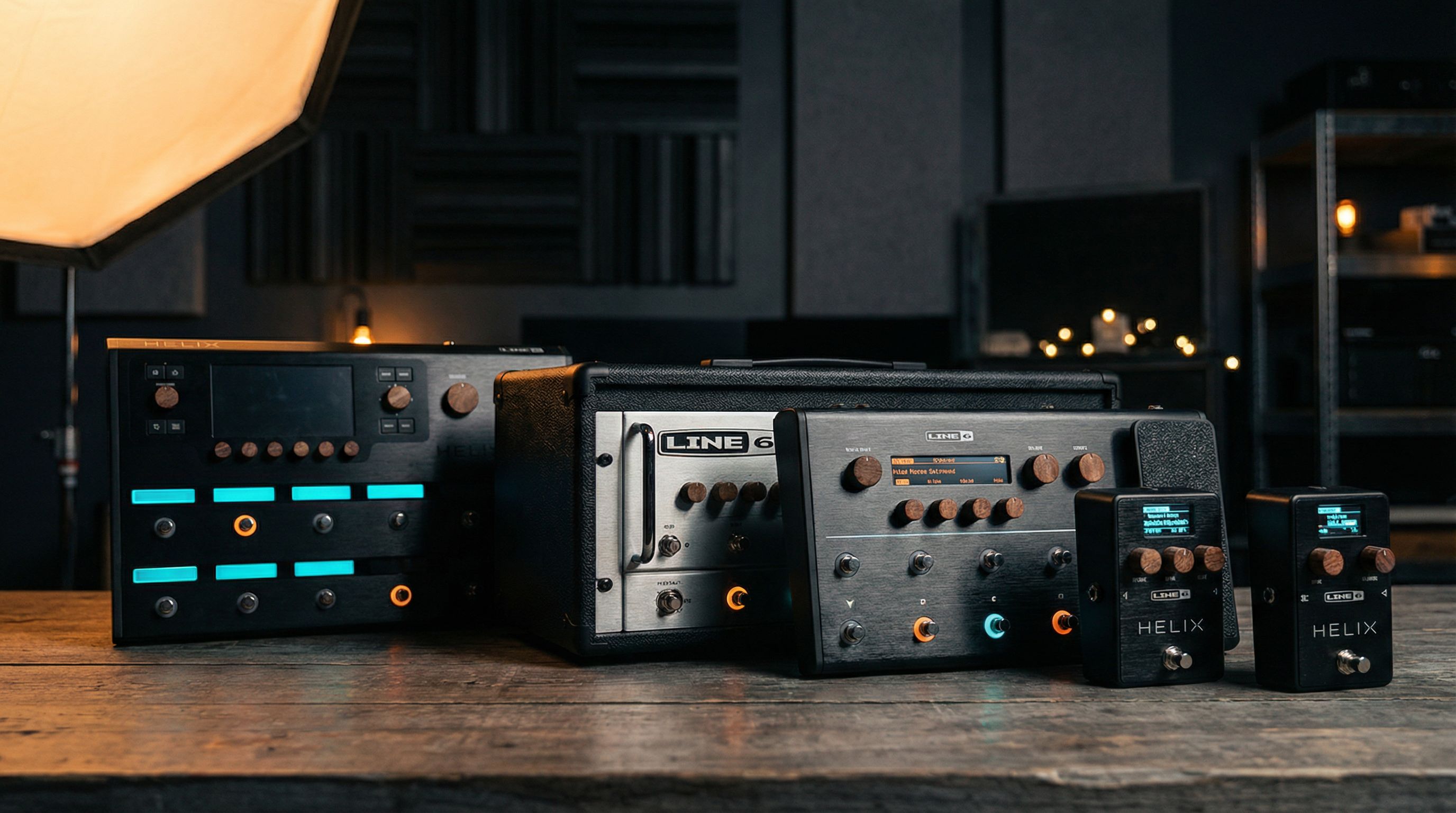
Line 6 currently sells eight hardware modelers under the Helix and HX umbrella. They all run the same amp models, the same effects, and the same firmware. A preset built on a Helix Floor can load on an HX Stomp. A tone dialed in on a POD Go transfers to a Helix Stadium. The modeling engine is the platform. The hardware is the delivery mechanism.
That shared DNA is what makes this decision tricky. You are not choosing between good and bad modeling. You are choosing how much DSP power, how many inputs and outputs, how many footswitches, and how large a form factor you actually need. Overshoot and you are carrying extra weight and spending extra money. Undershoot and you hit the DSP ceiling mid-gig when you try to add one more reverb block.
Here is how every current model compares, and a framework for choosing the right one.
The Full Lineup at a Glance
Before the details, the overview. This table covers the specs that actually affect your decision.
| Model | DSP | Blocks per Preset | Footswitches | Screen | Send/Return Loops | Variax Input | Street Price (USD) |
|---|---|---|---|---|---|---|---|
| Helix Floor | 2x SHARC | 32 (dual path) | 12 + toe switch | 6.2" color LCD | 4 mono / 2 stereo | Yes | ~$1,700 |
| Helix LT | 2x SHARC | 32 (dual path) | 12 + toe switch | 6.2" color LCD | 2 mono / 1 stereo | No | ~$1,300 |
| Helix Stadium | Agoura engine | 32 (dual path) | 16 + toe switch | 7" color touchscreen | 4 mono / 2 stereo | Yes | ~$2,200 |
| HX Stomp | 1x SHARC | 8 | 3 | 3.2" color LCD | 1 mono / 0.5 stereo | No | ~$650 |
| HX Stomp XL | 1x SHARC | 8 | 8 + toe switch | 3.2" color LCD | 2 mono / 1 stereo | No | ~$900 |
| HX Effects | 1x SHARC | 9 (effects only) | 8 + toe switch | 3.2" color LCD | 2 mono / 1 stereo | No | ~$600 |
| HX One | Dedicated | 1 effect at a time | 1 + tap | Small LCD | 0 | No | ~$250 |
| POD Go | 1x SHARC (reduced) | 6-7 | 6 + toe switch | 4.3" color LCD | 1 mono | No | ~$450 |
A few things stand out immediately. DSP determines your ceiling. Form factor determines your floor space. Everything else (footswitches, I/O, Variax support) is about workflow optimization.
DSP: The Spec That Actually Limits You
Every amp model, effect block, cab sim, and EQ you add to a preset consumes DSP. Run out of DSP and you cannot add anything else, even if you have empty block slots remaining.
The dual-SHARC models (Helix Floor, Helix LT, and their rack counterparts) give you two independent DSP chips, each running one of the two signal paths. You get 32 block positions across two paths, and in practice, you can run complex chains (dual amp setups, parallel effects, wet/dry/wet routing) without hitting the ceiling. Most players never max out dual-SHARC processing.
The single-SHARC models (HX Stomp, HX Stomp XL, HX Effects, POD Go) have half the processing power. The HX Stomp limits you to 8 blocks. That sounds restrictive, but consider what 8 blocks buys you: a noise gate, a drive, an amp, a cab, a modulation, a delay, a reverb, and a volume pedal. That covers the majority of real-world signal chains. You feel the limitation when you want dual amps, parallel routing, or stacking multiple effects of the same type.
The Helix Stadium runs Line 6's next-generation Agoura engine, which replaces the SHARC architecture entirely. More processing headroom, faster block loading, and room for future models that demand more computation than SHARC can deliver. The Stadium is the first hardware to use this engine. For players looking at what the firmware roadmap holds, Agoura is the foundation everything will be built on going forward.
The HX One is a different category. One effect at a time. No amp modeling. It is a single stompbox that happens to contain every HX effect in the library. DSP limits do not apply in the traditional sense because you are only ever running one algorithm.
I/O: When Connections Matter
If you are plugging a guitar in and running to a powered speaker or front of house, even the HX Stomp has everything you need. I/O complexity matters when you integrate with other gear.
Send/return loops let you insert external pedals into the modeler's signal chain. The Helix Floor and Stadium have four mono loops (two stereo pairs), enough to integrate several analog pedals exactly where you want them in the chain. The LT has two mono loops. The HX Stomp has one. If you plan to build a hybrid rig combining the modeler with external pedals through the effects loop, count your loops before you buy.
Variax input is a VDI (Variax Digital Interface) connection that powers and communicates with Line 6 Variax guitars. Only the Helix Floor and Helix Stadium have it. If you use a Variax and want per-preset guitar model and tuning changes, this narrows your options to two.
XLR outputs are standard on the Floor, LT, Stadium, and POD Go. The HX Stomp and HX Stomp XL lack XLR outs; you will need a DI box or adapter for balanced connections to a PA or audio interface with XLR-only inputs.
MIDI is available on the Floor, LT, Stadium, HX Stomp XL, and HX Effects. The standard HX Stomp has MIDI via its TRS jacks (with an adapter). The HX One and POD Go do not have MIDI.
Footswitches and Live Control
For home and studio use, footswitch count is irrelevant; you are using HX Edit or the screen. For live performance, it determines how you navigate your rig without bending down.
The Helix Floor and LT give you 12 capacitive-touch footswitches plus an expression pedal with toe switch. Scribble strips above each switch show the assigned function. You can switch presets, toggle individual blocks, control snapshots, and access the looper without menus.
The Helix Stadium raises this to 16 footswitches with the same capacitive-touch and scribble-strip design, plus a touchscreen for visual feedback. It is the most controllable unit in the lineup for complex live rigs.
The HX Stomp XL gives you 8 footswitches and an expression pedal input, a significant step up from the standard HX Stomp's 3 switches. If you play live with an HX Stomp, you will quickly learn that 3 switches require creative mapping and a lot of stomping modes. Adding an external MIDI controller solves this, but the XL removes the need.
The POD Go offers 6 switches and a built-in expression pedal. Adequate for straightforward preset switching and a few block toggles.
The HX One has one footswitch. It is a stompbox. You step on it to activate the effect.
The Decision Framework
Specs are useful. Context is better. Here is how the models map to real-world use cases.
Bedroom Player on a Budget
Best options: HX Stomp or POD Go
Both give you amp modeling, cab simulation, and effects in a compact format at the lowest price points in the lineup. The POD Go is more self-contained: built-in expression pedal, simple layout, enough footswitches to be usable standalone. The HX Stomp is smaller and more flexible but benefits from an external expression pedal and controller for full functionality.
If you are recording into a DAW, the HX Stomp's smaller footprint and USB audio interface make it ideal on a desk. If you want something you can plug in and play immediately with minimal setup, the POD Go is ready out of the box.
For the budget-conscious, our $500 gigging rig guide shows how far you can stretch an affordable modeler setup.
Gigging Guitarist Replacing a Pedalboard
Best options: Helix LT or HX Stomp XL
The Helix LT gives you dual-path DSP, 12 footswitches, and enough I/O to handle most live scenarios. It is the workhorse of the lineup, the model most working guitarists land on because it delivers 90% of the Helix Floor's capability at a lower price and weight. You lose two effects loops and the Variax input compared to the Floor. For most players, those omissions are irrelevant.
The HX Stomp XL suits players who want a smaller footprint or plan to combine the modeler with external pedals rather than replacing them entirely. Eight footswitches provide enough live control for preset and snapshot switching. Single-SHARC DSP means simpler chains, but if your needs are one amp, a few effects, and reliable switching, the XL handles it.
If you are building a pedalboard around the XL, the two send/return loops let you integrate your favorite analog pedals while the modeler handles amp and cab simulation.
Touring Pro Who Needs Everything
Best options: Helix Floor or Helix Stadium
The Helix Floor has been a touring standard since its release. Dual-path processing, four effects loops, Variax support, scribble strips on every switch, and a build quality that survives road life. If you need complex routing (wet/dry/wet, dual amps with independent effects chains, external MIDI control of other gear), the Floor has the architecture.
The Helix Stadium is the next generation. The Agoura engine provides more processing headroom, the 16 footswitches and touchscreen add live flexibility, and the platform is positioned to receive future models and features that may eventually exceed SHARC's capabilities. If you are buying new today and want the longest runway, the Stadium is the forward-looking choice.
The price difference is real. If the Floor does everything you need today, there is no reason to pay the Stadium premium on speculation. If you want the latest hardware architecture and the most physical controls available, the Stadium justifies the cost.
Already Have Pedals, Just Need Amp Modeling
Best option: HX Stomp
This is the HX Stomp's sweet spot. Use it as an amp-and-cab block at the end of your pedalboard. Your existing drive pedals, modulation, and time-based effects stay on the board. The Stomp handles what they cannot: amp modeling, cab simulation, and direct output to FOH or a powered speaker.
The single send/return loop lets you place the Stomp in the middle of your chain if needed: analog drives before, modeler effects after, with the amp block in between. The compact form factor fits on a standard pedalboard alongside your existing pedals. At roughly $650, it adds amp modeling to any rig without replacing what you already own.
For dialing in modeler tones when transitioning from real amps, the adjustment curve is the same regardless of which Helix model you choose; start with the amp block and work outward.
Only Need One Effect at a Time
Best option: HX One
The HX One is not a modeler. It is a stompbox with access to the entire HX effects library: every delay, reverb, modulation, drive, compressor, EQ, and pitch effect in the Helix ecosystem, one at a time. Step on it to engage, turn the knob to scroll through effects, dial in parameters.
At around $250, it is the entry point into HX-quality effects. If you need a single excellent delay, or a single excellent reverb, or the flexibility to change what that one pedal does from gig to gig, the HX One delivers. It also pairs well with any of the other models. Put an HX One in front of an HX Stomp for a dedicated drive that does not consume one of your 8 blocks.
The Upgrade Path
Every Helix and HX product runs the same modeling engine and uses the same preset architecture. Presets are cross-compatible across the lineup. If you start with an HX Stomp and later move to a Helix Floor, your presets transfer; the Floor simply has more DSP and block capacity to expand them.
This compatibility extends to Helix Native, the plugin version. Tones you build in the DAW transfer to hardware and vice versa. There is no ecosystem lock-in at the hardware level. You are choosing a form factor, not a platform.
That said, the Helix Stadium's Agoura engine represents a potential divergence point. Future models or effects built specifically for Agoura's capabilities may not be available on SHARC-based hardware. Line 6 has not announced this as a hard split, but the architectural difference exists. If longevity is a priority, keep this in mind.
What About the Amp Models Themselves?
The comparison above is entirely about hardware. The amp models, effects, and tonal capabilities are identical across every unit in the lineup: same algorithms, same sound, same parameter ranges. An amp model on the HX Stomp sounds identical to that model on the Helix Floor.
If you want to explore what those models can do, our guide to the best Helix amp models for blues covers seven of the strongest clean-to-crunch options with specific settings. The full model library is searchable in our tone browser.
Final Recommendation
Most players should start with the HX Stomp or the Helix LT. The Stomp if you want compact and affordable. The LT if you want full dual-path power for live use. These two models cover the widest range of practical use cases and represent the best value in the lineup.
If money is not the constraint and you want the most capable unit available, the Helix Stadium is the current flagship with the most modern architecture. If you need the proven reliability of SHARC-based processing and the Floor's feature set at a lower price, the Helix Floor remains an excellent choice.
The POD Go serves players who want simplicity above all else. The HX Stomp XL serves players who want the Stomp's flexibility with more live control. The HX Effects serves players who already have an amp they love and only need effects processing. The HX One serves players who need one great effect in a small box.
Pick the form factor that matches your rig. The tone is the same in all of them.