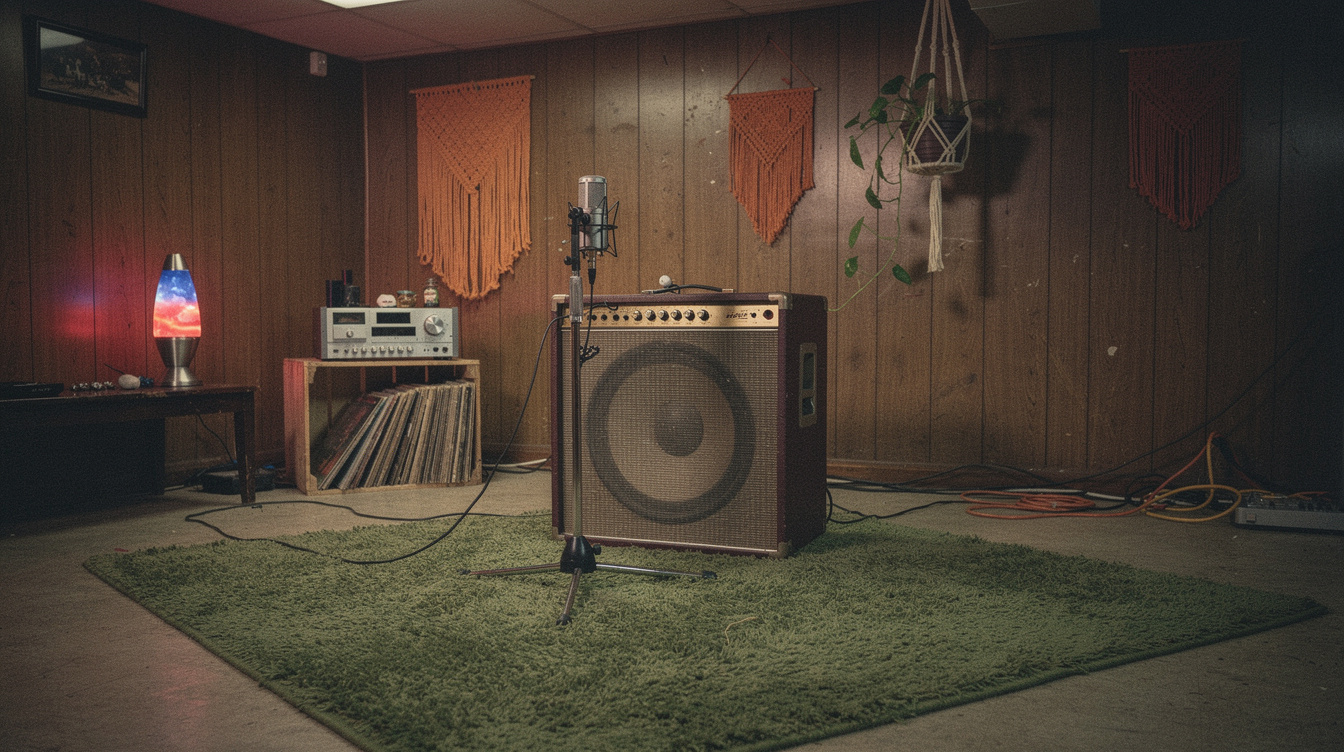
Most of the recorded electric guitar you have ever loved was made with one microphone in front of a speaker. Often it was an SM57, the same plain dynamic mic that ends up on snare drums and podium speeches. One mic, a couple inches off the grille, into a preamp. That is the whole rig. The reason it keeps working is not the mic. It is that the speaker is a tone control, and the mic is how you point at the part you want.
This post is about getting a finished guitar sound with a single SM57. Where to put it, how to find the spot fast, and when a second mic is solving a problem you do not have.
The Short Answer
| Mic position | What it gives you | Use it for |
|---|---|---|
| Center of the dust cap | Brightest, most pick attack, can bite | Dull amps, dark single-coils, clean funk |
| Edge of the dust cap | The balanced starting point | Almost everything |
| Out toward the cone | Rounder, darker, less top | Bright amps, fizzy high gain, leads |
| Angled 45 degrees off-axis | Trims harsh highs, keeps punch | Taming an icy or fizzy track |
| Pulled back 4 to 6 inches | A little room air, less bass | Roomy cleans, when the amp is loud |
Put it at the edge of the dust cap, straight on, two or three inches off the cloth. Track a few seconds. Move it if you need to. You will almost never need to.
The Speaker Is the Tone Control
Look at the speaker with the grille off. There is a small dome in the middle. That is the dust cap. Around it is the paper cone that slopes out to the edge.
The dust cap is the bright, aggressive part. The outer cone is the dark, round part. Everything between them is a gradient. The SM57 only hears a few inches of speaker at a time, so when you slide it from center to edge, you are dialing from bright to dark. That move covers more ground than any knob on the amp and any EQ you reach for afterward.
So you stop thinking about the mic. You think about where on the speaker you want to listen. Bright record, bridge pickup, lots of gain. Point at the cone. Dark amp, neck pickup, clean. Point at the cap. The answer is a few inches of travel.
Finding the Spot in Two Minutes
Put the mic at the edge of the dust cap, straight on, close. Record eight bars of the actual part you are going to play. Not a test riff. The real part, at the real volume.
Listen back. Too bright or harsh. Slide the mic a half inch toward the outer cone and record again. Too dull or boxy. Slide it back toward the center. You are bracketing the spot, the way you sneak up on a cut on a table saw. Two or three passes and you are there.
The reason you play the real part is that a chunky open chord and a high single-note line want different spots. Tune the mic to the part, not to a generic strum. Once it sounds right on the part, it is right.
Straight On or Angled
Start straight on. On-axis is the brightest, most direct sound the speaker makes, and most of the time that is what you want, because a recorded guitar usually needs to cut.
If the top end is harsh, if it has a hard edge on it like a pick scrape that will not quit, angle the mic. Turn it about 45 degrees so it is pointed across the speaker instead of straight into it. Off-axis, the highest frequencies fall off first. The harshness goes away and the note keeps its punch. This is the fastest fix for a fizzy high-gain rhythm track, faster than any EQ, and it costs you nothing.
That is the whole adjustment. Distance for low end, position for bright-versus-dark, angle for the harsh top. Three moves.
When a Second Mic Is Not Worth It
The internet will tell you to add a second mic. A room mic for air. A second close mic for blend. Sometimes that is right. Most of the time, for the guitar you are actually recording, it is not.
Here is the trade. The second mic sits at a different distance, so it hears the same note a hair later than the close mic. Add them together and some frequencies cancel. You can scoop a hole right out of the middle of the tone that way, and then you are fighting it. The whole problem and the fixes for it are their own job, covered in the close mic plus room mic breakdown. It is real work.
Now ask what the second mic buys you. On a dense track, two guitars, bass, drums, vocals, the room air from the second mic is the first thing to disappear in the mix. You did the work and took on the phase risk for a quality nobody will hear once the band shows up.
I went in assuming one mic was the budget version of two. I had it backwards. For a wall of rhythm guitar, one mic was not the compromise. It was the better answer. It sat in the track tighter, it never phased against itself, and I spent the saved time on the part instead of on lining up waveforms. The two-mic setup earned its keep only when the guitar was the whole show. A solo record. A sparse arrangement where you can actually hear the room. The song tells you which one you are making.
If the Guitar Is the Main Event
When the guitar is exposed and you do want size, you have two honest options.
Add a room mic several feet back and commit to aligning it, by ear or in the DAW, so it stops fighting the close mic. Pick which speaker the close mic is on first, because on a multi-speaker cab they do not all sound alike. That choice comes before this one and it is covered in which speaker to mic.
Or skip the second mic and add the space later, with a reverb you can dial and undo. For a busy mix that is usually the smarter move, because the room is a layer you control instead of a live decision you are stuck with.
Mic Choice Comes After Placement
People skip straight to the mic. Which mic, what brand, ribbon or condenser. Mic choice is real, and a ribbon or a condenser does change the character. That comparison is its own post. But it comes after placement, not before. A perfectly chosen mic in a bad spot still sounds bad. An SM57 in the right spot sounds like a record.
If you are working in a modeler instead of micing a live cab, the same idea holds. A cab block or an impulse response is one mic at one spot, captured and frozen. You pick the IR the same way you would slide the SM57, by listening for bright-versus-dark and choosing the one that fits the part. The physical version just lets you move it yourself.
One mic. The right spot. The real part. Get those three and the recording is done. The second mic can wait until the song asks for it, and most songs never do.