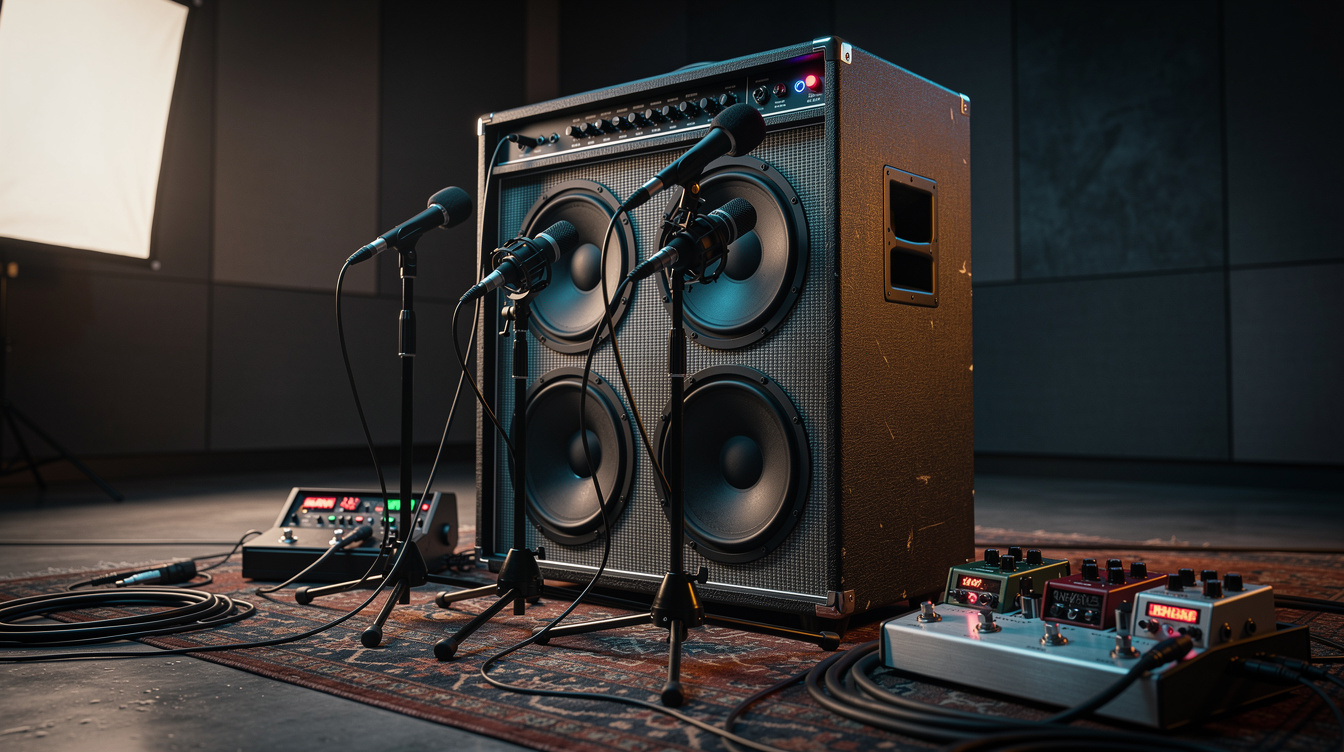
You've got a 4x12. Four speakers, same model, bolted into the same box. You'd figure it doesn't matter which one you stick a mic in front of — they're identical, right. They are not. Put a microphone on the bottom-left speaker and then the top-right and play the same riff, and you'll hear two different cabinets. Same wood, same speakers, same amp. The difference is real, it's bigger than most people expect, and once you know what causes it you can find the good speaker in about two minutes. Here's how.
The Short Answer
| Speaker position | What it tends to do | Start here? |
|---|---|---|
| Top speakers | Tighter, clearer, less low-end buildup | Yes |
| Bottom speakers | More low end and low-mid boom (floor coupling) | Only if you want that |
| The "broken-in" one | Looser, smoother, often the sweet one | Worth hunting for |
The rule of thumb: on a 4x12 on the floor, start with a top speaker. Then ignore the rule if your ears tell you otherwise — because they sometimes will.
Why Identical Speakers Don't Sound Identical
Three things make four matched speakers print differently.
Position against the baffle and the floor. A speaker in the bottom row of a cab sitting on the ground couples to the floor. That boundary reinforces low frequencies — you get more bass and a low-mid bloom around the bottom of the guitar's range. The top speakers are a couple of feet up and away from that boundary, so they stay tighter. This is the same floor-coupling effect that changes how a cab sounds tilted back or up on a stand — except here it's happening to two of your four speakers and not the other two.
Break-in. Speakers loosen up as they get played. The cone suspension softens, the top end rounds off, the whole thing gets a little more give. In a working cab the speakers don't all break in evenly, especially if it's been re-coned or had one replaced. The well-worn speaker and the fresher one are genuinely two different sounds.
Plain manufacturing spread. Any two speakers off the same line vary a little — voice coil, cone, glue, the magnet. Small on its own. Stacked on top of position and break-in, it's enough to make one speaker clearly the keeper.
The Surprise: One of Them Was Just Better
I had a Marshall 4x12 loaded with four of the same Greenbacks for years and assumed they were interchangeable. Doing a session I had to pick one to mic, so for once I actually listened to all four instead of grabbing whichever was easiest to reach. I expected them to print the same. They didn't, and it wasn't subtle.
The two bottom speakers had a low-mid bloom you'd swear came from a different, bigger speaker — a wooliness down around 200 to 300 Hz that was all floor coupling, and a honk in the low mids that sat right where a vocal lives. The top-right one was the one. Dry, immediate, tight underneath — it cut like AC/DC rhythm with no boom hanging off the bottom of it. Same cab. Same amp. I'd been recording the muddy corner of that cabinet for years out of pure laziness. After that I marked the good speaker with a paint pen so I'd stop guessing.
That's the whole lesson: the cab isn't one sound. It's four, and you only get to keep one when a single mic goes up.
How to Find the Good One
You don't need gear for this. You need one ear and somebody to play.
- Have someone hold a steady part. A cranked open chord, a chugging riff — something constant.
- Cup one ear with your hand and get it a few inches off the grille.
- Move slowly across all the speakers. Listen for the one with the least boom underneath, the least honk in the mids, and the clearest pick attack.
- Mark it. Paint pen, tape, whatever. That's your mic speaker.
Your cupped ear hears roughly what a close mic hears — a single speaker, up close, isolated from the room. It's not perfect but it's close enough to sort a 4x12 in two minutes. Trust it over the layout diagram.
When the Speakers Aren't the Same
Everything above is for a matched cab. Plenty of cabs aren't. Mixed-speaker loading — a couple of V30s and a couple of Greenbacks, or an X-pattern with two different models on the diagonal — is common in 4x12s from Mesa, Friedman, and Bogner, and the whole point of it is that the speakers sound different.
On a cab like that, which speaker you mic isn't a small tweak. It's the tone decision. The V30 will give you a brighter, more aggressive top with a forward upper-midrange; the Greenback will be warmer and looser with an earlier breakup. You're not finding the "best" speaker anymore — you're choosing the voice you want for that part, and then placing the mic to fine-tune it. If you're wiring or arranging a mixed cab yourself, which speaker sits where relative to the input jack matters too, and the Celestion speaker rundown covers what each model brings before you commit one to the mic.
Where on the Speaker the Mic Goes
Once you've picked the speaker, position on the cone is the next big lever — and it moves more tone than most pedals do.
| Mic position | Tone |
|---|---|
| Dead center (dust cap) | Brightest, most aggressive, most pick attack |
| Halfway out (cap-to-cone edge) | The usual home — balanced |
| Outer edge of the cone | Darkest, warmest, least fizz |
| Off-axis (angled, not straight-on) | Rolls off harsh top end |
Start halfway between the dust cap and the edge, mic right up on the grille, straight on. Too bright and spiky? Move toward the edge or angle it off-axis. Too dull? Move toward the center. Work in inches — an inch of movement here is a bigger change than swapping the mic. The speaker and the cab itself set the foundation; this is where you aim it. For why the box around the speaker matters as much as the speaker, cabinet size and tone is the companion read.
What This Means If You Use IRs
Here's the part for the modeler crowd. An impulse response is a recording of one speaker, in one spot, with one mic, in one cab. Every choice above is already baked into it — somebody picked the speaker, picked the position, picked the mic, and froze it. That's why two IRs labeled as the "same" 4x12 sound nothing alike: one is the tight top speaker on the dust cap, the other is the boomy bottom corner on the edge. You're not hearing a flaw. You're hearing two different speakers in the same box, exactly like the real cab does. When an IR sounds wrong, you're usually fighting the mic-and-speaker choice in it, and the fix is to load a different one — the Helix cab and IR pairing guide covers picking by character instead of by name. And if you mic your own cab to make IRs, find the good speaker first. No software fixes capturing the muddy corner.
The takeaway holds for both worlds. A multi-speaker cab is several sounds wearing one grille cloth. Listen before you commit, mic the speaker you actually want, and aim it on purpose. The good tone was in there the whole time — you just have to put the mic in front of the right twelve inches of it.