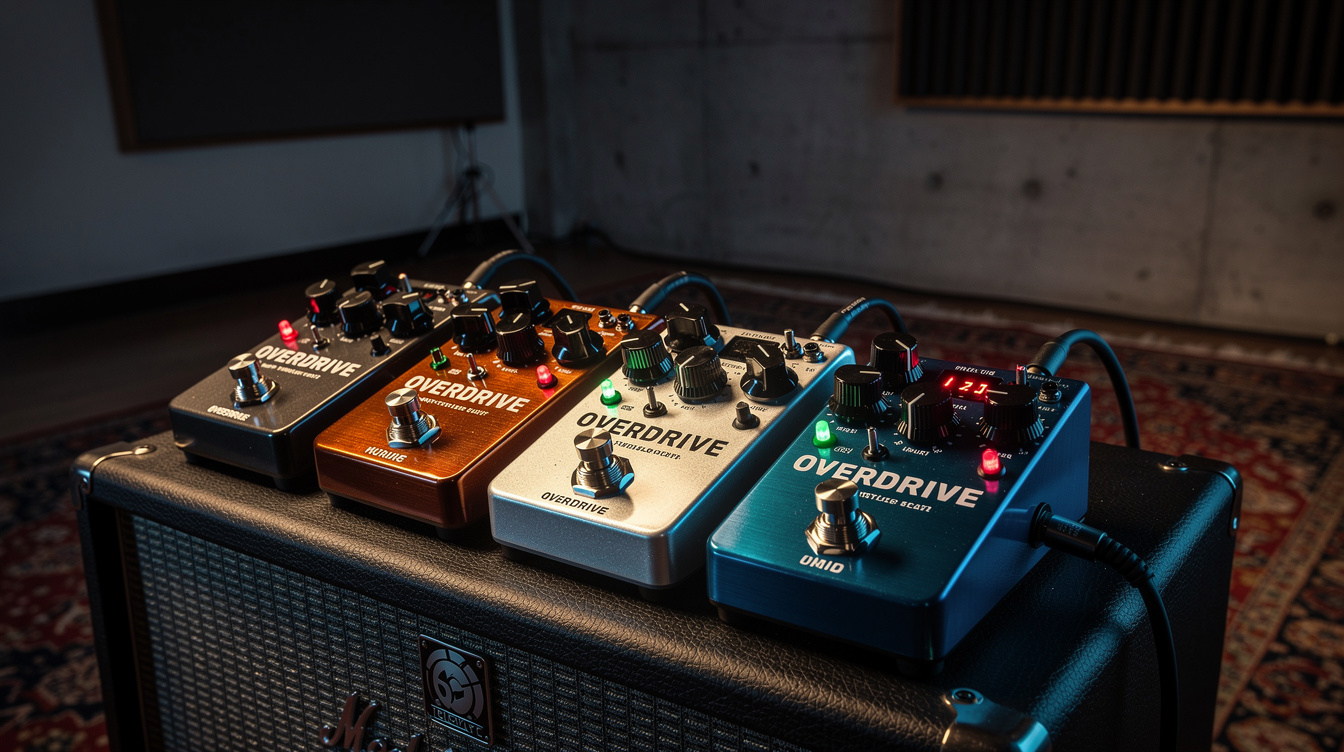
Quick Start: We tested five overdrive pedals (Ibanez TS808, Boss BD-2, Klon KTR, ProCo RAT, JHS Morning Glory) through a Marshall 2204 JCM800 and a Fender Deluxe Reverb. Below, you'll find exact settings for each on both amps, what each one actually does to the signal, and where they diverged from our expectations. Jess ran the same pedals through an HX Stomp with clean amp models. Her findings are inline.
Five pedals. Two amps. One guitar: a Les Paul Standard with PAF-style humbuckers. The methodology was simple: clean amp baseline, then each pedal one at a time, same guitar position, same picking angle, same three tests: open chord, single-note blues phrase, palm-muted rhythm.
The goal wasn't to pick a winner. It was to find where each pedal has leverage and where it doesn't, and what settings actually produce the sounds people are chasing.
The Setup
Amp 1: Marshall JCM800 2204 (50W)
- Presence: 5 | Bass: 5 | Mid: 7 | Treble: 6
- Volume: 4 (edge of breakup at full guitar volume)
- Master (if applicable): matched for unity with pedal on/off
Amp 2: Fender Deluxe Reverb (blackface reissue)
- Bass: 5 | Mid: 5 | Treble: 5
- Volume: 6 (just barely breaking up on hard picks)
- Reverb: off for all overdrive testing
Guitar: Les Paul Standard, bridge humbucker, volume full
Jess's Setup: HX Stomp, Fender Twin Reverb model (one of the cleanest amp models on the platform), output matched to unity. Same guitar, bridge pickup.
Pedal 1: Ibanez TS808 Tube Screamer
The reference. If you've played guitar for more than six months, you've probably played one of these or a variant of one.
The TS808's character comes from two things: a mid-frequency push around 700-800Hz, and soft-clipping diodes that compress the signal before it clips. The result is a pushed, singing tone that works by adding presence to an amp's midrange rather than just adding gain.
Settings that worked on the JCM800:
| Control | Position | Notes |
|---|---|---|
| Drive | About 9 o'clock | Low gain; letting the amp do the work |
| Tone | About 11 o'clock | Slightly dark; the JCM800 already has presence |
| Level | About 2 o'clock | Pushing the front end of the amp |
This is the configuration that made me understand why this pedal exists. Low drive, high level, clean amp. The TS808 becomes a front-end boost that makes the amp respond harder and tighter. The difference from the amp alone was the quality of the distortion when you pushed it. More compressed, more articulate, more controlled.
Settings that worked on the Deluxe Reverb:
| Control | Position | Notes |
|---|---|---|
| Drive | About 1 o'clock | Medium gain; the Deluxe needs more help |
| Tone | Noon | Flat; the Deluxe doesn't have the Marshall's inherent edge |
| Level | About 1 o'clock | Unity or slight boost |
The Deluxe Reverb doesn't have the JCM800's aggressive upper midrange, so the TS808 sits differently, more smoothly. The mid hump was audible here in a way that's less obvious on the Marshall.
Jess on the TS808 (HX Stomp, Fender Twin model):
"Okay, I don't hate it. The mid hump is annoying on my Jazzmaster but on the Les Paul into the Twin model it just... makes sense. Drive at about 25%, level at 60%, tone at 45%. It's like the pedal knows what it's doing. I still think it's overpriced for what it is, but the settings above aren't wrong."
The surprise: I expected the TS808 to sound too polite on the JCM800. The amp already has midrange presence. Two mid-heavy sources in the chain should be too much. It wasn't. The TS808's compression tightened the amp's natural breakup in a way I didn't predict.
Pedal 2: Boss BD-2 Blues Driver
The Blues Driver is not a Tube Screamer. It doesn't boost mids in the same way. Its clipping character is harder (closer to the RAT than the TS) but with a frequency response that extends brighter in the top end.
At lower gain settings, the BD-2 produces a sharp, cutting clean boost. At higher gain settings, it gets rough in a way that sounds intentionally raw.
Settings that worked on the JCM800:
| Control | Position | Notes |
|---|---|---|
| Gain | About 9 to 10 o'clock | Very low; this pedal gets rough fast |
| Tone | About 11 o'clock | Rolled back; the top end gets harsh above noon on a bright amp |
| Level | About 2 o'clock | High; using it as a cutting boost |
On the Marshall, the BD-2 at low gain was the most transparent of the five pedals tested. Almost like a buffer with a slight frequency push. Useful for adding presence without changing the amp's character.
At higher gain (past noon), the BD-2 on the JCM800 started to sound aggressive in a way that wasn't entirely musical. A brittleness in the upper mids that I couldn't dial out. The tighter the Tone knob, the more the low-end wooofed. Finding the sweet spot required more tweaking than the TS808.
Settings that worked on the Deluxe Reverb:
| Control | Position | Notes |
|---|---|---|
| Gain | About 1 o'clock | Medium; the Deluxe has more headroom |
| Tone | Noon | Flat starting point |
| Level | About 1 o'clock | Unity to slight boost |
On the Deluxe Reverb, the BD-2 was more at home. The amp's warmer character balanced the pedal's bright top end, and the result was a touch of Stevie Ray Vaughan-adjacent grit: raw, articulate, and expressive to pick attack.
Jess on the BD-2:
"The BD-2 is the pedal I recommend when someone tells me they want something like a Tube Screamer but they already have a Tube Screamer. Different character, same price bracket. Through the HX Stomp Twin model: Gain at 20%, Tone at 50%, Level at 55%. The top end cuts more than the TS808, which is either great or a problem depending on your other gear."
The surprise: The BD-2 at very low gain into the Deluxe Reverb (gain at 8 o'clock, just barely audible) produced a slight harmonic enrichment that wasn't quite distortion and wasn't quite clean. It made single notes more present without audible clipping. That's a useful and underexplored setting.
Pedal 3: Klon KTR (Original Circuit Reissue)
The Klon is the most mythologized pedal on this list. It's also one of the most misused.
The Klon's circuit is unusual: it splits the signal internally, adds soft-clipping to one path, and blends it back with the clean signal. This means the Klon always has some clean signal passing through, which is why it's described as "transparent." It's not that it doesn't affect the signal, it's that it doesn't replace the signal entirely.
The buffer built into the KTR is also notable. It's one of the better-sounding buffers available in a pedal format. It reshapes the high-frequency response in a way that some players notice immediately and others don't notice at all.
Settings that worked on the JCM800:
| Control | Position | Notes |
|---|---|---|
| Gain | About 8 o'clock | Very low; nearly unity |
| Treble | About 2 o'clock | Boosted; this is where the Klon's character lives |
| Output | About 1 o'clock | Pushing the amp front end |
This is the classic Klon configuration: clean boost with a treble presence lift. On the JCM800, it made single-note leads cut through with a kind of crystalline clarity, tighter than the TS808, brighter than the BD-2 in the high-end feel.
At higher gain settings (past noon), the Klon's clipping character is noticeably different from the TS808: less compressed, more dynamic. The notes feel like they're fighting back a little. That's not universally a good thing.
Settings that worked on the Deluxe Reverb:
| Control | Position | Notes |
|---|---|---|
| Gain | About 10 to 11 o'clock | Low-medium; more useful here than on the JCM |
| Treble | About 1 o'clock | Boosted |
| Output | About 2 o'clock | Pushing hard into the Deluxe |
The Klon was at its best on the Deluxe Reverb, pushing the clean amp into natural breakup while maintaining a responsive, dynamic character in single notes. This is the combination I understand people spending money on.
Jess on the Klon:
"It's a $500 boost pedal. I know what it does. I know it does it well. The HX Stomp has a Klone block that I set at: Gain 15%, Treble 65%, Output 60%. Does it sound exactly like this? Probably not. Does it get the job done for a venue that seats 200 people? Yes."
The surprise: The Klon's drive control has a wider useful range than the other pedals on this list. Even past noon (where most overdrives start to get messy), the Klon maintained note separation and dynamics in a way that made higher gain settings genuinely usable for rock rhythm playing.
Pedal 4: ProCo RAT
The RAT is the outlier on this list. Every other pedal here is in the overdrive category. The RAT crosses into hard distortion territory in a way that none of the others do.
Its clipping character uses op-amp hard clipping (rather than the soft diode clipping in the TS808 and Klon). The result is a more aggressive, compressed saturation that sits closer to a distortion pedal than an overdrive.
The Filter control is the RAT's secret weapon and its most misunderstood feature. See our full RAT settings guide for the deep dive, but briefly: the Filter is a passive low-pass filter that rolls off highs as you turn it clockwise. The opposite of most tone controls.
Settings that worked on the JCM800:
| Control | Position | Notes |
|---|---|---|
| Distortion | About 8 o'clock | Very low; the JCM80 has its own gain |
| Filter | About 8 o'clock | Open (bright) to balance the Marshall's top end |
| Volume | About 2 o'clock | Pushing the amp |
At low gain, the RAT into the JCM800 wasn't the most natural-sounding combination in this test. The two gain characters compete. The RAT's hard clipping sits on top of the Marshall's tube compression in a way that's less harmonically integrated than the TS808's soft clipping.
Where the RAT found its place on the JCM800 was at slightly higher gain (about 10 o'clock) for a rhythm crunch that was rawer and more aggressive than anything the other pedals produced.
Settings that worked on the Deluxe Reverb:
| Control | Position | Notes |
|---|---|---|
| Distortion | About 11 o'clock to noon | Medium; the Deluxe stays clean, giving the RAT room to work |
| Filter | About 10 o'clock | Slightly open; the Deluxe's warmth allows more top end |
| Volume | About 1 to 2 o'clock | Unity to boost |
The RAT was most at home here. A clean amp gives the RAT's distortion character room to breathe without two competing gain structures fighting each other.
Jess on the RAT:
"The RAT is the pedal I'd pick if I could only have one pedal. It covers everything from crunch to full distortion and it's twenty-five years old in design but it still goes. HX Stomp: Distortion 35%, Filter 30% (remember: lower = brighter), Volume 55%. That's my working RAT tone."
The surprise: The RAT with both Distortion and Filter very low (nearly minimal) into the clean Deluxe Reverb produced a sound closer to an amp in light breakup than I expected from a hard-clipping distortion circuit. At extreme low gain, the RAT's character almost disappears and what remains is a slight warmth in the mids. Useful and unexpected.
Pedal 5: JHS Morning Glory V4
The Morning Glory is an evolution of the classic Marshall Bluesbreaker circuit. Its clipping character is between the TS808's compression and the Klon's dynamics: asymmetrical clipping with a frequency response that emphasizes the low-mids more than the Klon but less than the TS808.
At low gain settings, it's among the most natural-sounding overdrives available. It doesn't push the midrange aggressively. It adds a slight harmonic density across the full frequency range.
Settings that worked on the JCM800:
| Control | Position | Notes |
|---|---|---|
| Drive | About 9 to 10 o'clock | Low; morning glories are subtle at low drive |
| Tone | Noon | Flat starting point |
| Volume | About 2 o'clock | High; this is a boost-oriented pedal |
On the JCM800, the Morning Glory was the most "out of the way" pedal on this list. I didn't expect it to be the most transparent at low drive. The Marshall barely changed when it switched on, but it was better. Slightly more harmonic richness in single notes, slightly more compression on the pick attack. The kind of improvement that takes you a moment to identify.
Settings that worked on the Deluxe Reverb:
| Control | Position | Notes |
|---|---|---|
| Drive | About 1 to 2 o'clock | Medium to higher; the Deluxe benefits from more push here |
| Tone | About 1 o'clock | Slightly bright to add presence |
| Volume | About 1 o'clock | Unity |
On the Deluxe Reverb, higher drive settings on the Morning Glory produced a singing, natural breakup quality that was the best-sounding result of this entire test for lead playing. Tone at 1 o'clock cut through without harshness. Single notes sang from the low strings upward without thinning out.
Jess on the Morning Glory:
"I've borrowed one of these twice. Never bought one because I have the KOT block on the HX Stomp and that's close enough for live work. But this thing sounds genuinely good and I resent it a little. HX Stomp equivalent: JHS Klon-ish circuit at Drive 40%, Tone 55%, Level 60%. That's my approximation."
The surprise: The Morning Glory V4's Hi/Lo input switch (which changes the output impedance) made a meaningful difference on the Deluxe Reverb. Lo setting into the bright Deluxe was warmer and smoother. Hi setting had more presence and edge. Worth noting that input impedance matters more on Bluesbreaker-style circuits than on most other overdrives.
Head-to-Head Summary
| Pedal | Best Amp Pairing | Strength | Weakness |
|---|---|---|---|
| TS808 | Marshall-style high-gain amps | Mid-push, compression, focus | Can sound congested on already-mid-heavy amps |
| BD-2 | Fender cleans | Transparent low-gain boost, raw high-gain | Gets brittle above medium gain on bright amps |
| Klon KTR | Fender or Vox cleans | Dynamic, wide useful range, excellent buffer | Expensive for what it does at low gain settings |
| ProCo RAT | Clean amps (Fender, clean Vox) | Most gain range, hard clipping character | Competes with tube breakup; better on clean platforms |
| JHS Morning Glory | Both, but especially Fender cleans | Most natural-sounding, best for transparent enhancement | Subtle at low drive; not a gain-machine |
Which One to Buy
If you're playing through a high-gain amp (Marshall, Mesa Boogie, Friedman): TS808 or equivalent. The mid push + compression before the amp's own gain stage is the formula. This is not a debate.
If you're playing through a clean amp and want the most versatile distortion range: ProCo RAT. One pedal from light crunch to heavy distortion, with a tone control that actually does useful things.
If you're playing through a clean amp and want the most natural-sounding enhancement: Morning Glory or Klon KTR. The Morning Glory is cheaper. The Klon has the buffer and the mystique, and it is genuinely different-sounding.
If you want the most dynamic response to your picking: Klon KTR. Of the five pedals on this list, the Klon was the most responsive to how hard you dug in.
If you want the brightest tone: BD-2. Keep the gain low and it cuts like nothing else.
FAQ
Q: Is the Tube Screamer or the Blues Driver better for blues? A: Different blues. The TS808 is the Texas blues pedal: mid-heavy, compressed, singing lead tone. The BD-2 is rougher and more raw, closer to a Chicago or British blues character. Try both on your amp before deciding.
Q: Can I stack two of these together? A: Yes, and it's worth experimenting. The classic combination is TS808 into Klon. The TS pushes the mids, the Klon adds definition and presence. Both in front of a clean amp produces a stacked character neither achieves alone. Set the TS as the primary drive, Klon as a clean boost on top.
Q: Is a Klon clone as good as the original KTR? A: For most purposes, yes. The Wampler Tumnus and the EHX Soul Food both use similar clipping configurations. You're not losing much in a live context. The biggest difference is the buffer circuit in the originals; some clones replicate it well, some don't.
Q: What's the difference between overdrive and distortion? A: See our full guide: Overdrive vs. Distortion vs. Fuzz. Short version: overdrive clips softly and works with the amp's natural character. Distortion clips harder and more aggressively, and typically imposes more of its own character on the signal.
Q: Do these settings work on modelers? A: Yes, with adjustment. The block models in the Helix and Quad Cortex are calibrated to respond similarly to the original pedals. Use the settings above as starting points and adjust for the amp model you're using; the same rules apply.