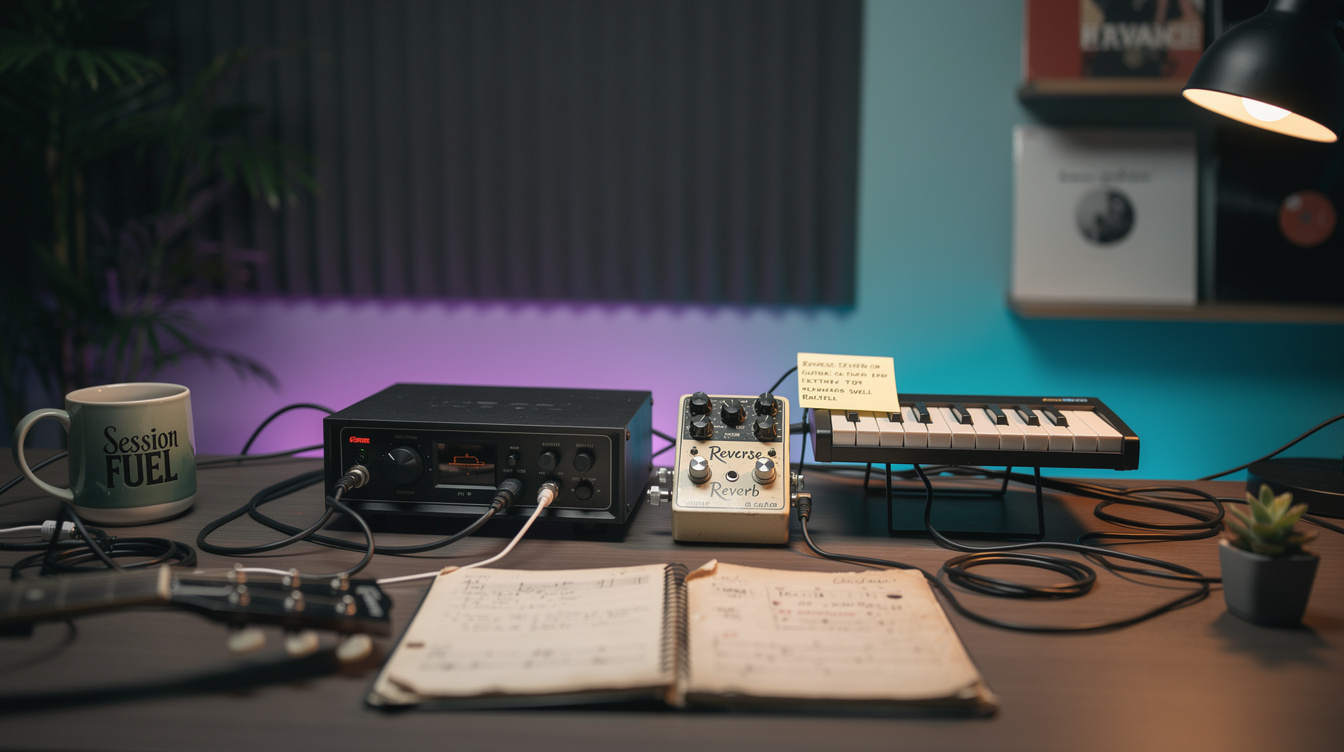
There's a sound you've heard a hundred times without knowing what it was: a note that seems to gather itself before it speaks, a soft rush of air that crests right as the string is struck and then vanishes. It's all over ambient records and the quiet parts of post-rock, the held breath before a Sigur Rós chorus blooms. That's reverse reverb — a wash that runs backwards, building up into the note instead of fading away behind it.
What Reverse Reverb Actually Does
Normal reverb is a tail. You play a note, and the reflections trail off after it, decaying into the room. Reverse reverb flips that envelope end to end. The diffuse, quiet part arrives first; the dense part crests last, landing right around your attack. So instead of a note that rings out and fades, you get a note that seems to inhale and arrive.
The texture is unmistakable. It's the backwards-tape sound — the thing producers used to get by literally flipping a reel of tape over, recording the reverb, and flipping it back. The swell rises like a wave you can see coming from a distance before it breaks. On a single held chord it's a slow crescendo. On a fast melodic line it's a soft shimmer that precedes every note, an exhale in reverse.
It's Not Predicting the Note — Here's the Trick
This is the part that surprised me, and it changed how I set the thing up. I assumed reverse reverb had to somehow anticipate the note to swell before it — which is impossible, the pedal can't hear the future. So how does the swell land on the attack?
It doesn't, exactly. A reverse reverb captures a short window of your playing, reverses that window in time, and plays the flipped version back. Because it has to wait for the window to fill up before it can turn it around, the swell always arrives after you played the note — lagging by the length of the window. What you're hearing isn't anticipation. It's a delayed, time-flipped echo that your ear reads as anticipation because the shape rises instead of falls.
Once that clicked, the length control stopped being mysterious. It's not "how much reverb." It's "how far behind my playing the swell sits, and how long it takes to build." That's the whole effect in one knob.
The Controls
Strip the branding off any reverse reverb and you get the same small handful of knobs.
- Length (sometimes Time or Decay) sets how long the swell takes to build and how far behind your note it sits. Short — half a second — gives you a quick inhale before each note, almost a reverse pluck. Long — three seconds — turns a held chord into a slow tide coming in. This is the knob that decides whether the effect is rhythmic or atmospheric.
- Mix is how much of the reversed wash you hear against your dry note. High mix is the dramatic, obvious backwards-whoosh — great for an intro, exhausting for a whole song. Low mix is where the effect actually lives most of the time: just enough that each note arrives with a little breath in front of it.
- Tone rolls the top off the swell. Keeping it darker than your dry signal pushes the wash behind the note in the frequency space so it adds depth without smearing your pick attack.
- Feedback, if there is one, re-feeds the reversed signal so swells stack into each other. A little is lush. A lot is a wall.
Reverse, Gated, Ducking: Three Ways to Bend a Tail
Reverse reverb is one of three nonlinear reverb behaviors, and they're worth keeping straight because they solve different problems. Gated and ducking reverb both deal with a tail that's in the way — gated chops it off after a set time for that abrupt 80s drum sound, and ducking pulls it down while you play and lets it bloom in the gaps.
Reverse does something different. It doesn't tame the tail; it relocates it. The wash moves from after the note to before it. Where ducking is about getting ambience out of your way, reverse is about putting a deliberate gesture in front of the note — an attack you composed instead of one the pick gave you. If a normal reverb is the room a note decays into, reverse reverb is the room it emerges from.
Reverse Reverb vs. a Volume Swell
These get tangled up because both rise instead of strike. But a volume swell shapes the dry note — you fade the pick attack in with a volume pedal or your guitar's volume knob, and the note itself arrives without a transient, that violin-like bloom. Reverse reverb leaves the dry note exactly as you played it and adds a separate reversed wash around it.
The two stack beautifully. A volume swell into a reverse reverb is one of the prettiest ambient textures there is — the dry note fading in while a reversed wash rises to meet it, two crescendos arriving together from different directions. But they're doing separate jobs. One shapes the note. The other shapes the air pulling into it.
Getting It on a Modeler
On the Helix, the backwards-swell sound lives in the Reverse Delay model rather than a dedicated reverse reverb block. Set a longer reverse time and a moderate mix and you get the core gesture immediately. To make it more diffuse and reverb-like — less discrete echo, more wash — stack a reverb block after it, or push the reverse delay's feedback so the swells blur into each other. The block order matters here: reverse first, then a short reverb to smear it.
The Quad Cortex has a Reverse delay in the same spirit, and the approach is identical — reverse for the gesture, reverb after for the diffusion. And plenty of reverb pedals build a reverse mode in outright: the Boss RV-6 has one, the EHX Cathedral has one, the Empress Reverb has one. They all expose the same length and mix idea under slightly different names.
Wherever you build it, start with the mix lower than feels exciting. The version I keep coming back to isn't the dramatic full-wet swoosh — that's a one-time intro trick. It's the low-mix setting where the swell sits just under the dry note and you barely register it as an effect... until you switch it off and the notes suddenly sound like they're starting from nothing. That little inhale before each phrase is the thing. It makes a part feel like it's breathing.