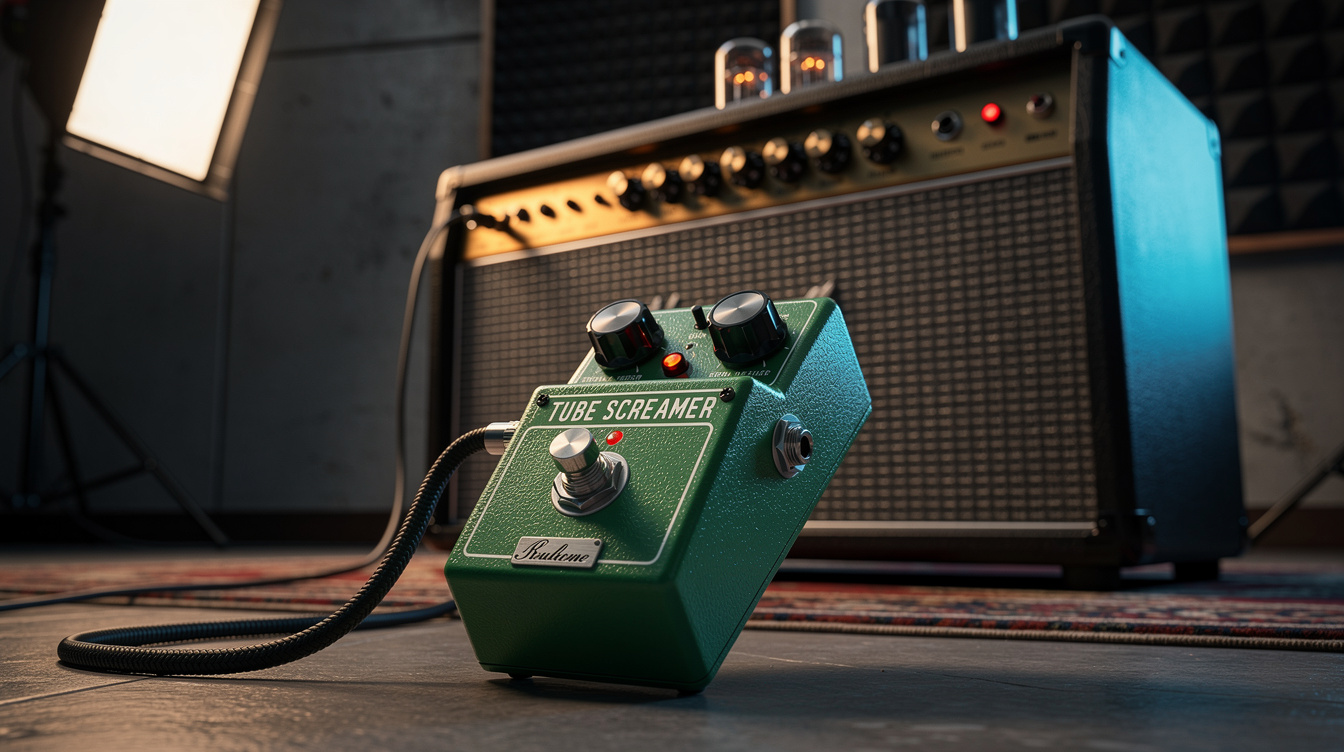
A drive pedal lives in front of your amp. That's the whole answer to where its distortion comes from, and most of the confusion clears up the second you accept it. The pedal plugs into the input. The input feeds the preamp. So whatever a Tube Screamer does — boost, clip, tighten the low end — it's doing it to the preamp. It never gets near the power tubes. If you've been chasing that cranked, blooming power-amp grind with a bigger and bigger overdrive, you've been knocking on the wrong door.
The Short Answer
| Tube Screamer out front | Cranked power amp | |
|---|---|---|
| Where the distortion happens | Preamp stage (and the pedal itself) | Output tubes |
| What creates it | Pedal clipping + a hotter signal into the preamp | High volume driving the power section |
| Feel under the pick | Stiff, compressed, consistent | Blooming, sagging, dynamic |
| Cleans up with guitar volume | A little | A lot |
| Depends on master volume | No | Completely |
A pedal can make your preamp do more. It cannot make your power tubes do anything they weren't already going to do — unless the amp is already loud enough that the power section is in the game. More on that exception below, because it's the part everybody gets wrong.
Why the Pedal Only Ever Talks to the Preamp
Signal flows in one direction: guitar, pedal, preamp, tone stack, phase inverter, power tubes, output transformer, speaker. The Tube Screamer is the second link in that chain. By the time the signal reaches the power tubes it's already been through the preamp and the tone stack. The pedal had its say a long way upstream.
So when you turn up the Drive on a Tube Screamer, you're adding soft clipping in the pedal and shoving a hotter, mid-focused signal into the first preamp tube. That preamp tube clips harder. That's your distortion. It's real, it's useful, and on a lot of records it's most of the dirt you hear. But it's preamp distortion with the pedal's fingerprint on it — not the sound of output tubes straining against an output transformer. Those two things are made in different rooms of the amp. This is the same split covered in preamp vs. power-amp distortion: how to tell which you're hearing — a pedal just plants you firmly on the preamp side of it.
What Power-Amp Distortion Actually Needs
Volume. That's it. Power tubes distort when you ask them to deliver more current than they comfortably can, and the only way to ask is to turn the master up until the output section is working flat out. A 100-watt Super Lead doesn't get there until the room is uncomfortable. A 15-watt amp gets there a lot sooner, which is why low-wattage amps have a reputation for "amp tone" at livable levels — the power tubes start cooking earlier.
You can't shortcut that with a pedal because the pedal isn't connected to the thing that makes the sound. No amount of Drive on a Tube Screamer reaches the output tubes any differently than turning your guitar up would. If you want the power section to bloom, you have to move air — or fake the load with an attenuator or a variable-power amp, which is the honest way to get that feel without the volume.
The Exception Everybody Gets Wrong
Here's where the "a pedal can't give you power-amp distortion" rule bends. It doesn't break — it bends.
Set your amp loud enough that the power tubes are already starting to break up on their own. Now kick on a Tube Screamer with the Drive low and the Level high. The pedal isn't adding much clipping. What it's adding is level — a hotter signal driving the entire amp harder, including the power section that was already on the edge. The output tubes saturate more. You get more power-amp distortion.
But read that carefully: the pedal didn't create the power-amp distortion. The cranked amp did. The pedal just leaned on it. Plug the exact same pedal into the exact same amp at bedroom volume and you get none of that bloom — you get a tighter, dirtier preamp and a power section that's still loafing. The pedal does the same thing both times. The amp is what changed.
That's the setup. Low Drive so the pedal isn't doing the clipping, high Level so it's shoving the amp. With a humbucker into a cranked Marshall, that's the AC/DC engine — not because the pedal is making the crunch, but because it's pushing a power section that's already giving. Roll the Drive up instead and you slide back toward preamp clipping. The knob tells you which kind of dirt you're stacking.
How to Hear the Difference Yourself
You don't need a scope. You need your hands.
Set up the dirty sound you've got and roll your guitar's volume knob from 10 down to about 6, then pick hard and pick soft. Preamp distortion — pedal or high-gain channel — barely budges. It stays compressed. The gain is baked in upstream and your dynamics don't move it much. Power-tube breakup does the opposite. It cleans up under a lower volume knob, and when you dig in, the note blooms — it swells a beat after the attack instead of arriving fully formed. There's give to it. The amp pushes back.
I spent years assuming a Tube Screamer slammed into the front of the Super Lead was "getting more of that power-tube grind." Then I A/B'd it honestly — pedal stacked at low volume against the amp simply cranked with the pedal off. The pedal stack was tighter and dirtier, sure, but it stayed stiff under the pick. The cranked amp, no pedal, bloomed and sagged and answered my right hand. Same guitar, same room. The pedal had been giving me more preamp, and I'd been calling it the wrong name for a long time. Your ears don't lie once you ask them the right question.
On a Modeler
The split is cleaner on a modeler because the controls are labeled. A Drive block in front of an Amp block is the pedal-into-preamp relationship, one-to-one. Turning up the amp's Drive or Gain parameter is preamp distortion. The thing that simulates power-amp behavior is the amp's Master parameter, and on Helix and many others a Sag parameter that models how the power supply droops under load — that's the bloom and give you feel from a real cranked output section.
So if you want power-amp character on a modeler, don't reach for the drive block or the gain knob. Push the Master up and the channel volume down to compensate, and bring Sag up until the note starts to bloom. That's the digital version of cranking the power tubes. Stacking a drive block in front of all that is the same move as the cranked-amp exception above — it pushes the modeled power section harder, as long as the Master is already up. If you're new to balancing those, the modeler dial-in guide walks through which knob does what.
The takeaway is simple. A Tube Screamer is a preamp tool. It's a great one — five different pedals depending on how you set it, and a proven way to tighten a high-gain amp's front end. Just don't ask it for power-amp distortion. That sound is made at the other end of the amp, and the only thing that gets you there is volume.