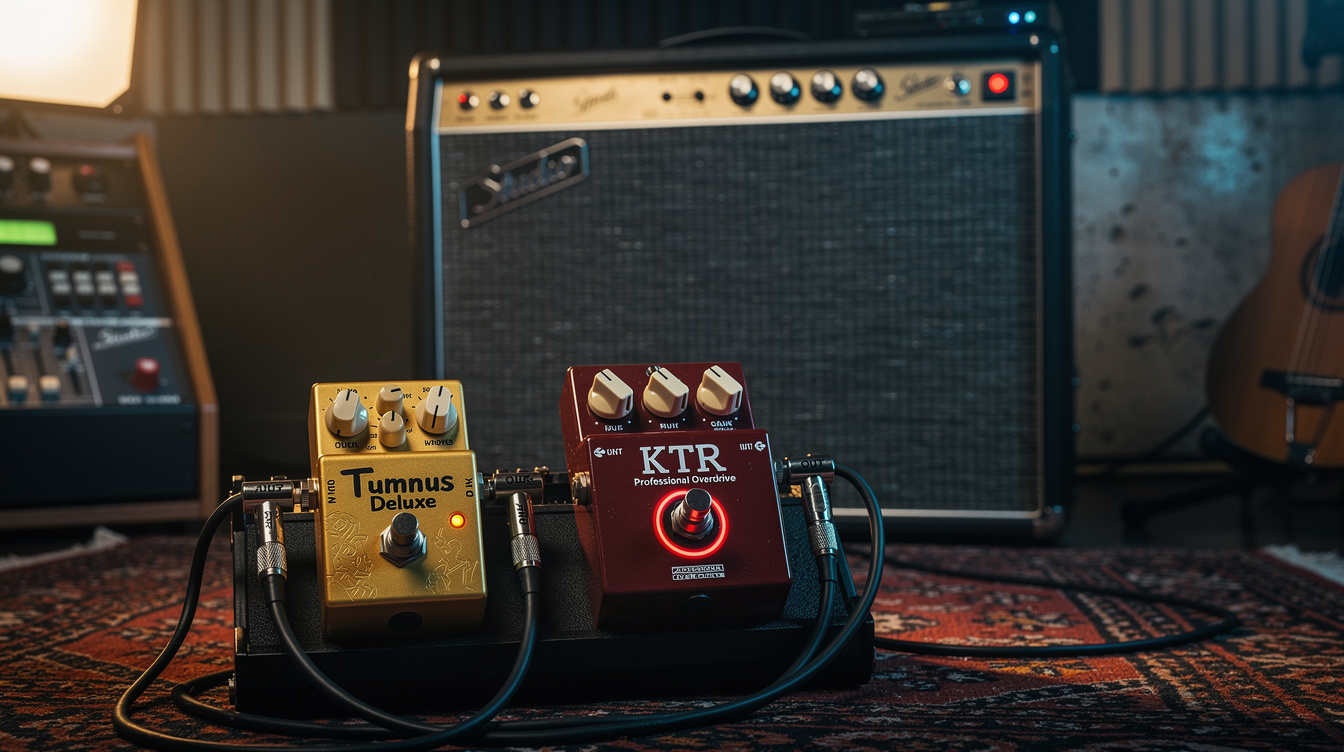
Start Here: The honest summary before we go deep:
- The Klon KTR and Tumnus Deluxe share the same core circuit philosophy: clean blend, Klon-derived topology, similar harmonic character at matched gain settings
- The Tumnus Deluxe's three-band EQ is a genuinely different tool. It's not just more of the same Klon character; the active bass and mid controls change how the pedal sits in a mix
- The KTR's bloom is slightly more refined at very low gain. This is audible to players who run drives at minimum and care about the dynamic response in that range
- For most playing situations, the Tumnus Deluxe ($200 new) is the better practical choice. The EQ flexibility closes most tonal gaps, and the price gap is $400 to $600 used KTR vs. $200 Tumnus Deluxe
- Buy the KTR if: you've played both, the KTR's specific bloom is the sound you're chasing, and $400 is a comfortable investment
Quick Reference: Head-to-Head
| Parameter | Wampler Tumnus Deluxe | Klon KTR |
|---|---|---|
| Circuit type | Klon-derivative with 3-band EQ | Original Klon circuit, Bill Finnegan design |
| EQ controls | Bass, Mid, Treble (3-band active) | Single Treble control (shelving) |
| Gain range | Very low to medium | Very low to medium |
| Clean blend | Yes (built into circuit) | Yes (core Klon architecture) |
| Bypass | Switchable buffered/true bypass | Buffered bypass |
| Street price (new) | ~$200 | Not currently in production; ~$450–600 used |
| USA-made | Yes | Yes (hand-built by Bill Finnegan) |
The Question This Post Is Actually Answering
If you're reading a comparison of the Tumnus Deluxe and the KTR, you already know a few things. You know the Klon story. You know the circuit architecture (clean blend topology, germanium diodes, specific op-amp behavior that generates the characteristic harmonic content). You know that the $5,000+ original Centaur is a different conversation entirely.
The question that remains is specific: once you've added the Tumnus Deluxe's three-band EQ and its additional flexibility, is the remaining difference between it and the KTR worth $400 in real money for a player who isn't collecting trophies?
The answer requires actually understanding what the EQ controls change, because they change more than you'd expect.
What the Three-Band EQ Actually Does
The original Klon circuit has a single Treble control that works as a shelving EQ. It boosts or cuts high frequencies above approximately 3.5kHz. That's it for intentional tonal shaping beyond Gain and Volume. The Klon's character (the mid-forward bloom, the way it pushes the 1kHz to 2kHz range when you dig in) comes from the circuit itself, not from an EQ section you're dialing.
The Tumnus Deluxe adds active bass and mid controls. This is a more significant change than it might appear.
The active mid control lets you shape the 720Hz to 1kHz range that defines the Klon's most recognizable character. You can dial that mid bloom forward (which the Klon does inherently at medium gain) or pull it back if your amp or pickup combination already has a mid emphasis and you need the Tumnus to sit flatter. The KTR can't do this; it does what it does in the midrange, and your only adjustment is Gain and Treble.
The active bass control manages low-end interaction with the clean blend. The Klon's clean blend adds the unclipped low end back into the saturated signal, which is part of why it sounds full and dynamic rather than thin like a standard low-gain overdrive. The Tumnus Deluxe's bass control lets you adjust how much of that clean low end comes through. This is useful if your guitar or amp already has a prominent low end that the Klon topology would over-emphasize.
The practical result: the Tumnus Deluxe can approximate more clean-amp and pickup combinations well. The KTR sounds like itself (which is beautiful, but it's one sound in a narrower range).
Where the KTR Is Genuinely Different
I expected the differences between these pedals to be negligible at matched settings with the Tumnus Deluxe's mid and bass controls at center. That turned out to be approximately true, but not entirely.
At very low gain settings (Drive knob between 7 and 9 o'clock), the KTR has a specific harmonic bloom quality that the Tumnus Deluxe doesn't quite match. It's not louder, more present, or more compressed. It's the character of what happens when you pick softly and then dig in: the KTR opens in a way that feels like the pedal is responding to you rather than processing you. This is the quality Klon devotees describe as "touch sensitivity," and it's real, not mythology.
The Tumnus Deluxe in the same range is excellent and genuinely close. But "genuinely close" and "identical" are different statements when the context is a player who runs their drive at minimum for the entire set and considers that exact response range the most important 10% of the gain knob.
At medium gain (Drive at noon and above), the differences are harder to identify reliably. Both pedals produce the characteristic Klon bloom, clean blend transparency, and mid-forward saturation that the circuit is known for. Experienced Klon-family players can identify subtle character differences, but I wouldn't describe these as functional differences for most playing contexts.
What the Price Gap Is Actually Buying
The KTR at $450 to $600 used is buying:
- The original circuit, designed and hand-built by Bill Finnegan, with the specific component choices and tolerances that Finnegan specified
- The exact bloom behavior at very low gain that the circuit produces natively, without approximation
- The Klon story (which is real provenance, not just narrative, if that matters to you)
- Buffered bypass only (no true bypass option, unlike the Tumnus Deluxe)
The Tumnus Deluxe at $200 new is buying:
- A three-band active EQ that the KTR doesn't have, which adds tonal flexibility the original circuit can't match
- Switchable buffered/true bypass
- USA-made build quality that's consistently excellent
- The ability to shape the Klon topology to more amps and pickup combinations
- The peace of mind of a pedal you don't feel anxious about gigging with
For a working player who uses this sound in every set and sweats through their hands during three-hour wedding receptions, the KTR math is harder to justify than it is for someone whose board rarely leaves the practice room.
Settings That Reveal the Differences
To hear what separates these pedals, use these A/B test settings:
Low-gain test (where the KTR shows its character most clearly):
| Control | Position | Notes |
|---|---|---|
| Gain (both) | 8 o'clock (minimum range) | This is where the bloom difference is most audible |
| Treble | Noon | Flat reference |
| Volume | Match unity | True level-matched comparison |
| Tumnus Deluxe Mid | Noon | Center for fair comparison |
| Tumnus Deluxe Bass | Noon | Center for fair comparison |
Pick softly, then dig in. The dynamic transition is what you're evaluating, not the static tone.
Mid-gain test (where the difference narrows):
| Control | Position | Notes |
|---|---|---|
| Gain (both) | Noon | Standard operating range |
| Treble | 2 o'clock | Slight presence boost (both circuits) |
| Volume | Match unity |
At noon gain, the functional difference between the two pedals is much smaller than at minimum gain.
Using the Tumnus Deluxe to approximate the KTR's low-gain character:
Set the Tumnus Deluxe's Mid control to about 1 o'clock (slight boost) and bass at about 11 o'clock (slight cut). This brings the midrange emphasis forward and reduces the low end that the clean blend adds, getting closer to the KTR's inherent character at low gain. It won't be identical, but the gap narrows significantly.
Who Should Buy Each
Buy the Tumnus Deluxe if:
- You want Klon-family character with the ability to adapt it to multiple amps and guitars
- You gig the pedal regularly and don't want to have anxiety about its replacement cost if it gets damaged
- You want switchable true bypass (the KTR is buffered bypass only)
- You're building a functional working board, not a collection
Buy the KTR if:
- You've A/B'd them directly and the KTR's low-gain bloom is the specific response you're chasing
- You've been running a Klon-family pedal in this position for years and want the original implementation
- $400 to $600 is a reasonable budget for this pedal in your world
- You want the actual Bill Finnegan design, not an approximation of it
Don't buy the KTR if:
- You haven't played one and you're going on reputation
- The price would cause genuine financial anxiety
- You haven't already maxed out everything else in the signal chain that affects this tone first (strings, guitar setup, amp settings)
Internal Links
For more context on how the Klon topology compares to other transparent overdrives, see our Klon Centaur settings guide. For the Timmy comparison (a different circuit philosophy for a similar transparency goal), see Paul Cochrane Timmy vs. Wampler Tumnus.
FAQ
Is the Wampler Tumnus Deluxe a Klon clone? It's Klon-derived. The core topology (clean blend, germanium diodes) is present, but the three-band active EQ is Wampler's addition to the circuit. "Clone" implies a direct copy; "derivative" or "inspired by" is more accurate for the Tumnus Deluxe's relationship to the Klon.
Why is the Klon KTR so expensive if it's a used pedal? Bill Finnegan builds the KTR himself in small quantities, and production has been inconsistent. New KTRs appear infrequently and sell quickly at list price (around $350); used examples often trade above that due to demand exceeding supply. The price reflects scarcity as much as anything.
Does the Tumnus Deluxe sound good with humbuckers? Yes, and this is an area where it often outperforms a stock KTR. The Tumnus Deluxe's active mid control lets you dial back the mid emphasis that the Klon topology inherently produces, which can be too much on top of a humbucker's natural mid-forward character. The KTR in the same context requires more amp EQ compensation.
What's the difference between the Tumnus and the Tumnus Deluxe? The original Tumnus has a single Tone control (like the original Klon). The Tumnus Deluxe adds active Bass and Mid controls alongside the Treble. The Deluxe costs roughly $50 more new. For most players building a working board, the Deluxe's additional flexibility is worth the difference.
Is the Klon Centaur worth $4,000+? That depends entirely on whether you're collecting provenance or buying a working sound. The KTR is the circuit-equivalent modern implementation at $400 to $600 used, and Finnegan designed it specifically as a continuation of that circuit. If you want the tone, the KTR and quality Klon derivatives deliver it without the collectible premium.