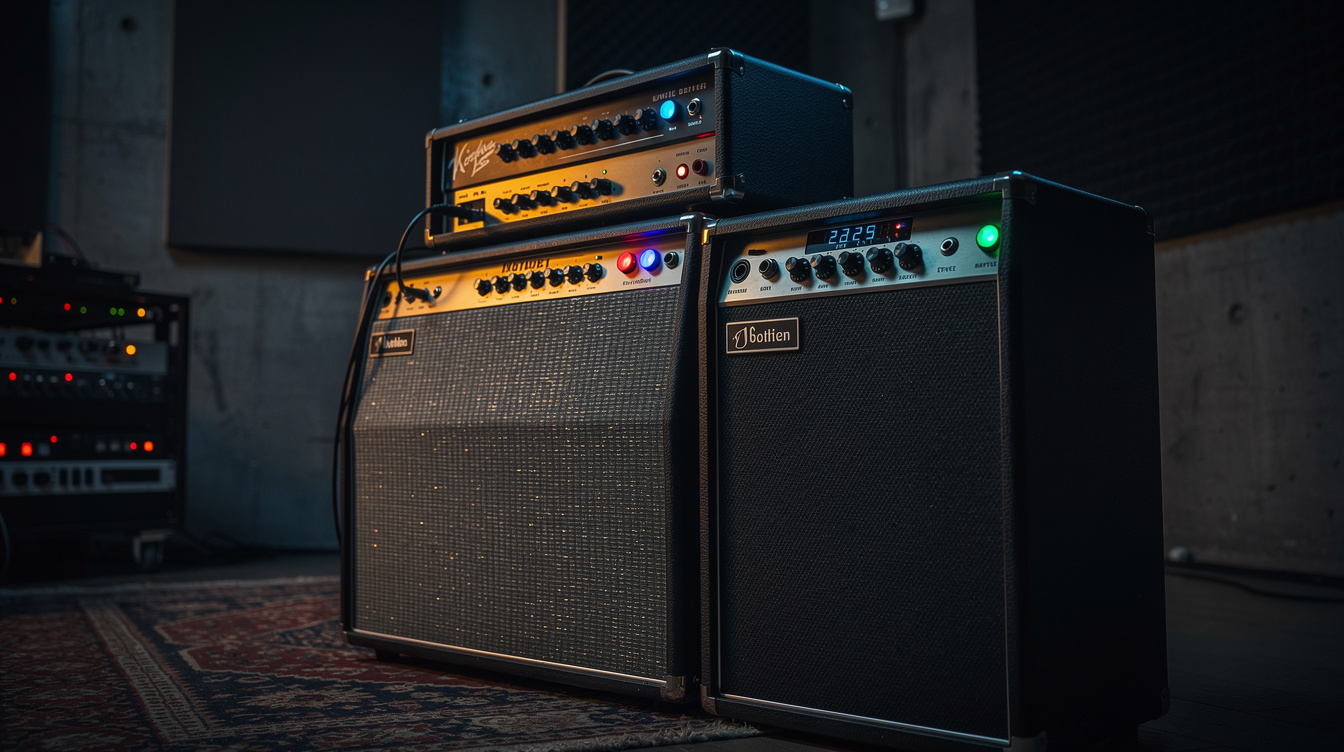
Open the back of an old 2x12 that some shop tech built up out of two different speakers, and you'll often find — if the person who wired it knew what they were doing — that the beefier of the two speakers is the one sitting closest to the input jack. That's not an accident, and it's not superstition either. It's an old bench habit rooted in what actually happens to current in the first instant you dig into a chord. The trouble is that the habit gets passed around as a tone tip, when what it really is, is an insurance policy. Let me untangle the two, because the difference is the whole thing.
The Rule, Stated Plainly
In a cab wired with more than one speaker, the speaker that sits electrically first in line from the input jack — the one with the least wire between it and the amp — takes the leading edge of the current surge when a hard transient arrives. So the working rule, the one cab builders like Scumback have repeated for years, is: put the higher-power speaker nearest the input jack. Wire the more fragile, lower-wattage speaker further down the chain, where the surge has had a few inches of copper and the rest of the network to settle into.
Now, the honest part, the part the tone forums tend to skip. That rule is about protecting the weaker speaker, not about making the cab sound better. The speaker up front isn't getting a tonal advantage. It's getting the stress. You put the tough one there so the delicate one — the vintage 25-watt Greenback you paired with a modern 65-watt speaker, say — doesn't spend its life absorbing the worst of every palm mute and give up the ghost in two years instead of twenty.
Wiring Order and Position Are Two Different Questions
Here's where most of the confusion lives, and it's worth slowing down for. When you build a mixed cab, you make two separate decisions that people collapse into one:
| Decision | What it is | What it affects |
|---|---|---|
| Wiring order | Which speaker is electrically nearest the jack | Which speaker takes the current surge — reliability |
| Physical position | Which baffle hole each speaker sits in | What you and the mic actually hear — tone |
These are independent. You can wire the high-power speaker first electrically and still mount it in the bottom hole, top hole, left, right — the wiring doesn't dictate the location. And it's the location that does the tonal work. The speaker nearest your ears, or nearest where you put the microphone, is the one whose voice dominates. In a 2x12 stood on the floor, the top speaker reaches your ears more directly; the bottom one couples to the floor and thickens the low end. Swap which speaker lives where and you've genuinely changed the cab's voice. Swap only the wiring order and leave the speakers in their holes, and you've changed almost nothing you can hear — you've only changed which one is shouldering the transient.
So the build sequence that makes sense: choose the position for tone — put the speaker whose character you want out front where the mic and your ears catch it — and choose the wiring order for protection, putting the higher-wattage speaker nearest the jack. Most of the time those two goals don't even conflict, and when they do, position wins for tone and you live with the wiring as the tiebreaker.
What Actually Drives the Sound
Since we're here, let me put the wiring question in its proper place in the pecking order, because it sits near the bottom. The things that decide how a mixed cab sounds, roughly in order of how much they matter:
- Which two speakers you chose. A bright, aggressive speaker next to a warm, rounded one is a different animal than two of either. This is the entire point of mixing speakers — see the mixed-speaker guide for the pairings that work.
- The sensitivity difference between them. Speakers are rated in dB sensitivity, and a 100 dB speaker next to a 96 dB speaker means the louder one dominates the blend whether you like it or not. The quieter speaker becomes seasoning, not an equal partner. If you want a true 50/50 voice, match sensitivities closely.
- Physical position relative to your ears, the floor, and the mic.
- Cab construction — open or closed back, the internal volume, the baffle.
- Wiring order. Down here. Real, but a reliability concern dressed up as a tone concern.
And underneath all of it, before you wire anything, the non-negotiable: match your impedances. A mixed cab still has to present your amp a load it expects. Two 8-ohm speakers in parallel give you 4 ohms; in series, 16. Mismatched-impedance speakers in one cab will share power unevenly and can leave your output section looking at a load it wasn't built for — a far more serious problem than which speaker sits by the jack. And rate the cab's power handling by the lowest-wattage speaker times the number of speakers, not the sum, or you'll trust it with more than the weak link can take. The power-handling guide walks through that math.
The Part I Had Backwards for Years
I'll own this one, because I told customers the wrong emphasis for a long time. I assumed the wiring-order rule was at least partly a tone rule — that the speaker up front, taking the bigger current hit, would somehow speak a little louder or a little firmer, and that swapping the order would shift the blend. It seemed reasonable. More current, more output, more presence. I'd wire a mixed cab, listen, and convince myself I heard the front speaker leading.
So one slow afternoon at the shop I actually tested it instead of believing it. Same 2x12, same two speakers — a Greenback and a higher-power Celestion — left physically in their exact holes, and I just reversed the wiring order, front to back, twice, listening hard each way with the same amp and the same mic in the same spot. And the tone didn't move. Not in any way I could honestly point to. What had been moving every other time I'd "heard it" was that I'd also been swapping the speakers' positions, which of course changed everything. With position held still and only the wiring flipped, the cab sounded like itself both ways. The surge difference is real on a meter, on a fast transient — but it isn't a tone you hear, it's a stress the front speaker quietly eats. The benefit was never in my ears. It was in the lifespan of the speaker I wasn't frying. I'd spent years giving people a tone reason for a thing that was really about keeping their weaker speaker alive. Both reasons land you on the same wiring. Only one of them is true.
Where This Matters and Where It Doesn't
If you run a real cab with two different speakers and you play hard — lots of low-end, lots of attack — wire the higher-power speaker nearest the jack and don't think about it again. It costs you nothing and it buys the weaker speaker an easier life. Choose your speaker positions for the voice you want, match your impedances, rate the power handling honestly, and the cab will both sound right and last.
And if you're running a modeler into the front of house, or an impulse response on headphones, none of this exists for you. An IR is one microphone on one speaker in one room — there's no network, no surge, no weak link to protect. The whole question of wiring order is a thing that only lives where electrons are actually pushing a cone full of air. That's most of why I still like a real cab in the room, surge and all. There's a conversation happening back there between the amp and the speakers — and the least you can do is wire it so the quiet partner doesn't get worn out first.