Start Here: The five things that actually define AC/DC's tone (and why it's harder to replicate than it looks):
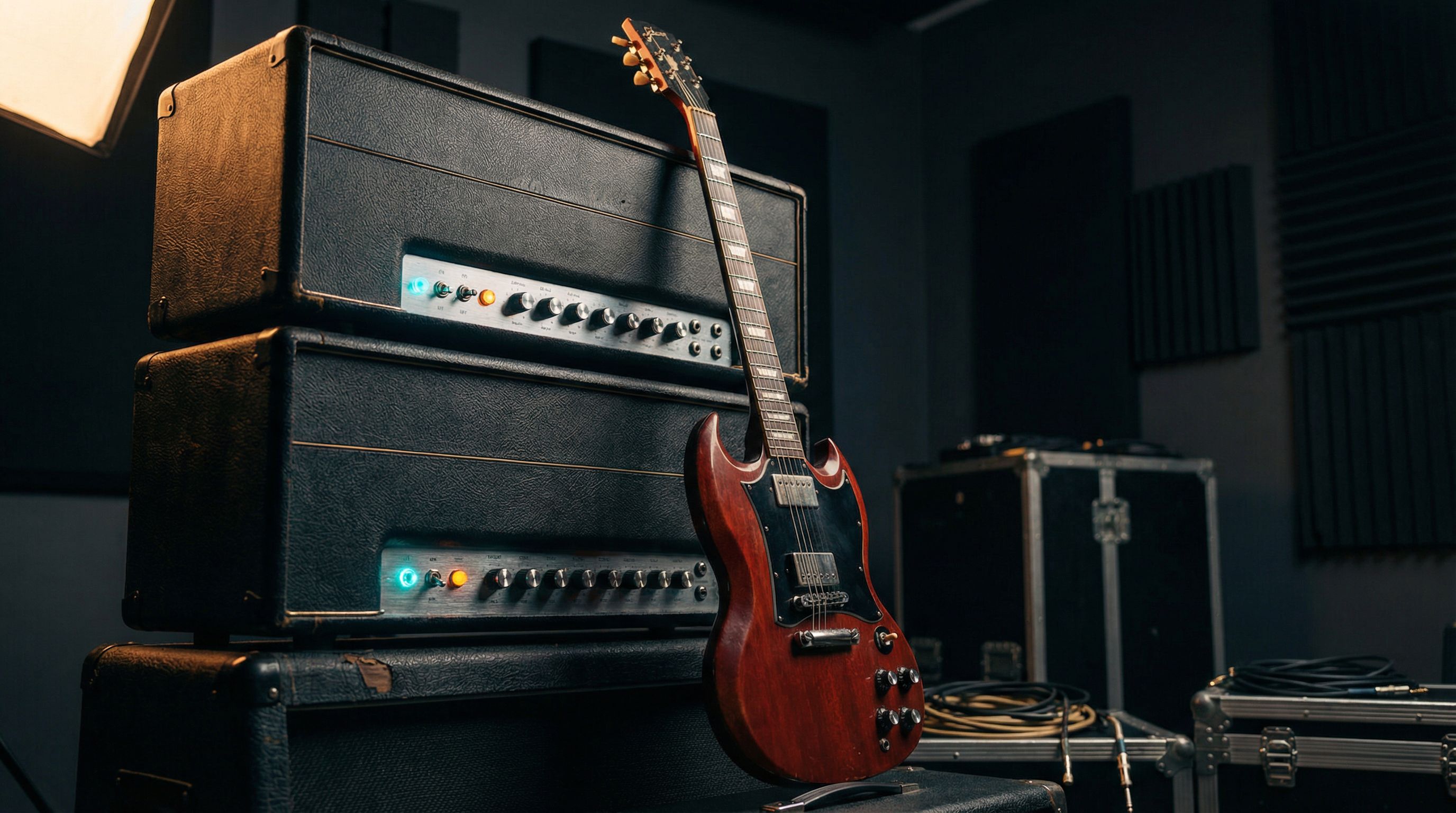
- A Gibson SG with PAF-style humbuckers into a Marshall running loud. The whole recipe starts here
- Marshall on the edge of breakup. Power amp saturation, not preamp gain. The volume is structural
- No pedals on most recordings. Dry, direct, loud. That's it
- Bon Scott era vs. Brian Johnson era. Two slightly different sounds with different EQ approaches
- Malcolm's rhythm tone is tighter than Angus's lead tone. They're playing different positions into similar rigs
What Makes AC/DC's Tone Deceptively Simple?
Most players hear AC/DC and assume it's easy to dial in. Three chords, cranked Marshall, done. Then they plug in and wonder why it sounds nothing like the record.
The reason is that AC/DC's sound is built on the physics of loud amplifiers, not on clever settings or exotic gear. Angus Young's tone comes from a Marshall Super Lead being driven hard enough that the output transformers are working. The power section is saturating, the speakers are compressing, and the whole rig is operating at the upper edge of its design envelope. You can't replicate that behavior by turning the preamp gain up. You replicate it by running the amp loud.
The controls are simple. The execution is not. Volume is the variable that most players underestimate, and it's the one that matters most.
There's also a common mistake in how players approach this sound: they reach for gain. AC/DC's recordings have very little preamp-stage distortion. The crunch comes from power tubes working hard, from speaker excursion, and from Angus's picking attack. Pull the gain back. Push the volume up. That's the direction.
The Gear: SG, Marshall, and Why They Work Together
The Guitar
Angus Young plays Gibson SG Standards. He's played them since the early days and hasn't meaningfully deviated. The SGs he uses are loaded with PAF-style humbuckers. Low-to-medium output, clear note separation, enough output to push a Marshall into breakup without requiring a high-gain circuit.
The SG's body construction matters too. It's lighter than a Les Paul, and the resonance hits different. More mids, quicker attack, less low-end weight. That forward-mid character is what feeds a Marshall the right signal.
Malcolm Young used SG Specials and Gretsch guitars at various points, but his most iconic rhythm tone (the Back in Black-era sound that defines the band's main catalog) came from a battered Gretsch Jet Firebird loaded with a Dirty Fingers humbucker. The Gretsch has a different tonal character than Angus's SG: a bit thicker in the low-mids, tighter in the low end. Malcolm's rhythm tone sits below Angus's in the frequency spectrum. That's not an accident. It's how two guitars playing similar chords carve out separate space in a mix.
The Marshall
Angus Young used a 1959 Super Lead Plexi. That's the 100-watt Marshall that most players mean when they say "Marshall Plexi." Malcolm used a Super Bass, which is a similar circuit with a slightly different EQ voicing in the bass frequencies. Both amps were run hard.
For Back in Black (1980), the studio amps were modified Plexis with tighter low-end. The specifics are debated. What matters is the sound: a Plexi-circuit Marshall, run hard, doing its job.
The core point stands regardless of the specific variant: a Plexi-circuit Marshall, run loud, with the volume controls doing the work rather than the gain structure.
The complete guide to guitar amp types covers why Plexi-circuit Marshalls behave differently from master-volume designs. The short version: the gain staging is fundamentally different when there's no master volume to limit the power section.
Why They Work Together
An SG with PAF humbuckers into a Plexi Marshall produces a specific interaction. The pickups' output is high enough to push the Marshall's input stage into mild saturation but not so high that they collapse the amp's headroom at the input stage. The amp's tone stack (run with treble and bass relatively high and mids scooped, which is the "British voicing" that Plexi owners gravitate toward) shapes the SG's forward mids into something that sits well in a band mix.
The result is a tone with real low-end weight, a present midrange, and enough treble to cut through drums and bass without getting shrill. No EQ pedal. No overdrive stacking. Just the right guitar into the right amp at the right volume.
Core Rhythm Tone: Marshall Settings
These settings assume a Marshall Plexi-style 100-watt amp (a 1959 Super Lead or equivalent). If you're running a JCM800 or a master-volume Marshall, the approach requires adjustment: see the era section below.
| Control | Position | Notes |
|---|---|---|
| Presence | About 2 o'clock | Forward, immediate. This is where the attack lives |
| Treble | About 2 to 3 o'clock | High, but the amp's EQ stack shapes it before the power section |
| Middle | About 9 to 10 o'clock | Scooped. Let the guitar's natural mid character come through |
| Bass | About 2 o'clock | High. The low-end weight is structural to the sound |
| Volume (preamp) | As high as the room allows | Power section saturation is the mechanism, not a bonus |
| Master volume | N/A on Plexi | No master volume. All control is at the preamp volume stage |
The mids-scooped, bass-and-treble-up setting is the "Marshall smile." It's called that because the EQ curve looks like a smile on a flat graphic EQ. It's the British rock default for a reason. On a Plexi being run loud, the mids that appear scooped on the control panel come back in the power section response. The amp fills the midrange back in as the output section saturates.
If you're running a JCM800 or a modern master-volume Marshall, the JCM800 settings guide covers the specific differences in approach. The gain structure is different enough that the Plexi settings above won't transfer directly.
Era Breakdown: Bon Scott vs. Brian Johnson
AC/DC's tone isn't static across their catalog. There are two distinct eras with different sonic signatures. Getting them right means knowing which you're chasing.
Bon Scott Era (1975–1979): Highway to Hell and Before
The Bon Scott records (High Voltage, Let There Be Rock, Powerage, Highway to Hell) have a rawer, more stripped quality than the post-Back in Black catalog. The production is simpler. The tones are less polished. There's more low-mid grit and less of the mid-scoop clarity that defines the Johnson-era records.
Part of this is production budget and studio approach. Part of it is that the amps were being run at the edge of their physical limits in smaller studios. The recorded sound has a compressed, almost amp-about-to-explode quality on tracks like "Let There Be Rock" and "Whole Lotta Rosie."
Angus Young's tone in the Bon Scott era tends to have more midrange presence and a slightly less refined high end. It's rawer and more forward. Less polished, more dangerous.
Bon Scott Era Settings (Plexi):
| Control | Position | Notes |
|---|---|---|
| Presence | About 1 to 2 o'clock | Slightly less presence than the Johnson era |
| Treble | About 2 o'clock | Present, but not as pushed as later recordings |
| Middle | About 10 to 11 o'clock | Less scooped than Back in Black; more raw midrange |
| Bass | About 2 o'clock | Similar to core tone; the low-end weight stays |
| Volume | Maximum practical | This era depends on raw power section saturation |
The key distinction from the core table: don't scoop the mids as aggressively. The Bon Scott records have a more forward, less polished mid character. Let the mids breathe a little more.
Brian Johnson Era (Back in Black and Beyond)
Back in Black (1980) is the defining document of AC/DC's sound for most listeners. The production is more deliberate, the tones are tighter and cleaner, and the rhythm guitar has a precision that the Bon Scott records don't always have. This is partly Mutt Lange's production and partly the custom Marshall circuit used for some of the sessions.
The Johnson-era tone has more of the "smile" EQ curve: bass and treble high, mids scooped. The result is a tighter, more focused sound. The rhythm guitar cuts through more cleanly. The low end is tighter. Less of the Bon Scott era's slightly wooly low-mid character, more controlled weight.
Angus's lead tone in this era is also slightly more forward in the treble. The solo work on "Back in Black" and "You Shook Me All Night Long" has a brighter, more cutting quality than the Highway to Hell leads.
Brian Johnson / Back in Black Era Settings (Plexi or Plexi-style):
| Control | Position | Notes |
|---|---|---|
| Presence | About 2 to 3 o'clock | More presence. The tone is brighter and more cutting |
| Treble | About 3 o'clock | High. The Johnson-era records have real treble on the guitar |
| Middle | About 9 o'clock | More scooped than the Bon Scott era |
| Bass | About 2 o'clock | Same weight, same position. This doesn't change |
| Volume | Maximum practical | Same logic. Power section saturation is still the mechanism |
The treble and presence difference between eras is not huge. We're talking about moving knobs a clock position or so. But in the context of a band playing loud, that difference is audible and meaningful.
Angus vs. Malcolm: Same Spirit, Different Jobs
Here's something most players miss: Angus Young and Malcolm Young were not playing the same tone.
Angus plays lead, plays riffs, plays solos. His tone is set up to project. Bright, cutting, slightly more aggressive in the upper mids. He needs to be heard over Malcolm's rhythm.
Malcolm plays rhythm. His job is to anchor the band, define the chord voicings, and provide a foundation that Angus can play over. His tone is thicker, tighter in the low end, and slightly less aggressive in the high mids. Malcolm's rhythm tone sits below Angus's in the frequency spectrum. Two guitars, two EQ curves, one sound.
The tool Malcolm used for this was primarily amp placement in the room and pickup choice. His Gretsch Jet Firebird with the Dirty Fingers humbucker has a fatter, more compressed character than Angus's SG PAFs. He also reportedly ran his amp with more bass and slightly less presence. His job was to be the wall of rhythm guitar, not to cut through it.
Malcolm's Rhythm Tone Adjustments (relative to Angus's settings):
| Control | Change | Notes |
|---|---|---|
| Presence | Pull back about a clock position | Less projection. His job is body, not cut |
| Treble | Pull back about a clock position | Thicker, less cutting |
| Middle | Nudge up slightly, around 10 to 11 o'clock | More low-mid body |
| Bass | Same or slightly higher | The rhythm foundation is all bass weight |
These are adjustments, not a separate recipe. Start with the core Marshall settings above and modify in the direction indicated. Malcolm's tone is the rhythm bed. Angus's tone is what plays on top.
How to Approximate on Modelers
The AC/DC tone is one of the harder classic rock tones to nail convincingly on a modeler. Not because of the gear complexity (there isn't much), but because so much of the sound comes from power amp saturation at high volume. Modelers simulate that behavior, but the physical reality of 100 watts pushing a 4x12 at stage volume is something a modeler approximates rather than replicates.
That said, the approximations are very usable. Here's where to start.
On Helix
The two most relevant amp models are "Brit Plexi Jump" (based on the Marshall 1959 Super Lead) and "Brit 2204" (based on the JCM800, if you want more preamp gain character). For AC/DC, start with the Brit Plexi Jump.
Helix starting settings (Brit Plexi Jump):
| Parameter | Setting | Notes |
|---|---|---|
| Gain | About 35–40% | Low. Power amp saturation is the mechanism, not preamp gain |
| Bass | About 65% | High; matches the amp's voicing |
| Mid | About 30–35% | Scooped |
| Treble | About 65–70% | High |
| Presence | About 60–65% | Forward |
| Volume/Master | About 65–70% | Push the power section model |
| Cab | 4x12 with Greenback IRs | G12M or G12H30, not V30s (too mid-forward) |
No drive block before the amp. If you're tempted to add one, read the pedals section below first. AC/DC's recorded tone had no pedal in most cases.
On Quad Cortex
The QC has community and factory captures of Plexi-style Marshalls available in the Cloud library. Look for captures labeled "Super Lead," "Plexi," or "1959." Quality varies; verified captures from reputable providers are preferable to random community uploads.
For the built-in amp models, the Marshall-based models (look for "Brit" in the name) are the starting point. Set them with the same logic as the Helix approach: low gain, high bass and treble, scooped mids, push the output stage. QC's power amp modeling is generally effective enough to get into the right territory.
One practical note for both platforms: the "feel" of power amp saturation on a modeler differs from the real thing. The pick response and dynamic compression behavior of a real Plexi at volume is not identical to a modeled version. It's close enough to be usable on a gig or in a recording context. It's not the same.
Pedals: Do You Even Need One?
Short answer: probably not.
AC/DC's foundational recordings were made with guitar directly into amp. No overdrive pedal. No boost. The saturation on those records came from the amp being pushed hard. The gain staging is all happening in the amp, not in a pedal before it.
That said, there are two situations where a pedal is useful.
When you can't run the amp loud enough: If the amp needs to run at lower volume (rehearsal studio, bedroom practice, any situation where you can't push the power section), an overdrive pedal before the amp can compensate by adding some of the saturation the amp would normally provide at high volume. The key is using the overdrive to push the amp's input stage rather than to add fuzz or heavy clipping. A Tube Screamer-style pedal works well here. Set the gain low to medium on the pedal and use it to hit the amp's input harder. The Tube Screamer settings guide covers this application: low gain, volume boosted above unity.
When you want more edge: Angus Young occasionally used a treble booster (a Rangemaster-style circuit or similar), particularly in the early catalog. A treble booster doesn't add overall gain across the frequency spectrum; it boosts the high-mids and treble specifically before hitting the amp's input. The effect is a brighter, more cutting, slightly more aggressive version of the same amp tone. If you want the Let There Be Rock era attack and your amp's base tone is a touch thick or dark, a treble booster is the period-accurate way to sharpen it. A Dallas Rangemaster clone (or a modern equivalent like the Catalinbread Naga Viper) is the tool.
What you don't want is a high-gain overdrive or distortion pedal. The difference between an overdrive and a distortion matters here. An overdrive pushing an amp is still fundamentally amp distortion shaped by a pedal boost. A distortion pedal replacing amp saturation sounds like a distortion pedal, not like a cranked Marshall. The overdrive vs. distortion vs. fuzz guide covers the circuit difference in detail if this isn't intuitive.
The Treble Booster: The Optional Secret
If you're chasing the earliest AC/DC recordings and your amp isn't quite getting there, a treble booster is worth understanding.
A Rangemaster-style treble booster is a germanium transistor boost that rolls off low frequencies at its input and boosts high-mids and treble. What comes out of the pedal is a signal with more high-mid content than went in. When that signal hits the Marshall's input stage, it drives the amp into breakup from a frequency range that produces a specific character. Brighter, more cutting, more forward in the upper mids.
The treble booster isn't adding distortion itself. It's telling the amp which part of the frequency spectrum to saturate. The distortion character is still the amp's character. That's a meaningful distinction from running an overdrive into the amp.
Settings for a treble booster are simpler than an overdrive. Most Rangemaster clones have just a gain/level knob. Set it so the amp's breakup point is reached more easily. Don't push it so hard that the amp sounds compressed and choked. Let the amp breathe. The right amount of boost makes the amp respond faster to pick attack, not louder overall.
FAQ
What amp settings does Angus Young use?
Angus Young runs a Marshall Super Lead Plexi (or equivalent) with presence and treble high (around 2 to 3 o'clock), mids scooped (around 9 to 10 o'clock), bass high (around 2 o'clock), and the preamp volume cranked for power amp saturation. The exact positions shift slightly between eras. The Bon Scott recordings have less mid-scoop, the Brian Johnson recordings have more presence and treble. The constant across both is the amp being run loud.
Can I get AC/DC tone from a modern Marshall with a master volume?
You can get close. The fundamental challenge is that a master-volume Marshall's gain structure is different from a Plexi. The preamp gain stage is designed to provide the saturation that a Plexi's power section provides. Set the preamp gain (or "gain" knob) fairly low, around 9 to 10 o'clock, and push the master volume as high as the room allows. You want the output stage doing the work, not the preamp stage doing it all. The result won't be identical to a Plexi, but it's the right approach on a master-volume amp.
Did Angus Young use any effects?
On most recordings, no. AC/DC's studio sound was dry guitar directly into Marshall. No chorus, no delay, no reverb on the guitar. The occasional treble booster before the amp, particularly in the early catalog. Live, Angus has occasionally used a small amount of short room reverb, but it's not a significant component of the tone.
What's the difference between Angus's tone and Malcolm's?
Angus's lead tone is brighter, more forward in the upper mids, and set up to project and cut through the mix. Malcolm's rhythm tone is thicker, tighter in the low end, and lower in the frequency spectrum. He provides the rhythmic and harmonic foundation that Angus plays over. Same general rig concept, different EQ approach and pickup character. Malcolm's Gretsch with a Dirty Fingers humbucker has a naturally thicker, more compressed character than Angus's SG with PAF-style pickups.
Why does my AC/DC tone sound thin at low volumes?
Because AC/DC's tone depends on power amp saturation and speaker compression that only happens at volume. At low volume, the amp is operating in a clean range and the distortion you hear is mostly preamp-stage. The result is thinner, buzzier, and less full than the record. Solutions: run the amp through a power attenuator (keeps the amp loud, reduces speaker volume), use a low-wattage Marshall-style amp that reaches power section saturation at lower volumes, or use a modeler with the power amp and speaker simulation doing the work. Turning up the gain control to compensate makes it worse. More preamp distortion is not the same as more power amp saturation.
Should I use the neck or bridge pickup for AC/DC rhythm tone?
Bridge pickup for rhythm, in almost all cases. Angus and Malcolm both use the bridge pickup for the chunk and attack that defines AC/DC's rhythm tone. The bridge pickup has more attack, more high-mid presence, and more compression from the humbucker's behavior at that position. The neck pickup is too warm and round for the AC/DC rhythm character. It softens the attack in a way that works against the aggressive, driving quality the rhythm parts need.