Why Amp Type Matters More Than You Think
The amplifier is the single biggest factor in electric guitar tone. More than pickups, more than pedals, more than strings. Everything in a signal chain ultimately feeds into an amplifier that shapes, colors, and projects the sound. Understanding how different amp types work isn't just gear knowledge; it changes how you buy, how you set up, and how you play.
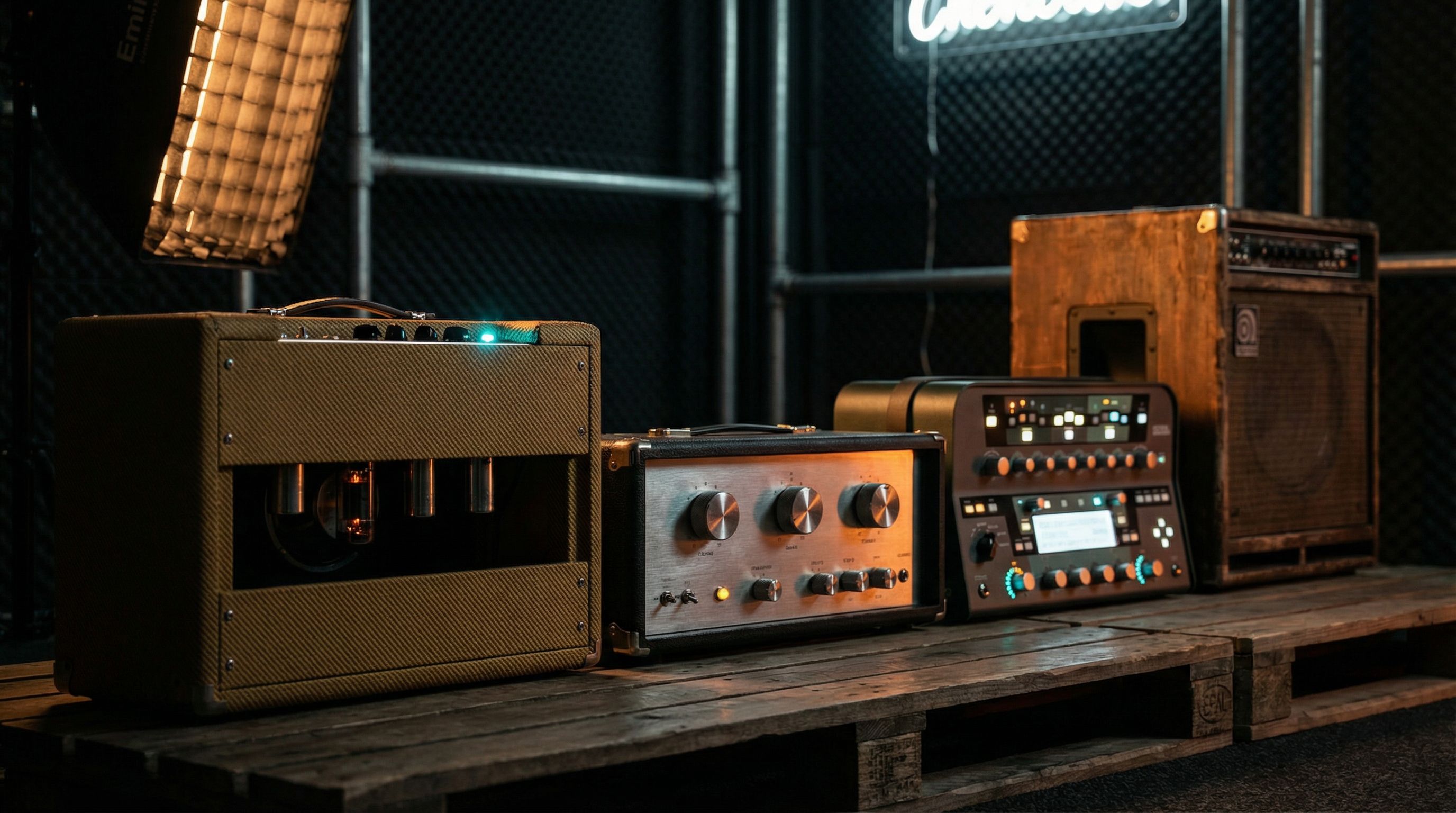
There are four broad categories of guitar amplifiers: tube (also called valve), solid-state, modeling, and hybrid. Each one handles the signal differently, responds to playing dynamics differently, and sounds different. None of them is objectively "the best." But each one has a job it does better than the others.
Tube Amps: The Gold Standard (and Why)
Tube amps have been the backbone of electric guitar tone since the 1940s. Nearly every iconic guitar sound (from the clean shimmer of a Fender Twin Reverb to the roaring crunch of a Marshall Plexi) was produced by vacuum tubes. The technology is eighty years old, and nothing has fully replaced it.
How Tube Amps Work
A tube amp has four main sections, and understanding each one helps explain why they sound the way they do.
The Preamp is where the guitar signal enters. Preamp tubes (usually 12AX7 tubes, sometimes 12AT7 or 12AU7) amplify the tiny signal from the pickups and shape it with the EQ controls. When you turn up the gain or volume knob on most amps, you're driving the preamp tubes harder, which causes them to clip, and that clipping is what we call overdrive or distortion. Tube clipping is asymmetrical, which is a fancy way of saying it rounds off the signal unevenly. That's what gives tubes their warm, musical quality when they distort. It's the same reason a cranked Deluxe Reverb sounds sweet while a cranked transistor amp can sound harsh; the tubes are just doing something different to the signal on a fundamental level.
The Power Amp takes the shaped signal from the preamp and amplifies it to a level that can drive speakers. Power tubes are bigger than preamp tubes, and their type has a massive impact on the amp's character.
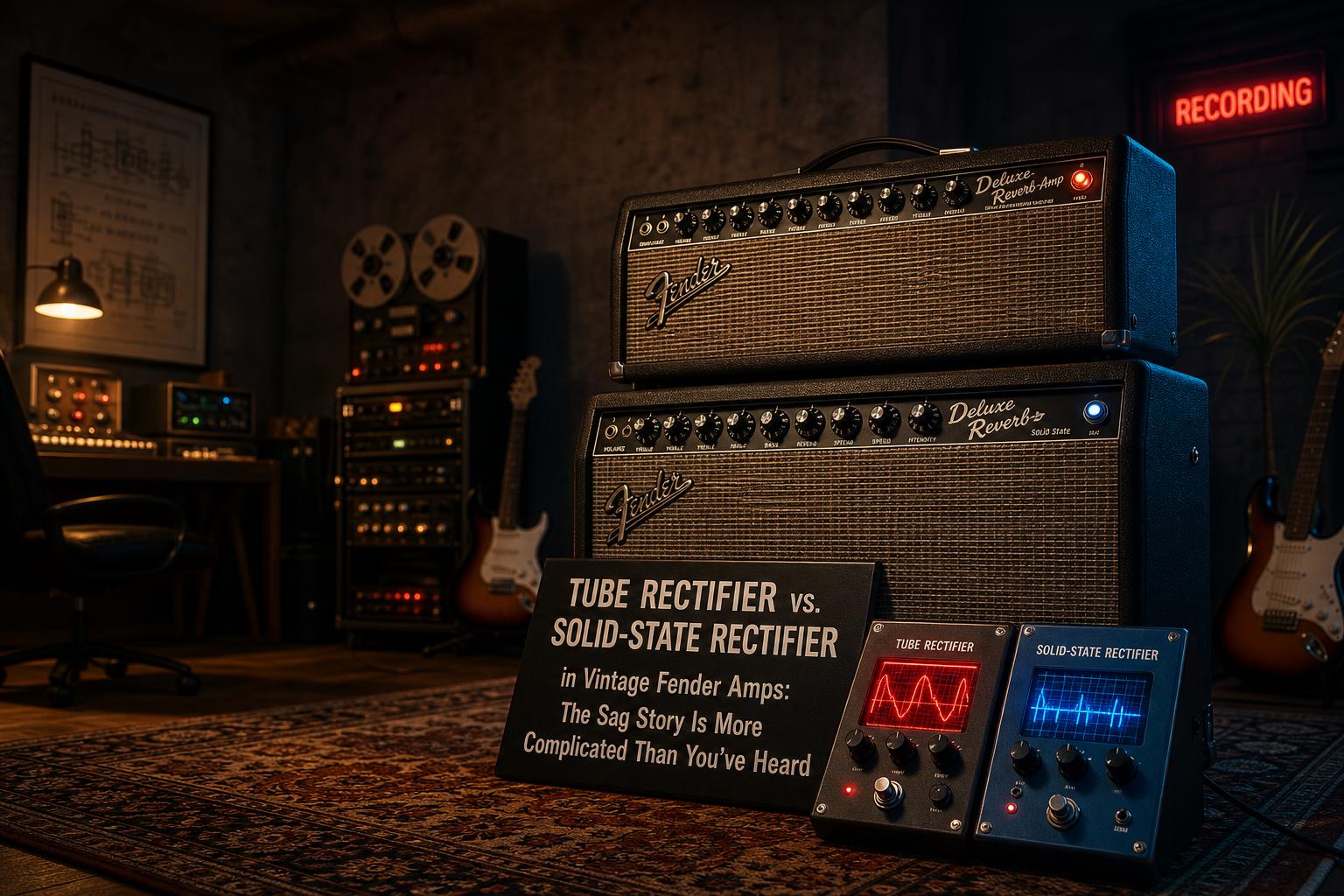
The Rectifier converts AC power from the wall into DC power that the tubes need to operate. There are two types, and the distinction matters more than most players realize:
- Tube rectifiers (like the GZ34 or 5AR4) introduce a slight voltage sag under heavy load. When you hit a big chord, the rectifier can't keep up instantly, and the power supply dips for a split second before recovering. This creates a compression effect: a soft, yielding attack followed by a bloom of sustain. It's one of the things that makes old Fender amps and Vox AC30s feel so responsive. The note pushes back against you, then opens up. Players in the 1950s didn't design this on purpose; it was a limitation of the available rectifier tubes. But the resulting feel became so desirable that modern amp builders still include tube rectification as a deliberate design choice.
- Solid-state rectifiers (silicon diodes) deliver power instantly with no sag. The result is a tighter, more immediate response. Many high-gain amps use solid-state rectification because precision and punch matter more than sag at extreme gain levels. Mesa Boogie's Dual Rectifier famously offers a switch between the two.
I expected the rectifier to be a subtle difference (one of those things only engineers notice). What I found, after years of swapping rectifiers in the same chassis, is that it changes the feel of the amp as dramatically as swapping power tubes. Players who can't articulate why one amp feels "spongy" and another feels "stiff" are usually describing the rectifier.
The Output Transformer is the last stage. It matches the high-impedance output of the power tubes to the low-impedance speakers. The size and quality of the output transformer affects the low-end response, the overall headroom, and the amp's "feel." Cheap transformers can sound thin and compressed. Great transformers let the amp breathe. This is one reason why a hand-wired boutique amp can sound noticeably different from a budget tube amp using the same tube complement. The iron matters.
Class A vs Class AB
These terms describe how the power tubes operate, and they have a real effect on tone and feel.
Class A means the power tubes are conducting signal for the full 360 degrees of the waveform. In practical terms:
- The tubes are always "on" and running hot
- The amp compresses naturally as it gets louder
- Distortion comes on gradually and smoothly
- Lower wattage for the number of tubes (a Class A amp with two EL84 tubes might put out 15-18 watts)
- The classic example is the Vox AC30: jangly, compressed, with a harmonic complexity when pushed that sounds like a choir agreeing on the same note from different directions
Class AB means two sets of power tubes alternate handling the positive and negative halves of the waveform. In practical terms:
- More efficient; more wattage from the same number of tubes
- Cleaner headroom at lower volumes
- Distortion comes on more suddenly, with a sharper transition from clean to dirty
- Most amps are Class AB, including Fender Twins, Marshall Plexis, and Mesa Boogies
Neither class is better. Class A gives you that compressed, singing quality that works beautifully for blues and jangly rock. Class AB gives you more headroom and a punchier, more defined response that scales from sparkling cleans to tight high-gain. Different tools for different jobs.
Common Power Tube Types and Their Character
The choice of power tube shapes the entire personality of an amp. This is where amp voicing starts (not at the EQ knobs, but at the glass).
EL34. The British tube. Found in Marshall JCM800s, Plexis, Hiwatts, and Orange amps. EL34s have a pronounced midrange emphasis with a grinding, aggressive quality when overdriven. The distortion is harmonically rich and complex; dense in the way a well-aged wood is dense, where pushing harder reveals more layers rather than just more volume. If you think of classic British rock (AC/DC, Iron Maiden, early Van Halen on the Marshall side), you're hearing EL34s. They break up earlier than 6L6s and have a more aggressive character in the mids.
6L6. The American tube. Found in Fender Twins, Deluxes, and Mesa Boogies. 6L6 tubes have more clean headroom, a scooped midrange (more bass and treble relative to mids), and a rounder, smoother overdrive when pushed. Think of Fender's sparkling cleans, or the thick sustain of a Mesa Mark series. 6L6 amps tend to feel bigger and more open, with deeper bass response (like the difference between a room with hardwood floors and one with carpet). Stevie Ray Vaughan's tone through his Vibroverbs and Super Reverbs sits squarely in 6L6 territory.
EL84. The compact British tube. Found primarily in Vox AC15s and AC30s, as well as many lower-wattage boutique amps. EL84s have a chimey, jangly quality when clean and a thick, compressed overdrive when pushed. They break up at lower volumes than EL34s or 6L6s, which makes EL84 amps fantastic for getting overdriven tones at manageable volume. The Beatles, The Edge, Brian May: all EL84 tone.
6V6. The small American tube. Found in smaller Fender amps like the Deluxe Reverb and Champ. 6V6 tubes break up earlier than 6L6s and have a warmer, slightly compressed quality; less headroom, more give, like a conversation at close range versus one shouted across a field. The Fender Deluxe Reverb with 6V6 tubes is arguably the most recorded amp in history.
KT66 and KT88. Found in some Marshall and Hiwatt designs. KT66 tubes have a warm, round quality (think early Marshall JTM45). KT88 tubes have enormous clean headroom with a tight, punchy response; Hiwatt's signature sound that David Gilmour used extensively. The KT88 in a Hiwatt DR103 delivers clean power that fills a stadium and still has room to spare.
Why Tube Amps "Feel" Different
Tube amps are reactive. When you pick softly, the amp stays clean and responds with a warm, open tone. When you dig in hard, the tubes clip more and the tone becomes crunchier and more compressed. This happens on a note-by-note, pick-stroke-by-pick-stroke basis. The amp is constantly responding to dynamics in a way that feels like a conversation between the player's hands and the speaker.
This dynamic response comes from several factors working together:
- Soft clipping: tubes transition from clean to distorted gradually, not suddenly
- Power supply sag: the voltage drops momentarily on hard attacks, creating natural compression
- Speaker interaction: the impedance of the speaker changes with frequency and volume, and tube amps respond to this impedance curve (solid-state amps don't)
- Touch sensitivity: rolling the guitar volume back from 10 to about 7 on a tube amp can take you from crunchy to clean, because the preamp tubes respond to the reduced input level
This is the "feel" that guitarists talk about. It's real, it's measurable, and it's the primary reason tube amps remain the benchmark after eighty years.
Solid-State Amps: Reliability and Clean Power
Solid-state amps replace vacuum tubes with transistors. They've carried an unfair reputation for decades, but they have genuine strengths that tube amps can't match.
How Solid-State Amps Work
Instead of vacuum tubes, solid-state amps use transistors and op-amps (operational amplifiers) to amplify and shape the guitar signal. The gain stages work on the same basic principle (amplify the signal, clip it for distortion), but the way transistors clip is fundamentally different from tubes.
Transistor clipping is symmetrical, meaning it chops the signal off evenly on both sides. The result tends to sound harsher and buzzier than tubes, especially when you push the gain up high. This is why solid-state distortion has historically gotten a bad rap. It's not that it sounds "bad" exactly; it just sounds different, and most players over the years have preferred what tubes do.
However, solid-state amps have real advantages:
- Reliability: No tubes to replace, no biasing needed, less heat, longer lifespan. A solid-state amp can sit in a closet for 20 years and fire up like new.
- Consistency: They sound the same every time you turn them on. Tubes drift as they age, and even ambient temperature affects tube amps. Solid-state amps are predictable.
- Clean headroom: Solid-state amps can deliver massive, pristine clean tones at any volume. The Roland JC-120 Jazz Chorus is the most famous example; its cleans are so crystalline and defined that Andy Summers and Robert Smith both chose it over any tube amp for clean tones. The JC-120's chorus circuit, built into the power amp topology itself, produces a stereo shimmer that no pedal has fully replicated (not because the effect is complex, but because it's inseparable from the amp's solid-state architecture).
- Weight and cost: Generally lighter and cheaper than equivalent tube amps.
- Built-in effects: Many solid-state amps include onboard chorus, reverb, and other effects integrated into the circuit design.
When Solid-State Shines
The best solid-state amps lean into their strengths instead of trying to sound like tube amps:
- Pristine cleans: The JC-120, Quilter amps, and many acoustic amps use solid-state circuits because they can deliver perfectly clean amplification without coloration.
- Practice and home use: Solid-state amps sound good at low volumes because they don't need to be cranked to come alive. A tube amp at bedroom volume often sounds thin and lifeless. A solid-state amp at bedroom volume sounds pretty much like it does at any volume.
- Bass guitar: Most bass amps are solid-state because bass frequencies demand clean headroom and tight low-end response. Tube bass amps exist (and they're glorious), but they're heavy, expensive, and not always what the gig requires.
- Pedal platforms: A clean, transparent solid-state amp makes an excellent pedal platform because it amplifies your pedals faithfully without adding its own color.
Modeling Amps: Digital Recreation of Analog Tone
Modeling amps use digital signal processing (DSP) to simulate the behavior of tube amps, solid-state amps, effects pedals, and speaker cabinets, all inside a single unit. The technology has reached a point where the gap between the model and the original is, for many practical purposes, gone.
How Modeling Works
At the core of every modeling amp is a processor running mathematical recreations of what happens inside an analog circuit. There are several approaches:
Component-level modeling (used by Line 6 Helix, Fractal Axe-FX) breaks down an amp circuit into individual components (each resistor, capacitor, tube, and transformer) and simulates their behavior and interactions. This is computationally expensive but produces the most realistic results because it captures the nonlinear interactions between components that create the "feel" of a real amp.
Profiling/capturing (used by Kemper, Quad Cortex) takes a different approach. Instead of modeling the circuit, it sends test signals through a real amp and analyzes the output to create a mathematical "snapshot" of how that specific amp, at those specific settings, responds to input. The result is eerily accurate for that one setting, but you can't tweak the virtual knobs the same way you'd tweak the real amp, because the capture doesn't know about the circuit, only the result. It's the difference between a blueprint and a photograph: the photograph is perfect at one angle, but the blueprint lets you walk around the building.
Behavioral modeling (used by Boss Katana and many mid-range modelers) aims for a middle ground. It doesn't model every component, but it captures the broad behavior of an amp type (its EQ curve, gain structure, and dynamic response) and recreates it digitally. Less CPU-intensive, which means it can run on cheaper hardware, but less detailed.
Why Modelers Have Gotten So Good
Modern modelers are stunningly close to the real thing:
- Processing power: The DSP chips in a Helix or QC are orders of magnitude more powerful than what was available even 10 years ago. More power means more accurate models with more component-level detail.
- Impulse responses (IRs): Speaker cabinet simulation used to be the weak link in modeling. IRs solved this. A great IR makes a massive difference, and modern modelers ship with excellent ones.
- Years of refinement: Companies like Line 6 and Fractal have been iterating on their algorithms for over a decade. Each generation gets closer. Blind tests consistently show that experienced players can't reliably distinguish the model from the original, a result that would have been unthinkable in 2010.
The Big Three (and Katana)
Line 6 Helix. Component-level modeling with an intuitive interface. Known for its excellent amp models and deep editing capabilities. The workflow is fast, the screen is big, and the learning curve is gentler than Fractal. The Helix ecosystem (Helix Floor, Helix LT, HX Stomp, POD Go) covers every price point.
Neural DSP Quad Cortex. Combines traditional amp modeling with neural captures. The touchscreen interface is polished, the captures can be eerily accurate, and the Cortex Cloud lets you download thousands of user-created captures. Its strength is that you can capture your own real amps and take them with you digitally. (For a detailed breakdown of when to use captures versus models, see our Quad Cortex captures vs models guide.)
Fractal Axe-FX III. The deepest, most tweakable modeler on the market. Fractal's amp modeling is arguably the most accurate, with an almost obsessive level of parameter control. The tradeoff is complexity; the learning curve is steep, and the interface is less intuitive than Helix or QC. But for players who want to dial in every last detail, nothing else comes close.
Boss Katana. Not in the same league as the Big Three for recording or professional use, but it deserves mention because it's the most popular modeling amp in the world for good reason. The Katana series delivers quality tones at accessible prices, with a simple interface that doesn't overwhelm beginners. The Katana's "Sneaky Amps" (hidden amp types accessible through the Boss Tone Studio software) include excellent Fender, Marshall, and Vox-style voicings.
How Modelers Recreate Specific Amp Types
Here's what's actually happening when you select a "Fender Twin" model on a Helix, and this is where the engineering becomes genuinely fascinating.
The DSP is running a mathematical simulation of the Twin Reverb's circuit: the 12AX7 preamp tubes, the 6L6 power tubes, the solid-state rectifier, the output transformer, the tone stack (Fender's distinctive bass-mid-treble circuit), and the negative feedback loop. It's calculating how each component responds to the input signal in real time, thousands of times per second.
When you turn the virtual "Drive" knob up, the signal level hitting the virtual preamp tubes increases, causing them to clip in the same asymmetrical, even-harmonic way real tubes do. When you pick harder, the increased signal pushes the virtual power amp harder, and the simulation recreates sag and compression accordingly.
The result is a digital signal that behaves like the output of a real amp. Feed that into a good IR (or a real speaker cab via a power amp), and the difference between the model and the real thing becomes surprisingly small.
Hybrid Amps: The Best of Both Worlds?
Hybrid amps combine tube and solid-state technology in the same chassis, typically using a tube preamp for tone-shaping and a solid-state power amp for amplification.
How Hybrids Work
The idea is straightforward: the preamp is where most of the tone is shaped, and tubes excel at this. The power amp just needs to make that tone louder, and solid-state does this reliably, cheaply, and with less weight. Combine them.
The most common hybrid design puts one or two 12AX7 preamp tubes in front of a solid-state power section. You get real tube saturation and harmonic complexity in the gain stages, plus the reliability and lightweight portability of a transistor power amp.
Examples include:
- Vox Valvetronix series: A 12AX7 tube in the preamp section combined with Vox's modeling technology and a solid-state power amp
- Marshall Valvestate series: One of the first popular hybrids, with a tube preamp and transistor power amp. These found a wide audience among working musicians in the late 1990s who needed tube character without tube maintenance.
- Blackstar HT series: Uses Blackstar's patented ISF (Infinite Shape Feature) circuit with a tube preamp
The Honest Tradeoff
Hybrids get you real tube harmonics in the preamp, which is where most of your distortion character comes from. What you lose is the power amp interaction: that sag, compression, and speaker feedback that happens when tube power sections are pushed hard. A solid-state power amp is linear and predictable where a tube power amp is dynamic and reactive.
For many players, this is a perfectly acceptable tradeoff. If you use a lot of pedals and keep your amp relatively clean, the power amp character matters less. If you're cranking the amp for natural overdrive, chasing that sweet spot where the whole circuit is interacting — you'll miss the tube power section.
The Classic Amp Voicings: A Player's Guide
Regardless of the technology, most guitar amps fall into a handful of "families" that define their sonic character. These voicings show up in tube amps, modeling amps, and everything in between.
Fender: Clean Headroom and Sparkle
The sound: Scooped mids, sparkling highs, deep bass, enormous clean headroom. Fender amps are the definition of "American clean": bright, open, and three-dimensional. When Leo Fender designed these circuits in the 1950s, he was building for steel guitar and country players who needed volume without distortion. The jazz and rock applications came later, but the architecture he created proved adaptable enough to define multiple genres.
The circuit: Fender's tone stack naturally scoops the midrange. Even with the mid knob at 10, a Fender amp has less midrange than a Marshall at 5. This is a design choice, not a flaw; it creates that open, spacious quality.
Key amps: Twin Reverb (the workhorse), Deluxe Reverb (the recording favorite), Princeton Reverb (the small-room secret weapon), Bassman (the original that inspired Marshall).
Best for: Country, blues, jazz, funk, indie, worship, anything that needs pristine cleans. Also exceptional as a pedal platform; Fender cleans take drive pedals beautifully. The Tube Screamer into a Fender circuit is one of the foundational combinations in electric guitar.
Marshall: Mid-Forward Crunch
The sound: Thick, aggressive midrange with a grinding overdrive that defined rock and roll. Jim Marshall took the Fender Bassman circuit, modified the tone stack to emphasize midrange, and created what became the sonic identity of rock guitar. The change was not dramatic on paper (a few component values in the tone stack), but the result was a completely different instrument.
The circuit: Marshall's tone stack emphasizes the midrange, which is why Marshalls cut through a band mix so effectively. The preamp gain structure clips earlier and more aggressively than Fender, giving you that classic crunch at moderate volumes.
Key amps: Plexi 1959 Super Lead (the original rock amp), JCM800 (the 80s rock standard), JCM900 (more gain), Silver Jubilee (Slash's amp), DSL series (modern versatility).
Best for: Classic rock, hard rock, blues-rock, punk, metal (with a boost pedal). Marshalls love humbuckers, and they respond exceptionally well to a mid-boosting drive pedal in front.
Vox: Jangly, Compressed, Chimey
The sound: Bright, jangly, with a rich harmonic complexity and natural compression. Vox amps have a chime that no other amp family quite matches: a shimmering, bell-like quality in the upper harmonics that sounds less like a single note and more like the note plus its reflections arriving simultaneously.
The circuit: Class A operation (in the AC30 and AC15) creates that natural compression and harmonic richness. The Top Boost circuit adds a brilliant, cutting treble. Vox amps break up early and compress beautifully, which is why they sound so good when cranked.
Key amps: AC30 (The Beatles, The Edge, Brian May, Radiohead), AC15 (the smaller sibling, equally musical).
Best for: Jangle pop, Britpop, classic British rock, ambient music, anything that needs chime and shimmer. The AC30 with a touch of crunch and a delay pedal is one of the most iconic combinations in recorded music.
Mesa Boogie: Tight, Sculpted High Gain
The sound: Tight, focused, with a compressed and sculpted quality. Mesa amps range from crystalline cleans (on the clean channel) to crushing high-gain saturation. The distortion is thick but articulate; every note in a chord rings out clearly even at extreme gain levels.
The circuit: Randall Smith pioneered cascading gain stages, running the signal through multiple gain stages in series to build up massive amounts of distortion while keeping it defined. The graphic EQ on many Mesa amps (especially the Mark series) gives surgical control over the tone. Smith's insight was that high gain didn't have to mean high mess; careful gain staging could produce saturation that remained musical at levels previous amps couldn't reach without turning to noise.
Key amps: Dual Rectifier (nu-metal, modern hard rock), Mark V (the Swiss army knife), Lonestar (boutique cleans and crunch), JP-2C (John Petrucci's signature, prog-metal perfection).
Best for: Metal, progressive rock, hard rock, fusion. Mesa amps are the standard for modern high-gain guitar tone, but their clean channels are criminally underrated. The Lonestar clean is one of the finest clean tones available from a production amp.
Hiwatt: Clean Power and Headroom
The sound: Massive, clean, powerful, with an articulate midrange and tight bass. Hiwatt amps are the loudest clean amps ever made. A Hiwatt DR103 at full volume is staggeringly loud and still relatively clean. Where a Fender starts to break up, a Hiwatt stays composed.
The circuit: Hand-wired with military-spec components and enormous transformers. Dave Reeves designed these circuits in the late 1960s with an engineering philosophy closer to military radio equipment than consumer electronics, overbuilt at every stage. The circuit design emphasizes clean headroom and articulation. Even when pushed into overdrive, Hiwatts retain note definition and clarity.
Key amps: DR103 (the 100-watt beast David Gilmour used), DR504 (the 50-watt version).
Best for: Clean tones that need to fill a stadium, pedal-driven rigs (Gilmour ran extensive pedalboards into Hiwatts), and any application where massive clean headroom is required.
Dumble: Touch-Sensitive Overdrive
The sound: Smooth, vocal, touch-sensitive overdrive with a warmth and complexity that sits in a category of its own. Dumble amps respond to pick dynamics like no other. Whisper and they clean up; dig in and they sing with a rich, harmonically saturated overdrive. The tone is not so much "warm" as it is dimensionally deep. The note has a front, a middle, and a back, and you can feel the overdrive develop through all three as you increase your attack.
The circuit: Howard Dumble hand-built approximately 300 amplifiers, and he epoxied the circuits to prevent copying. The general principle involves a Fender-inspired circuit with a carefully voiced overdrive section that responds to input dynamics with extreme sensitivity. The scarcity created a mystique, but the engineering underneath the epoxy was genuine. Dumble understood something about gain staging and dynamic response that the rest of the industry spent decades trying to reverse-engineer.
Key amps: Overdrive Special (the holy grail; Robben Ford, Larry Carlton, John Mayer), Steel String Singer (SRV played one, among other Dumble designs).
Best for: Blues, jazz-fusion, sophisticated rock. If you need that vocal, singing lead tone that cleans up with a lighter touch, the Dumble voicing is the target. Originals cost six figures. Boutique builders like Two-Rock and Bludotone make inspired designs that get you in the neighborhood.
When to Use Each Amp Type
A practical breakdown:
Choose a tube amp when:
- Tone and feel are your top priority
- You play live and want that dynamic interaction with the amp
- You're willing to maintain tubes and deal with the weight
- You've found "your amp" and want to commit to that sound
Choose a solid-state amp when:
- You need pristine, consistent cleans (JC-120 territory)
- Reliability matters more than tonal character (touring, rental backlines)
- You're on a budget
- You want a lightweight, portable practice amp
Choose a modeling amp when:
- You need versatility: multiple amp tones in one unit
- You play direct (no mic'd cab) for recording or live
- You want to experiment with different amp types without buying them all
- You need consistent tone at any volume, any venue (if your modeler tone sounds harsh, our guide on why modeler tone sounds fizzy explains how to fix it)
Choose a hybrid when:
- You want real tube preamp character in a lighter, more reliable package
- You use lots of pedals and keep the amp mostly clean
- Budget matters but you want a step up from pure solid-state
The Bottom Line
There has never been a better time to be a guitarist shopping for amplification. Tube amps are still being made and still sound incredible. Solid-state amps have found their niche and serve it well. Modeling technology has reached a point where working professionals are switching from tube amps to modelers for tour and studio work. And hybrid amps offer a practical middle ground.
The best amp is the one that makes you want to play. Understand how each type works, try as many as you can, and trust your ears. The technology matters, but only in service of the music.