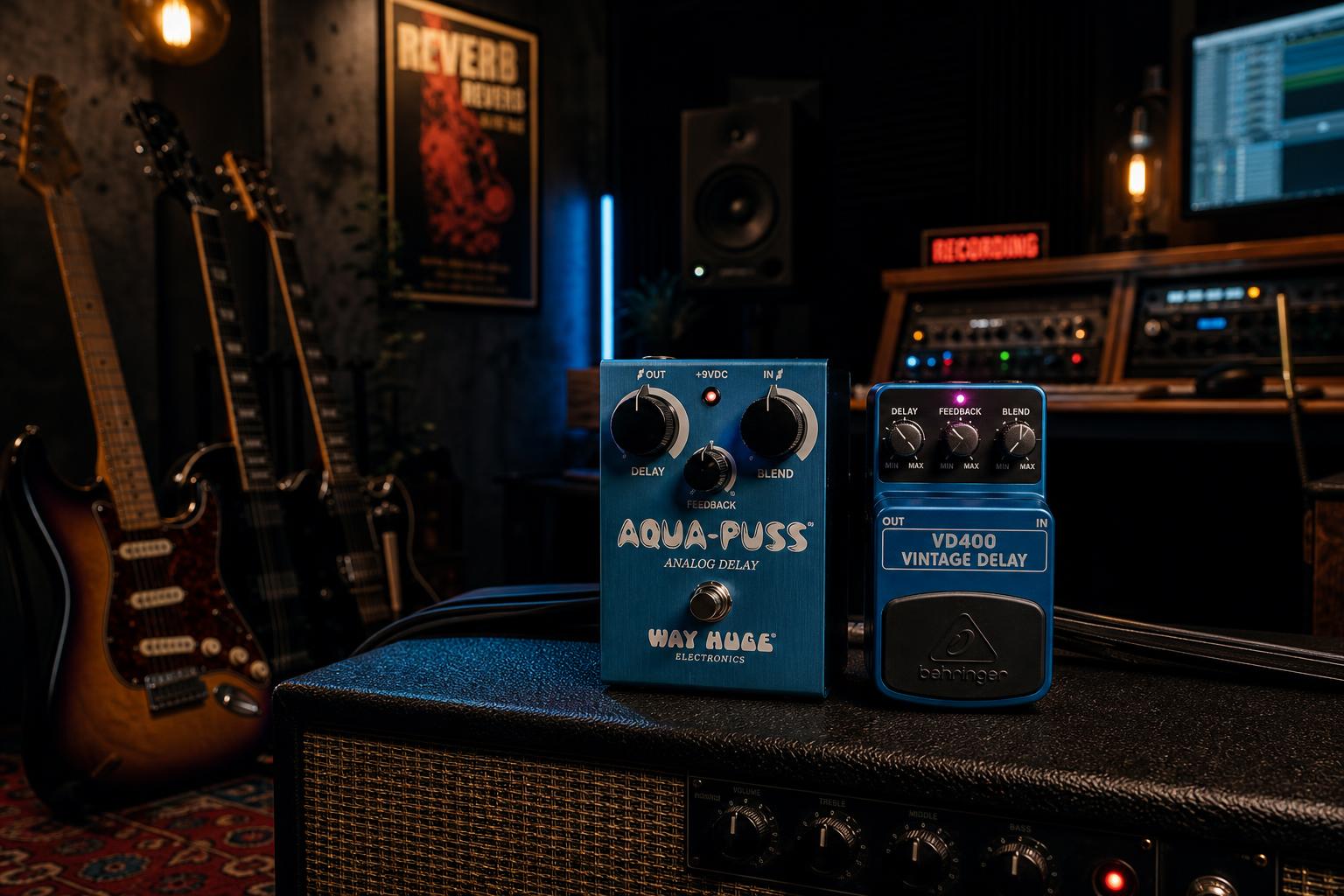
Quick read: The Behringer VD400 is a $30 plastic-enclosure clone of the Way Huge Aqua-Puss that uses a Cool Audio V3205 BBD chip — the same chip family used in the modern Aqua-Puss MkIII. The two pedals sound about 90% the same in side-by-side tests; the differences are in the input buffer, the modulation depth control, and the build quality. For bedroom use and recording, the VD400 is a legitimate substitute for the Aqua-Puss at one-fifth the cost. For touring or anything that involves a loaded pedalboard taking real abuse, the Aqua-Puss earns its price difference through enclosure durability and switch reliability — not through superior tone.
| Feature | Way Huge Aqua-Puss MkIII | Behringer VD400 |
|---|---|---|
| Price (new) | $150 | $30 |
| Price (used) | $90-115 | $15-25 |
| Enclosure | Cast metal, road-grade | ABS plastic |
| BBD chip | Cool Audio V3205 (modern reissue) | Cool Audio V3205 (same family) |
| Knobs | Speed, Depth, Mix | Repeat Rate (Speed), Echo (Mix), Intensity (Depth) |
| Bypass | True bypass | Buffered |
| Footswitch | Mechanical, 30-yr design | Click-pen feel, 2-3 yr typical life |
| Input/output jacks | Switchcraft, 1/4" | Plastic, 1/4" |
| Power | 9V DC standard | 9V DC standard |
| Max delay time | ~300 ms | ~300 ms |
| Modulation | Always-on, depth-controlled | Always-on, depth-controlled |
Why This Comparison Matters
The question isn't whether the VD400 sounds as good as the Aqua-Puss. It's whether the differences matter for how you actually use a delay pedal.
The interesting wrinkle: the modern Aqua-Puss MkIII no longer uses the original Reticon SAD1024 BBD chip from the 1990s. Reticon stopped making the SAD1024 decades ago and the remaining stock is collector-priced. Both the modern Aqua-Puss MkIII and the Behringer VD400 use a Cool Audio V3205 BBD chip — Cool Audio being a Behringer-owned company that produces modern reproductions of vintage BBD chips.
This is the key fact that makes the comparison interesting. When you buy an Aqua-Puss MkIII, you are not buying a vintage chip; you are buying a modern Cool Audio chip in a high-quality enclosure with a high-quality input buffer and switching. When you buy a Behringer VD400, you are buying the same modern Cool Audio chip in a low-cost plastic enclosure with a buffered bypass and a different supporting circuit.
The chip is the same family. The chip determines most of what an analog delay sounds like. So how different can the pedals be?
The A/B Listening Test
The test rig: a Fender Player Stratocaster on the bridge pickup into each pedal, then into a Line 6 HX Stomp running a Plexi model with a Greenback IR. Both pedals fed the same DI signal through identical signal chains. Pedal settings matched as closely as the differences in knob behavior allow:
- Speed (Aqua-Puss) / Repeat Rate (VD400): noon position on both, which lands around 200 ms
- Mix (Aqua-Puss) / Echo (VD400): noon position on both
- Depth (Aqua-Puss) / Intensity (VD400): 1 o'clock on both
The signals were recorded into a DAW for repeated listening and waveform comparison.
Tonal character of the dry-to-first-repeat transition: Essentially identical. On the bench, the VD400's repeats are slightly brighter on the first two taps. In a band mix, that difference disappears. Both pedals produce a first repeat that is darker than the dry signal, with high-frequency rolloff above about 4 kHz. The pick attack on the first repeat is recognizable on both, with the same softness compared to the dry signal. If you blind-tested two clips of the first-repeat transition, you would not reliably tell them apart.
Tonal character of subsequent repeats: Very close, with one consistent difference. The Aqua-Puss's repeats roll off slightly faster in the high-mid range (around 1-2 kHz) than the VD400's. After three repeats, the Aqua-Puss has lost more upper-midrange detail than the VD400 has. The VD400's repeats stay slightly more "present" through the decay tail.
This difference is small and direction-dependent. If you prefer a darker, more vintage-feeling decay, the Aqua-Puss is closer to the classic BBD character. If you prefer slightly more detail in the repeat tail, the VD400 sits closer to a clean digital delay's behavior. Both are valid; neither is "wrong."
Modulation behavior: The two pedals handle modulation differently in a way you can hear. The Aqua-Puss's Depth knob controls both the modulation rate and depth simultaneously — there is no separate rate control. The VD400's Intensity knob behaves the same way nominally, but the modulation rate changes more gradually as you turn the knob, and the maximum depth is slightly less than the Aqua-Puss can reach.
In practice: at maximum modulation on both pedals, the Aqua-Puss wobbles more aggressively. The VD400 stops short of the Aqua-Puss's most extreme chorus-leaning territory. For players who like the Aqua-Puss's wobble, this is a real reason to buy the original. For players who use modulation moderately (depth knob below 1 o'clock), the difference is inaudible.
Noise floor: The VD400 is slightly noisier — about 3-4 dB more hiss with the Mix at noon and the input quiet. This is the buffered input stage at work. The buffered bypass means the signal is always passing through the active circuitry, even when the pedal is off, and the Cool Audio chip's noise floor is contributing on every cycle. The Aqua-Puss's true bypass keeps the signal completely out of the BBD circuit when the pedal is off, which makes the off-state noise floor lower.
For recording, this 3-4 dB difference is meaningful. For live use through a loud rig, you will not hear it.
Where the Build Quality Difference Shows
The acoustic differences are small. The build quality differences are not.
The enclosure. The Aqua-Puss uses a die-cast aluminum enclosure (1590B-equivalent size) with powder coating. The VD400 uses an ABS plastic enclosure with surface graphics. The plastic enclosure is fine for desk use, fine for a small home pedalboard, and fine for occasional gigging in friendly environments. It is not fine for touring, for being stepped on hard, or for being thrown into a gig bag with other gear. The plastic will crack at the edges, the screws will strip the plastic threads over time, and the input/output jacks will eventually loosen because the plastic surrounding them does not hold the jacks rigid.
The footswitch. This is the most common failure point on Behringer pedals. The footswitch on the VD400 has a "click pen" feel — short throw, light spring, audible mechanical click. It is a momentary switch with a latching circuit, not a true mechanical latch. The mechanism typically lasts 2-3 years of daily-use stomping before the contact becomes intermittent. A switch replacement is possible (Boss-style 3PDT switches drop in with minor wiring changes) but at that point you are doing pedal modification, not just using a pedal.
The Aqua-Puss uses a standard mechanical 3PDT true-bypass footswitch with a 30-year design lineage. These switches typically outlast the pedal itself.
The input/output jacks. The VD400's plastic-mounted jacks are the second most common failure point. The plastic flexes when a cable is plugged in or pulled out, and over time the solder connections to the jack contacts develop hairline cracks. This produces intermittent signal loss and sometimes a sudden complete failure during use.
The Aqua-Puss uses Switchcraft 1/4" jacks mounted to the metal enclosure with locking nuts. These are touring-grade and they do not loosen.
The knobs. The VD400's knobs are friction-fit plastic with no setscrews. They occasionally come off in your hand and they are easily knocked askew. The Aqua-Puss's knobs are aluminum with setscrews and they stay where you put them.
The summary: the Aqua-Puss earns its price difference in components that matter for durability, not in components that matter for tone. If you are choosing a pedal for the bedroom, the build quality difference is irrelevant. If you are choosing a pedal for touring, the build quality difference is the entire reason to spend the extra $120.
The "Modify the VD400" Conversation
A common workaround in budget pedalboard discussions: buy the VD400, replace the footswitch with a true-bypass 3PDT, replace the plastic jacks with Switchcraft, and reinforce the enclosure. This brings the build quality up to mid-tier pedal standards while keeping the BBD chip and the circuit topology that produces 90% of the Aqua-Puss tone.
Total cost of the modifications:
- 3PDT true-bypass footswitch: $5
- Two Switchcraft 1/4" jacks: $4
- Mounting hardware and enclosure reinforcement: $5
- Time: 1-2 hours of soldering and rewiring
Total: $14 in parts plus the pedal cost of $30, bringing the all-in cost to about $44 — still less than half of a new Aqua-Puss MkIII and less than the used Aqua-Puss price floor.
Whether this is worth doing depends on your soldering skills and whether you enjoy pedal modification. For players who do not solder, the math changes — paying a tech to do the modification work runs $40-60 in labor, which closes the cost gap to the Aqua-Puss substantially. At that point, just buying the Aqua-Puss is the cleaner decision.
A Surprised-Discovery Moment
Going into the comparison, the expectation was that the Behringer would sound noticeably worse than the Aqua-Puss in some specific way — that there would be a "tell" that revealed the cheap pedal in any side-by-side. The actual finding was the opposite: the tonal differences are subtle enough that most listeners cannot reliably identify which pedal is playing in a blind test.
What surprised the testers was where the "cheap pedal tell" actually lives: not in the audio path, but in the user experience. The plastic enclosure feels insubstantial. The footswitch feels like a remote control button. The knobs wobble. The pedal's overall presence on a pedalboard reads as "this is a toy" even when its sound is professional.
This matters more than tone-only thinking would suggest. Players who go through a Behringer pedal phase often replace the pedals not because they sound bad but because they do not feel like the rest of the rig. The cognitive friction of looking down at a $30 plastic pedal in a row of $150-300 metal pedals is real. The Behringer's place is either as the entire rig (where the lack of contrast disappears) or as a deliberate choice you have made peace with.
Who Should Buy Which
Buy the Behringer VD400 if:
- You are building your first pedalboard and want to understand whether you like BBD analog delay before spending real money
- You play exclusively at home or in low-stakes gig environments
- You are comfortable with the pedal failing in 2-3 years of regular use
- You are willing to consider modifications (true-bypass, Switchcraft jacks) to extend the pedal's useful life
- You need a backup pedal that lives in the gig bag and only comes out when the main pedal fails
Buy the Aqua-Puss MkIII if:
- You are touring or playing regular gigs with a loaded pedalboard
- You want the maximum modulation depth — the Aqua-Puss reaches further into chorus territory than the VD400 does
- You prefer the slightly darker, more vintage-feeling repeat tail
- You want a pedal that will outlast multiple boards
- You do not solder and are not interested in pedal modifications
Buy a used Aqua-Puss if:
- You want the build quality and tone of the new Aqua-Puss without the new-pedal price
- You can find one in good condition under $115 on Reverb
- You are okay accepting unknown service history (most Aqua-Puss pedals from the Dunlop production era have been trouble-free, but used pedals occasionally have issues)
For a deeper look at where the Aqua-Puss sits among other BBD delay options, see our Aqua-Puss MkIII review and the Carbon Copy vs. DM-2W comparison that frames the broader BBD delay category.
What This Comparison Says About Behringer's Catalog
The VD400 is one of the better Behringer clones because the original (Aqua-Puss) is a relatively simple three-knob circuit with no boutique-level component selection driving its tone. The signal path is the BBD chip, a few op-amps, and the input/output buffers; the Cool Audio chip family puts the Behringer in the same chip-tier as the original.
This pattern does not extend to every Behringer clone. Pedals where the original derives much of its character from specific transistor selection (Tube Screamer clones, Klon clones), specific transformer selection (most fuzz clones), or specific op-amp selection (Big Muff clones) tend to show larger gaps between the Behringer version and the original. The VD400 is favorable for the clone because the Aqua-Puss was never a "magic component" pedal — it was always a Reticon BBD chip with simple support circuitry.
For players evaluating other Behringer clones in their lineup, the rule of thumb is: if the original pedal's character is in a single specialty chip (BBD delays, PT2399 delays), the Behringer is likely close. If the original's character is in transistor matching, transformer iron, or op-amp brand selection, the Behringer is likely audibly different.
Bottom Line
The Behringer VD400 is the most defensible clone in Behringer's pedal catalog because it shares a BBD chip family with the modern Aqua-Puss MkIII. The tonal differences are subtle and direction-dependent rather than universally negative. The build quality differences are not subtle at all — the VD400 is a $30 pedal that looks, feels, and reliability-wise functions like a $30 pedal.
For bedroom and recording use, the VD400 is a legitimate purchase that gets you into BBD analog delay territory for the cost of a single Sweetwater shipping fee. For touring or regular gigging, the Aqua-Puss earns its $120 price difference in enclosure, switch, and jack quality — not in tone.
The honest answer to "which one should I buy" is that they answer different questions. The VD400 answers "do I like BBD delay?" The Aqua-Puss answers "do I want a BBD delay that will work for the next 20 years?" If you are still figuring out your relationship with analog delay, start with the VD400. If you have already decided BBD is your sound, get the Aqua-Puss.