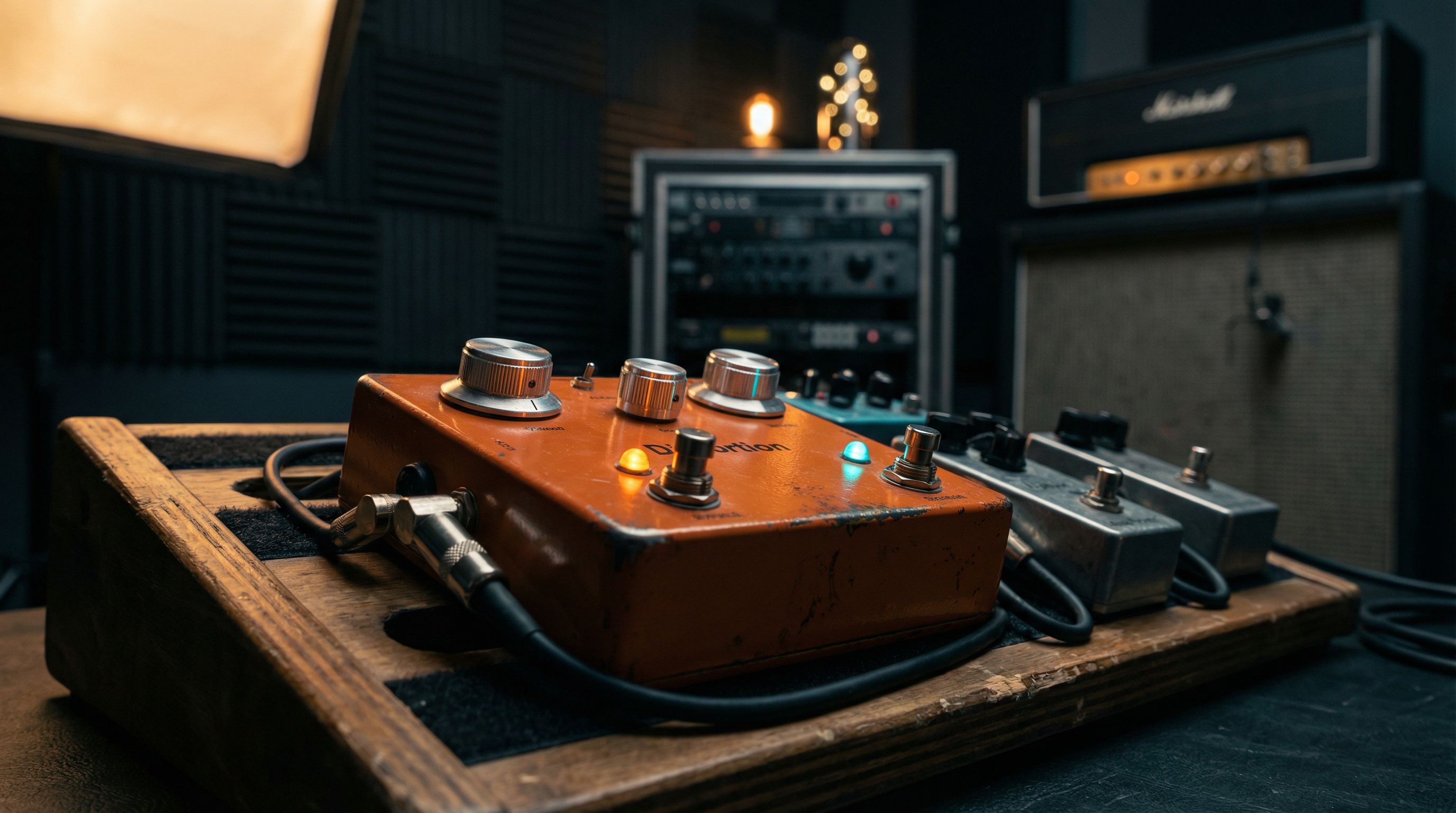
Start Here: The DS-1 has three knobs: Dist, Tone, Level. That's it. No hidden voicing switch, no internal trim pot, no secret mode. The entire reputation of this pedal (for both good and bad) comes down to how you set those three controls and what you plug it into. Most players who say the DS-1 sounds bad are setting the Tone knob wrong. The fix is simple, and it's in here.
What the Three DS-1 Knobs Actually Do
Before the settings: the basics, fast.
| Knob | Function | Notes |
|---|---|---|
| Dist | Gain amount | 7 o'clock = almost clean crunch; 5 o'clock = full saturation |
| Tone | High-frequency emphasis | Noon is balanced; above noon gets progressively harsher |
| Level | Output volume | Set to match or exceed your bypassed signal (unity) |
The Dist knob determines how hard the clipping circuit is working. The Tone knob shapes which frequencies pass through to the output; it's a simple treble-emphasis control, not a full EQ. Level sets how loud the pedal hits your amp.
Street price: around $50–60 new. $20–30 used if you're patient about it.
The Tone Knob Sweet Spot (Most Players Miss This)
Here's the thing nobody tells you. The DS-1 has a reputation for being harsh and bright ("that cheap Boss pedal that sounds like a beehive") and most of that reputation comes from players leaving the Tone knob at or above noon. It's an intuitive mistake. More tone sounds like it should mean more presence, more cut, more good.
It doesn't.
The DS-1's Tone control, when pushed above noon, starts emphasizing a frequency range that is genuinely unpleasant: an upper-midrange and low treble harshness that sits badly in a band mix and clashes with amp resonances. It's not subtle. It's the thing people mean when they say the DS-1 sounds "fizzy."
Roll the Tone back to about 11 o'clock (just slightly below noon) and something different happens. The harshness drops out. What's left is a rounder, more focused midrange with actual body to it. Notes have presence without the metallic edge. The DS-1 starts sounding like a real distortion pedal instead of a guitar through a broken speaker.
This is testable. Dial in any setting from this guide, then slowly sweep the Tone from 9 o'clock up to 2 o'clock while playing a power chord through your amp. You'll hear the midrange get progressively thinner and more abrasive as you pass noon. The 11-noon range is the window. Everything above it is increasingly difficult to make work.
The same principle applies across every genre setting below. The starting point for Tone is almost always lower than you'd expect.
Genre Settings
What Are the Best DS-1 Settings for Punk?
Punk tone on a DS-1 is about pick attack without compression, crunch without mush. You want notes to feel physical, like they're landing, not blooming into a saturated wash.
Billie Joe Armstrong used a DS-1 extensively (alongside his trademark direct-into-the-amp approach). The sound: enough gain to saturate power chords cleanly, with the top end controlled so individual strings don't blur together. You can hear the pick. That's the goal.
| Knob | Position | Notes |
|---|---|---|
| Dist | About 11 o'clock | Medium-low gain; punch without compression |
| Tone | Around noon | Balanced; back off to 11 o'clock if it bites |
| Level | About 1 o'clock | Match or slightly above unity |
Amp pairing: A clean amp with a relatively flat EQ response, like a Fender-style combo or a solid-state amp pushed reasonably hard. Punk doesn't require a lot of amp gain; the DS-1 provides the character. A slightly dirty amp works too, but the gain stacking can make the low end flabby.
What to listen for: Power chords should have clear string definition, not a single, indistinct blob. If the two or three strings in a chord are melting together, back the Dist off a half-turn. The Level should be pushing the amp slightly; punk tone is partly about volume interacting with speaker compression.
What Are the Best DS-1 Settings for Grunge?
Kurt Cobain used a DS-1 on Nevermind, on a lot of it. The Dist is higher than punk settings, and the Tone is backed off into murkier territory. The DS-1's character at higher gain is more blanketed, more compressed, with a low-mid thickness that fits the grunge aesthetic.
This setting should feel slightly ungainly in a good way. Not tight. Not surgical. BIG and slightly out of control.
| Knob | Position | Notes |
|---|---|---|
| Dist | About 2 o'clock | High gain; sustained, thick, slightly compressed |
| Tone | About 10 o'clock | Dark; takes the fizz away and adds body |
| Level | About noon to 1 o'clock | Unity; push slightly if the amp needs it |
Amp pairing: A Marshall-style amp (even a practice Marshall or a modeler running a JCM800 model) gives the grunge setting its low-end weight. The combination of the DS-1's high Dist into a slightly driven Marshall-style amp produces the wall-of-sound density that makes this tone recognizable. Clean amps work, but they can sound thin at this gain level.
Tone knob note: At 10 o'clock, you're cutting significant treble. That's intentional. Grunge guitar lives in the low-mids and lower registers. If this setting sounds too dark (too muffled) nudge the Tone clockwise to about 10:30. But don't go above 11 o'clock or the fizz comes back.
What Are the Best DS-1 Settings for Classic Rock?
Classic rock on a DS-1 means less gain, better pick response, and a Tone position that lets the amp's natural character come through. The DS-1 at low Dist settings behaves more like a hot overdrive; it adds harmonic saturation and sustain without the full compression of higher gain levels.
| Knob | Position | Notes |
|---|---|---|
| Dist | About 9 o'clock | Low gain; clean pick response, amp-like crunch |
| Tone | About noon to 1 o'clock | Slightly above noon; lets the top end breathe |
| Level | About 1 to 2 o'clock | Push the amp; this setting should feel present |
Amp pairing: A British-voiced amp at edge of breakup, like a Marshall, a Vox, or a modeler running either. The DS-1 at low Dist into a slightly driven amp is additive: the pedal adds sustain and upper harmonic content, the amp adds its own warmth and compression, and the combination is denser than either one alone. See the signal chain order guide for placement details.
Guitar note: Single-coil guitars (Strats, Telecasters) have extra brightness at low Dist settings. Keep the Tone at noon or just below. Humbuckers can take Tone up to about 1 o'clock without the harshness becoming a problem, since the humbucker's natural frequency rolloff compensates.
What Are the Best DS-1 Settings for Metal?
Here's the counterintuitive one. Most players trying to get metal sounds from a DS-1 crank the Dist and feel disappointed by the results. The high-gain DS-1 gets loose, the low end gets flabby, and the tone gets diffuse. The fix is to stop using the DS-1 as a standalone high-gain pedal and start using it as a tight boost into a high-gain amp.
Same principle as the Tube Screamer-into-high-gain-amp trick (covered in the Tube Screamer settings guide). Lower the Dist, raise the Level, and let the amp do the actual distortion work.
| Knob | Position | Notes |
|---|---|---|
| Dist | About 7 to 8 o'clock | Very low; just enough to shape the signal |
| Tone | About 11 o'clock | Controlled; adds presence without harshness |
| Level | About 2 to 3 o'clock | High; this is doing the boosting |
Amp requirement: This only works if your amp already has significant gain. A high-gain channel on a Peavey 5150, Mesa Dual Rectifier, JCM800 cranked, or a modeler running any of the above. The DS-1 in boost mode tightens the amp's low end (the hot signal saturates the input stage differently than a clean signal) and adds presence. The amp provides the actual saturation.
What to listen for: Palm mutes should be tight and defined; individual notes in a chugged passage should be distinguishable. If they're blurring together, the amp's gain is too high for this approach. Back the amp's gain down, then bring it up slowly until the mutes tighten. The sweet spot is where the DS-1 is doing the tightening work and the amp is doing the sustain work.
DS-1 as a Recording Boost (The One Nobody Talks About)
Set the Dist to minimum, all the way down. Tone wherever sounds right for your source. Level up. Now the DS-1 is functioning as a clean boost with a slight tone-shaping character from the Tone control and minimal clipping from the soft, near-off Dist stage.
| Knob | Position | Notes |
|---|---|---|
| Dist | About 7 o'clock (minimum) | Near zero; very slight saturation only |
| Tone | About 10 to 11 o'clock | Adjust to taste; lower = warmer |
| Level | About 2 to 3 o'clock | As much clean boost as you need |
This is useful for pushing a clean amp into natural breakup, adding presence to a modeler signal that feels thin in a mix, or giving solos an extra push without changing the gain character. Honestly, it's one of the best uses of the pedal, and one of the last things most players try with it.
Settings Summary: At a Glance
| Style | Dist | Tone | Level |
|---|---|---|---|
| Punk | About 11 o'clock | Around noon | About 1 o'clock |
| Grunge | About 2 o'clock | About 10 o'clock | About noon–1 o'clock |
| Classic Rock | About 9 o'clock | About noon–1 o'clock | About 1–2 o'clock |
| Metal (boost) | About 7–8 o'clock | About 11 o'clock | About 2–3 o'clock |
| Recording Boost | About 7 o'clock | About 10–11 o'clock | About 2–3 o'clock |
DS-1 Mods: Are They Worth It?
The stock DS-1 is competent. The modded DS-1 is actually good. Two mods have become the standard reference points:
The Keeley Mod
Robert Keeley's DS-1 mod replaces the clipping diodes and several capacitors. The result: tighter low end (less low-frequency buildup at high Dist settings), a more open high end (less of the compressed, smeared quality at moderate gain), and a generally more defined overall response. The DS-1 after the Keeley mod sounds like a more expensive pedal, not because the circuit is fundamentally different, but because the specific component choices reduce the pedal's inherent looseness.
Labor cost: around $40, plus your pedal. Worth it if you're keeping the DS-1 long-term or building around it.
The Monte Allums Mod
The Monte Allums mod focuses on frequency response correction rather than clipping character, specifically the low-mid frequency bump that makes the stock DS-1 sound mushy and undefined at higher Dist settings. The mod tightens the low end through component changes that shift the pedal's frequency response toward a more balanced character.
The Allums mod is slightly more surgical than the Keeley; it addresses specific frequency complaints rather than a general refinement of the circuit. If the DS-1's muddiness at high gain is your primary complaint (rather than a general "it sounds cheap" feeling), the Allums mod targets that directly.
Both mods are available as DIY kits or as a service. Neither is reversible without replacing the components again, so if you're uncertain, run the stock pedal through these settings first and see how far it gets you.
DS-1 vs. Tube Screamer: What's the Actual Difference?
These two pedals are not interchangeable, and they're not really competing for the same job. The differences are structural:
The DS-1 uses harder clipping; the circuit clips the signal more aggressively, producing a more saturated, more scooped distortion character. It's louder, more compressed at high gain, and more aggressive. The frequency character is relatively flat to slightly scooped in the mids.
The Tube Screamer uses softer clipping and has a built-in midrange bump from its circuit topology. It sounds more compressed in a natural way, has less low end (TS famously rolls off the bottom), and has that characteristic honk in the upper mids. It's smoother, less aggressive, more focused.
Different tools for different jobs. DS-1 in front of a clean amp = full distortion character, relatively flat. TS in front of a high-gain amp = the classic "TS boost" that tightens and focuses without adding dramatic distortion. The DS-1 can do the boost trick (see the metal settings above), but the TS is more transparent in that role. Check the overdrive vs. distortion vs. fuzz guide if you want the full circuit breakdown on why these pedals behave differently.
FAQ
Are DS-1 settings different for bass guitar? The DS-1 is not optimized for bass. The circuit's frequency response is tuned for guitar, and the low-end handling at high Dist settings can get muddy on bass. That said, some bass players use it intentionally for the aggressive midrange character in punk and hardcore contexts. If you're trying it on bass, the Dist should stay low (around 9 o'clock), the Tone around 10 o'clock, and you'll want to blend a clean signal in parallel so the fundamental doesn't disappear. It's a specialized use, not a general recommendation.
Why does my DS-1 sound thin and harsh? Two likely causes. First: the Tone is too high. Bring it below noon, ideally to the 11 o'clock position. Second: the Level isn't pushing the amp enough. The DS-1 sounds thin when it's not interacting with the amp at volume, so bring the Level up until the amp responds. If both fixes don't help, try a different amp. The DS-1 in front of a very clean amp at low volume genuinely does sound thin. It needs some headroom interaction to fill out.
Can the DS-1 be used in a modeler's effects loop? It can, but the character changes. In the loop, the DS-1 isn't interacting with the amp's input stage, so the boost application (metal settings) doesn't work the same way. The DS-1 in the loop is processing the preamp output, which changes how the Level knob interacts with the overall signal. Most players get better results running the DS-1 in the input path, before the amp model. The signal chain order guide covers the full preamp vs. loop placement logic.
Is the Boss DS-1 good for metal? In the boost configuration (low Dist, high Level, into a high-gain amp), yes. It's a legitimate metal tool. As a standalone high-gain pedal, it's workable but not optimized: the low end gets loose at high Dist settings, and the character doesn't have the tight, defined quality that purpose-built high-gain pedals (Mesa V-Twin, ISP Decimator pairing, etc.) offer. The boost application is the legitimate metal use case.
What guitar and amp combination works best with the DS-1? The DS-1 is relatively forgiving about guitar type; it works with humbuckers and single coils, with some Tone adjustments needed for single coils (back the Tone off slightly to compensate for brightness). Amp type matters more: the DS-1 sounds best into an amp that has some personality of its own. A completely flat, characterless amp reveals the DS-1's weaknesses. A Marshall or Vox-style amp at low-to-moderate gain gives the DS-1 something to interact with, which fills out the tone and makes the whole rig sound more complete.