You hit the solo, lean in, and... nothing. The lead sits right on top of the rhythm instead of stepping out in front of it. So you do the obvious thing — kick on more gain — and somehow it gets worse. The notes blur together, the attack disappears, and the whole thing sinks further into the mix. The fix isn't more drive. It's understanding that "louder" and "more distorted" are two different knobs, and picking the tool that turns the one you actually want.
Gain Is Not Loudness
This is the whole misunderstanding in one line. Gain is how hard you're driving a stage — more gain means more distortion and more compression. Loudness is output level, the thing the room and the mix actually measure. They feel related because cranking a dirty amp does get louder, but past a point, adding gain trades away the things that help you cut: it compresses your dynamics flat and scoops midrange. A more-distorted solo is usually a smaller, more buried solo. To be heard, you want level and midrange, not drive.
So the real question for a lead boost is: do you want it louder, thicker, or both — and with or without a tone change? Three tools, three answers.
The Three Tools at a Glance
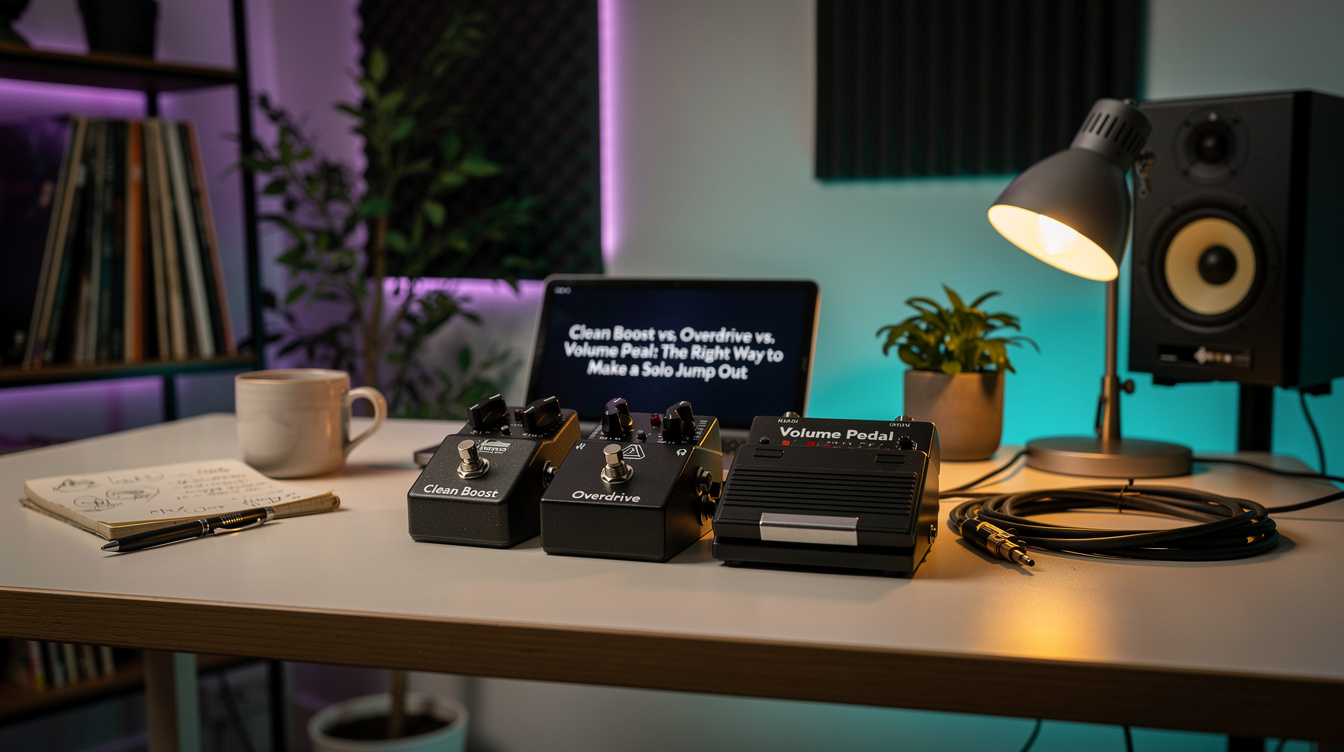
| Tool | What it adds | Tone change? | Best for |
|---|---|---|---|
| Clean boost | Level (+ gain if amp's breaking up) | A little | Lead jump with a bit more attitude |
| Overdrive (as dirty boost) | Level + midrange + compression | Yes — on purpose | A solo that should get thicker and sing |
| Volume pedal / level block | Pure level | None | Uncolored "just louder" with no tone shift |
Clean Boost: Louder, With a Catch
A clean boost is built to raise your signal level with as little coloration as possible. Into a clean amp, that's mostly what you get — the lead jumps up in volume and stays the same tone. But the same pedal does a second job depending on where the amp already sits.
If the amp is already at the edge of breakup, that extra level slams the preamp harder, and now the boost is adding gain — the solo gets dirtier and more aggressive, not just louder. That's not a bug; it's the most useful thing about a boost in front. Just know which one you're getting before you're standing in front of the band.
The Thing That Made This Click
I expected a clean boost to be a simple volume knob — kick it on, lead gets louder, done. Into a fairly clean setting, it was exactly that. But the night I stomped it in front of an amp already sitting right at breakup, it barely got louder — it got meaner. Same apparent volume, way more grind. The boost wasn't acting on output at all; it was acting on how hard I was hitting the preamp, and the amp's existing position decided which one it became. Once you see a front-of-amp boost as a "how hard am I pushing the amp" control rather than a volume control, you stop being surprised by it and start using it on purpose.
Overdrive: When You Want the Solo to Get Thicker
Run an overdrive with the Level up and the Drive low and you've got a "dirty boost" — it raises volume and adds a midrange hump and some compression. For a lot of leads that's perfect: the mid bump is exactly the frequency range that helps a guitar poke through a band, and the compression smooths out your picking so long notes sustain. The trade is that it's not transparent — it changes your tone on purpose. If your rhythm sound is clean or low-gain and you want the solo to bloom into something saturated and singing, this is the move. A mid-hump pedal like a Tube Screamer is the classic here; our Tube Screamer settings guide covers the level-up-drive-down "boost" config specifically. If you're fuzzy on what counts as overdrive versus distortion versus fuzz in the first place, start here.
Volume Pedal / Level Block: Pure Louder, Zero Drama
If you want the solo louder and you want nothing else to change — no added grit, no EQ shift, no compression — this is the tool. A volume pedal set above unity, or a level/volume block on a modeler bumped up a few dB, raises output and touches nothing else. It's the only genuinely uncolored option of the three. On a modeler this is the cleanest solo boost there is: drop a Volume or Gain block at the end of the chain, set it to engage a few dB hotter, done. No menu-diving, no new tone to babysit.
The one thing to get right is where it sits, which brings us to the rule that ties all three together.
Placement: Front Pushes the Amp, After Just Gets Loud
Where you put a boost decides whether it adds attitude or just volume:
- In front of the amp (or before the amp block on a modeler), a boost or overdrive pushes the preamp — so it adds gain and drive on top of level. Front placement is for more aggressive.
- After the amp — in the effects loop, or as a level block after the amp block — it raises output and pushes the power section without touching your preamp gain. After placement is for clean louder.
That's the same front-vs-loop logic that governs drive pedals generally; the overdrive in the loop vs. front breakdown digs into why, and the signal chain order guide shows where each block lands in the row. A volume pedal lives at the end of the chain for a true master-volume boost; put it up front and it behaves like your guitar's volume knob instead.
Making the Call
Quick version, because that's usually what you've got time for:
- Want it louder with a little more bite? Clean boost, in front of the amp.
- Want it louder and thicker, ready to sing? Overdrive as a dirty boost — level up, drive down.
- Want it louder and identical otherwise? Volume pedal at the end, or a level block after the amp.
And if your solo patch is somehow coming out quieter than your rhythm even with a boost engaged, that's a different problem — gain staging, a mid-scoop, or a compressor eating your dynamics — and the solo volume-drop fixes walk through each one. Get the level right first. Then decide how much attitude you want on top.