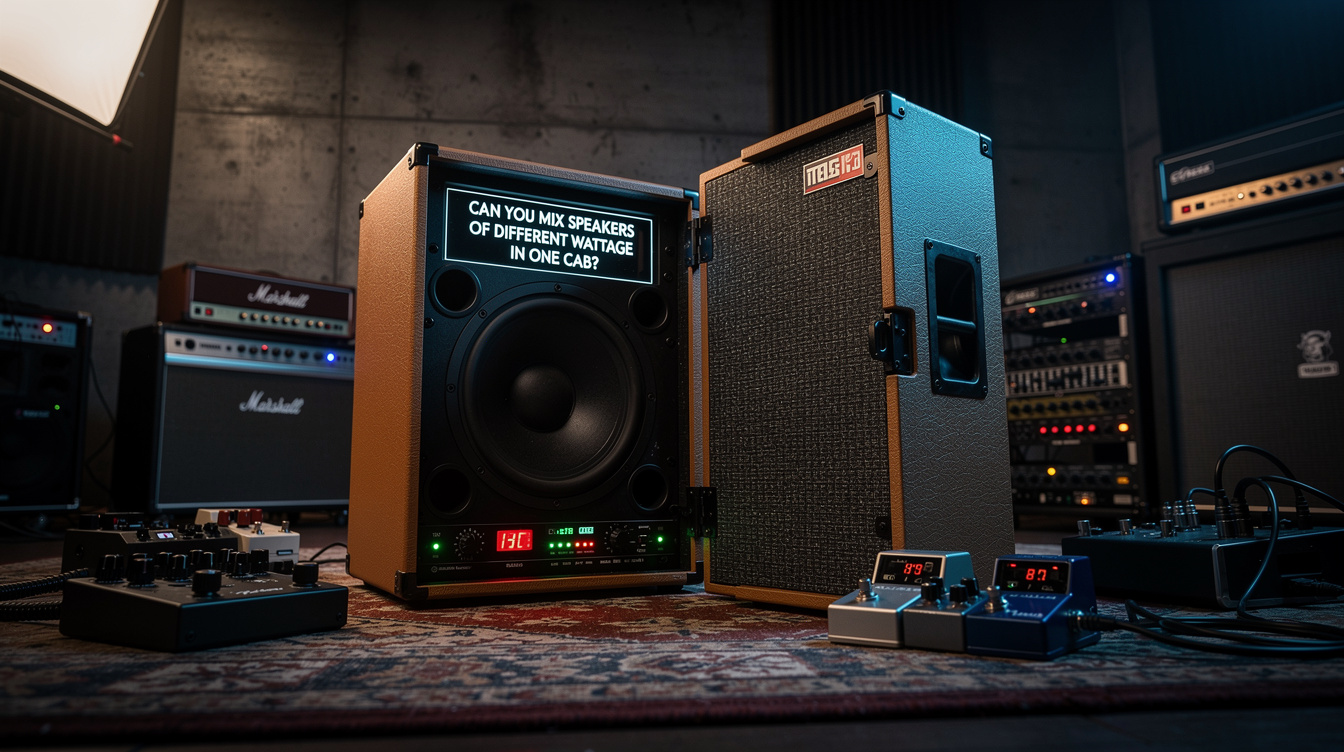
Walk into any club backline from the last fifty years and there's a decent chance the 4x12 sitting there has more than one kind of speaker in it, whether the owner planned it that way or just replaced a blown cone with whatever the shop had on the shelf. Mixing speakers of different wattage, different model, even different brand is not the cardinal sin players sometimes fear — it's a technique, and a good one, as long as you respect two rules. Get the impedance right and rate the cab off the weakest speaker, and the rest is open territory for chasing a tone neither speaker gives you on its own.
The Short Answer
| Question | The rule |
|---|---|
| Different wattage? | Fine. Rate the cab as the lowest wattage times the speaker count. |
| Different model or brand? | Fine, and often the whole point. Blends two voices. |
| Different impedance? | Avoid. Power splits unevenly and so does the tone. |
| Who's louder? | The higher-sensitivity speaker dominates the blend. |
| Best layout in a 4x12? | The X-pattern — diagonal pairs for an even blend. |
Two rules carry the whole subject: match the impedance, and rate the cab off the lowest-wattage speaker. Everything else is taste.
The Wattage Math
This is where players talk themselves out of a perfectly good idea. Say you want to drop a 25-watt Greenback and a 60-watt Vintage 30 into a 2x12. The instinct is to add them — 85 watts of handling, plenty. That's not how it works, and assuming it does is how cones get cooked.
When two speakers of the same impedance share a cab, the amp's power divides roughly evenly between them. Send 50 watts into that 2x12 and each speaker gets about 25. The V30 is loafing. The Greenback is at its limit. Push to 60 watts and the Greenback is now taking 30 watts against its 25-watt rating, and it's the one that fails — the bigger speaker can't save it. So the safe rule is the lowest-rated speaker times the number of speakers. Two 25-watt-floor speakers in a 2x12 gives you about 50 watts of honest handling. A 4x12 with two 25-watt and two 60-watt speakers handles about 100 watts (25 times 4), not 170. The full power-handling breakdown walks through the rest of the headroom story, but the mixed-cab version comes down to that one multiplication.
The Impedance Trap
Here's the rule that bites people who ignored it. Two speakers only share power evenly if they have the same impedance. Put an 8-ohm and a 16-ohm speaker side by side and the 8-ohm draws more current, takes more power, plays louder, and runs hotter, while the 16-ohm sits back doing less than its share.
You've now skewed two things at once — the loudness balance between the speakers and the power handling of the cab — and both in directions that are hard to predict by ear. There are players who do this deliberately to bias a cab toward one voice, but it's an advanced move, not a starting point. Match your impedances. Then your wiring stays simple: two 8-ohm speakers in series give you 16 ohms, in parallel they give you 4, and the open-back versus closed-back choice can come after.
The Surprise: The Louder Speaker Runs the Room
I'll tell you what caught me out the first time I built a mixed 2x12. I figured a 25-watt Greenback and a 60-watt V30 would land somewhere in the middle — half Greenback, half V30, a tidy average. I expected the bigger speaker to be the bigger sound.
It wasn't an average at all. The V30 has higher sensitivity, which means it turns the same watt into more decibels, so it sat noticeably out front in the blend — the cab leaned V30 with the Greenback filling in underneath rather than the two meeting halfway. That's not a defect. It's the actual variable nobody tells you about: in a mixed cab, sensitivity decides the balance more than wattage does. If you want more of the quieter speaker in the mix, you don't turn anything up — you choose speakers whose sensitivities are closer, or you accept that the louder one is going to lead. Once I understood that, I stopped fighting it and started choosing pairs on purpose.
Why Mix Models At All
Because two speakers can give you a voice neither one has. A Celestion Greenback breaks up early and has a vocal, crunchy midrange — it's the sound of a cranked late-'60s Marshall, all push and bark. A Vintage 30 is tighter and brighter, with an aggressive upper-mid cut that slices through a loud band and a firmer low end. Each is a classic. Each also has a weakness — the Greenback can sound small and woolly pushed hard, the V30 can sound harsh and a touch nasal on its own.
Put them in the same box and they cover for each other. The Greenback rounds off the V30's bite; the V30 gives the Greenback the cut it lacks. The blend has the midrange singing quality of one and the presence of the other, and it records better than either alone because the harsh and the woolly partly cancel. That's the whole reason the trick survived. The Celestion speaker showdown lays out how each model sounds solo, which is the homework before you decide what to blend.
The X-Pattern
In a 4x12 there's a right way to arrange a mix, and it's the X-pattern. Put two of one model on one diagonal and two of the other on the opposite diagonal, so each speaker sits across from its twin. The point is evenness — no matter where you stand in the room or where an engineer puts a microphone, you're getting a balanced helping of both voices rather than walking into a Greenback corner and a V30 corner.
A straight top-row/bottom-row split sounds different depending on whether you mic high or low, and it changes as you move. The diagonal keeps the blend honest from every angle. It's a small bit of geometry that's outlived every trend, and it's worth doing right if you're building the cab yourself.
Before You Wire Anything
Decide the two rules first and the fun part takes care of itself. Confirm both speakers are the same impedance. Rate the cab off the lowest-wattage speaker times the speaker count, and keep your amp under that number. Then pick your pair for what each one does — the bark of a Greenback, the cut of a V30, or whatever two voices you're trying to marry — and remember the more efficient one will lead the blend. A mixed cab isn't a compromise you settle for. Done with a little care, it's a tone you went out and built. The V30 in medium-gain rock is a fine place to hear what one of those voices brings before you pair it with another.