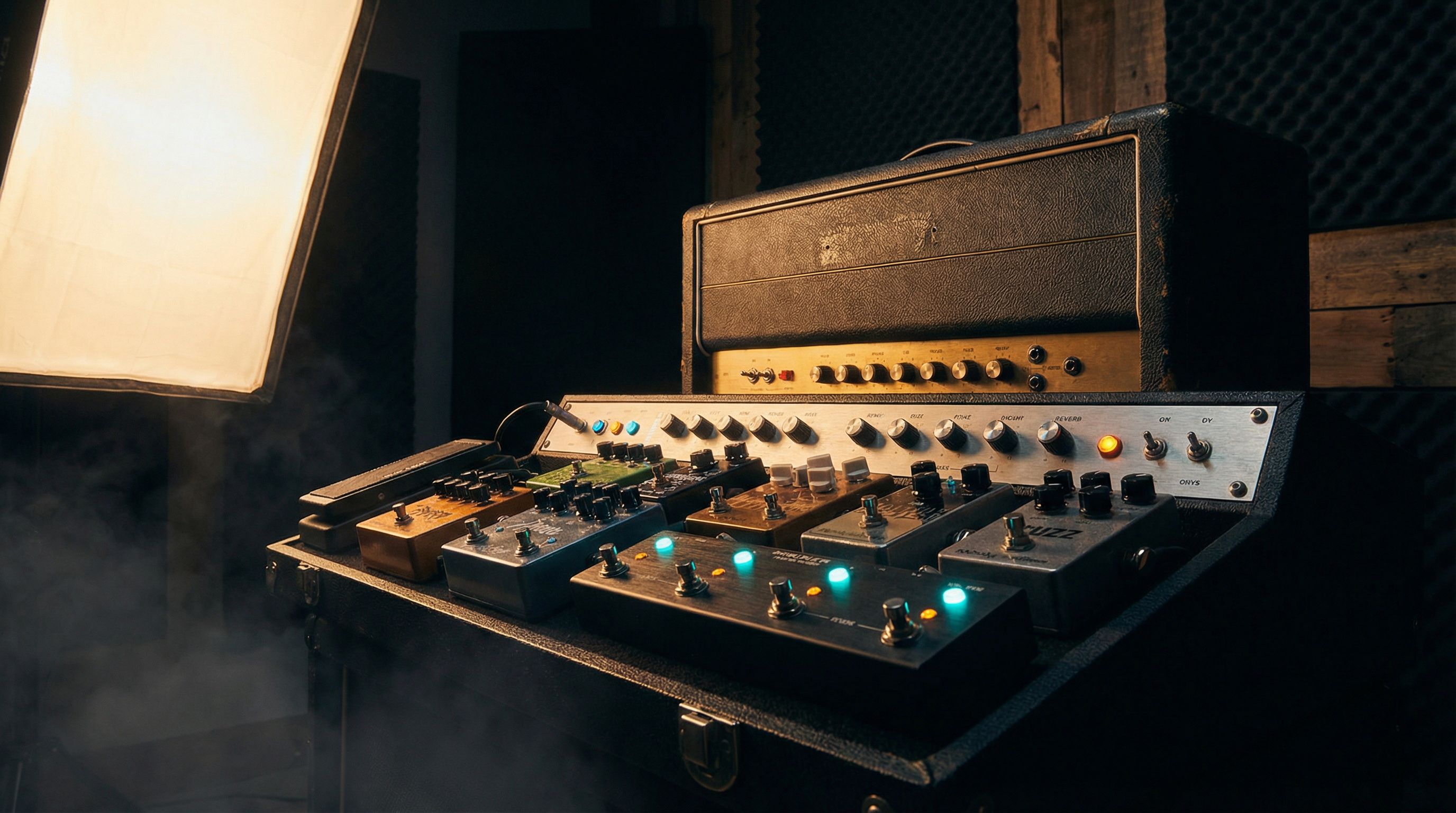
Start Here: The Core Chain
- Fuzz (Big Muff or RAT): the saturated foundation
- Chorus or Flanger: width and movement
- Reverb (very long, very wet; this is the defining layer)
- Delay (optional, tape-style; adds depth behind the reverb wall)
This tone does not "cut through" anything. It envelops. If you're chasing clarity, you're building the wrong thing.
What Makes Shoegaze Tone Different?
Most guitar tones are built around presence (the idea that the guitar should be audible, distinct, forward in the mix). Shoegaze inverts that entirely. The goal is submersion. The guitar should feel like something you're standing inside of, not something you're listening to from across a room.
That quality comes from a specific approach to frequency space. The fuzz fills the mids and upper mids with dense, compressed saturation. The chorus widens the image laterally. The reverb pushes everything back in the stereo field, not just adding size, but adding distance. By the time signal exits the chain, what started as a guitar chord has become an atmosphere.
My Bloody Valentine, Slowdive, Ride, Lush, Chapterhouse: these artists weren't using reverb to make the guitar sound bigger. They were using it to change the guitar's relationship to everything else in the composition. That's a mixing decision as much as a tone decision. It's why shoegaze translates so well to headphones and studio monitors. This tone was built in studios, for studios.
It's also why this recipe is particularly well-suited to bedroom players building tracks in a DAW. You don't need a loud amp for this. You need the right layers, the right settings, and a clear mental model of what each layer is doing to the frequency space.
The Fuzz Foundation
The fuzz is what gives shoegaze its body. Without it, the reverb just sounds like a clean guitar in a cave. With it, the reverb has something dense and harmonically complex to work with, and the result is that signature smear.
The Big Muff is the classic choice. Kevin Shields used various fuzz units throughout My Bloody Valentine's recording sessions, but the sound he's associated with shares common DNA with the Muff: heavy sustain, a scooped midrange, and a compressed quality that flattens the note dynamics and lets the texture take over. The RAT is a viable alternative (slightly tighter and more aggressive), but the Muff's midscoop interacts with the reverb in a way that's difficult to replicate with other drives. For more on why the Muff behaves the way it does, the Big Muff settings guide covers the circuit and all major variants in depth.
One thing worth understanding: the Muff's tone control shapes an already-saturated signal. Moving it counterclockwise makes the fuzz darker and blurs note definition faster. In a shoegaze context, that's usually desirable; you want the fuzz to blur, not articulate.
Big Muff Settings for Shoegaze
| Parameter | Target Setting | What It's Doing |
|---|---|---|
| Sustain | About 2–3 o'clock | Maximum density; notes compress into texture |
| Tone | About 10–11 o'clock | Dark, scooped; midrange pulls back to let the reverb fill |
| Volume | Matched to bypass level or slightly above | Unity gain into the next stage |
The Sustain knob at that position collapses dynamic range almost entirely. Single notes and chords lose their attack transients and bloom into a sustained wash. That's the goal. You're not trying to preserve note-to-note articulation here.
The Tone setting is counterintuitive if you're used to dialing in clarity. About 10 to 11 o'clock is noticeably dark. But the reverb tail will brighten the overall impression, and the darkness of the fuzz prevents the high end from turning harsh when the reverb mixes in. Fight the instinct to brighten the fuzz in isolation; listen to the whole chain together.
The Modulation Layer
After the fuzz, something needs to create width and movement. Chorus and flangers are the standard tools. The key is restraint, at least relative to the reverb layer. The modulation is doing spatial work, not adding obvious wobble.
A chorus at slow rate and moderate depth widens the signal in the stereo field without drawing attention to itself. It makes the fuzz feel wider than a single source, which primes the space for the reverb to move in. A flanger at a slow rate with minimal feedback does similar work with a slightly more metallic quality, which can complement certain fuzz tones well.
The mistake most people make is setting the rate too fast. A fast chorus creates an obvious warbling effect that competes with the reverb's sense of distance. Slow it down until the movement is barely perceptible as a discrete effect. It should feel like the tone breathing, not oscillating.
Chorus Settings for Shoegaze
| Parameter | Target Setting | What It's Doing |
|---|---|---|
| Rate | About 8–9 o'clock | Slow enough that movement isn't obvious |
| Depth | About 10 o'clock | Moderate; enough to widen, not enough to wobble |
| Blend / Mix | Around noon | Equal dry/wet; keeps some direct signal grounded |
If you're running a flanger instead, set the rate similarly slow, keep the feedback low (around 9 o'clock), and aim for the range where you hear widening rather than a jet-engine sweep. The manual depth is the same principle: subtle.
The Reverb Wall: The Most Important Section
This is where shoegaze lives. The reverb isn't an effect applied to the guitar tone; it is the guitar tone. Everything else is preamble.
The thing to understand about shoegaze reverb is that you're not adding room ambience. You're building a space the guitar disappears into. The tail (the long, sustained decay after the initial signal) is where all the character lives. A common mistake is cranking the reverb size while keeping the mix at 30 or 40 percent and wondering why it doesn't sound like Loveless. That reverb mix percentage is the core setting to get right first.
This reverb doesn't make the guitar sound bigger. It makes it sound further away. There's a difference, and it changes the entire mood of everything built around it.
Reverb Settings for Shoegaze
| Parameter | Target Setting | What It's Doing |
|---|---|---|
| Size / Room | Maximum or near maximum | Creates the largest possible space |
| Decay / Tail | Very long, 6 to 10 seconds or more | The tail is the tone; let it sustain |
| Mix / Wet | About 70–100% wet | No subtlety here; this is a wet signal |
| Pre-Delay | Short, under 20ms | Keeps note onset present before the wash takes over |
| Damping | Low-to-moderate | Lets high-frequency content sustain in the tail |
| Modulation (if available) | Slow, subtle | Adds organic movement to the tail |
The 70–100% wet range is not a typo. The first time you push reverb mix that far, everything becomes indistinct and hazy. That is correct. That's the target. Notes turn into suggestions. Chords become texture. The reverb tail overlaps with whatever comes next, and the result is a continuous wash that has no clean edges.
If your reverb pedal has a modulation parameter (many hall and plate reverbs do), set it to the slowest available rate with subtle depth. This adds a chorus-like movement to the tail itself, creating the shimmering quality you hear on tracks like "Sometimes" or "Alison." This is a small detail that makes a significant difference.
The Tail Is the Tone
Here's the specific mistake worth calling out: many players set a large reverb but back off the decay because a very long decay feels messy during individual note playing. That instinct is the wrong frame. Shoegaze playing is built around the assumption that the decay will overlap. Chords are chosen and spaced so that the overlapping tails blend. If you play through this setting and it sounds muddy, the answer is usually to change what you're playing (simpler chords, wider intervals, more space), not to shorten the decay.
Kevin Shields used reverse reverb extensively, capturing the reverb tail, reversing it, and using that as a separate layer. If your reverb unit has a reverse mode, it's worth experimenting: a reversed reverb underneath the main signal adds a swell that feels like the note is being inhaled before it's played.
Adding Delay
Delay is optional in shoegaze but often essential for depth. The reverb creates the space; the delay creates movement within that space.
The style is tape delay or analog delay: darker, softer repeats that blur into the reverb rather than sitting in front of it. A pristine digital delay will sound out of place here. The repeats should feel like echoes heard through the reverb, not as distinct rhythmic events.
Delay Settings for Shoegaze
| Parameter | Target Setting | What It's Doing |
|---|---|---|
| Style | Tape or analog | Dark, degrading repeats that blend with reverb |
| Time | Quarter-note or dotted-eighth to tempo | Rhythmic foundation without metronomic rigidity |
| Feedback | Around 5–6 repeats visible | Enough to create depth, not self-oscillation |
| Mix | About 30–40% | Subtle underneath the reverb; not the focal point |
If your delay has a tone or treble control, roll it off. Darker repeats blend into the reverb tail more naturally. The goal is that you can feel the delay more than you can hear it as a distinct effect. It adds dimension to the reverb wall without breaking it apart into separate elements.
The delay should sit in front of the reverb in your signal chain: fuzz into modulation into delay into reverb. If you put the delay after the reverb, the delay will repeat the full reverb signal, which creates a different and generally less usable result in this context.
The Tremolo Arm and Pitch Variation
Shoegaze tone isn't only about pedals. Kevin Shields' "glide guitar" technique (using the tremolo arm while sustaining notes) creates a warbling pitch effect that no pedal fully replicates. The arm pressure makes individual notes drift in pitch, and because the fuzz and reverb blur the source, the result is an organic movement that sounds unlike vibrato or chorus.
The technique itself is simple in concept: pick a note or chord, sustain it through the reverb, and make small, slow movements on the tremolo arm. The pitch drifts fractionally up and down. Through the fuzz and a high-wet reverb, that drift becomes the kind of instability that sounds intentional and beautiful.
If you're working in a DAW, pitch modulation plugins or automation on a pitch-shift effect can approximate this. It's not identical, but it captures the spirit. The goal is organic imprecision: a slight, slow waver rather than a defined vibrato pattern.
Multiple layers of guitar recorded with slight pitch differences between them is the studio technique that creates the full My Bloody Valentine effect. Two or three guitar tracks, each with marginally different pitch from tremolo use or tape speed variation, combine into something wider and more complex than any single layer. In a DAW this is replicable: record multiple passes and allow subtle pitch differences, or use pitch-shifting plugins at ±5–10 cents on different layers.
Building This in a DAW
The complete shoegaze tone chain is entirely reproducible with plugins, and for headphone listeners, the plugin path is often better: more control, more flexibility, and some genuinely excellent free options.
Recommended plugin chain:
| Stage | Plugin Option | Notes |
|---|---|---|
| Fuzz | Any Big Muff emulation (GVST GFuzz, Auburn Sounds, amp sim with fuzz block) | Set per the table above |
| Chorus | Valhalla Chorus (paid) or TAL-Chorus-LX (free) | Slow rate, moderate depth |
| Delay | Valhalla Delay (paid) or Valhalla Supermassive (free) | Tape mode, 30–40% mix |
| Reverb | Valhalla Supermassive (free) or VintageVerb (paid) | Maximum size, very long decay, 70%+ wet |
Valhalla Supermassive deserves specific mention. It's free, and its Massive mode (essentially an infinite-decay reverb with modulation) gets to about 80% of the classic shoegaze reverb territory without any cost or complexity. Set the mix high, the decay to the longest available setting, and the Warp parameter around 0.4–0.6 for shimmer. It's not subtle and it doesn't need to be.
In Ableton, Logic, or any DAW with aux return routing: putting the reverb on a return track rather than inline gives you more flexibility to adjust the wet/dry balance non-destructively, and lets you blend in reverse reverb on a separate return without touching the main chain.
For a full breakdown of how effects loops work and when to use send/return routing versus inline, the effects loop guide is worth reading; the same logic applies to DAW routing architecture.
Reference Tracks and Their Tonal Signatures
Listening to the architects of the sound is part of learning the sound. Each of these tracks has a specific tonal character worth studying:
| Track | Artist | Tonal Notes |
|---|---|---|
| "Only Shallow" | My Bloody Valentine | Dense fuzz, massive reverb wall, pitch-warped glide guitar; the canonical reference |
| "Sometimes" | My Bloody Valentine | Cleaner fuzz with extreme reverb modulation; shimmer approach |
| "Alison" | Slowdive | Warmer, more melodic; fuzz is lighter, reverb still enormous |
| "Drive Blind" | Ride | Brighter fuzz character, chorus more prominent, slightly more definition |
| "De-Luxe" | Lush | Jangly with reverb; lighter fuzz, demonstrates the lighter end of the spectrum |
| "Blue Flower" | Mazzy Star | Minimal fuzz, maximum reverb presence; space over saturation |
"Only Shallow" is the entry point for understanding the extreme version of this approach. "Alison" is useful for understanding how much reverb you can use with a cleaner source and still arrive at the same spatial quality. Mazzy Star represents the edge of the genre where the fuzz recedes almost entirely and the reverb and space do the heavy lifting. That clean-and-spacious end shades directly into dream pop — if you pull the fuzz out and keep the time-and-space effects, you're most of the way to the dream-pop clean chain, where the order of compressor, chorus, delay, and modulated reverb does the work the fuzz does here.