Start Here: Five things that define Tom Morello's RATM tone (and what most players overlook):
- The kill switch: not a pedal, not a setting; it's built into the guitar and it IS the technique
- Gain is controlled, not maxed: the JCM800 is running tight, not saturated into mush
- Wah as a static filter: half-cocked and left there, not swept
- Whammy for pitch effects: the divebombs and octave-up sounds are all pedal, no bar
- The DOD parametric EQ: used as a boost and frequency sculptor before the amp
Quick Reference: Core Rhythm Tone Settings (JCM800)
| Control | Position | Notes |
|---|---|---|
| Preamp gain | About 2 o'clock | Controlled aggression; not maxed |
| Bass | About 10 o'clock | Tight; prevents low-end saturation |
| Mid | About 2 o'clock | Forward and present |
| Treble | Around noon | Balanced; the mid does the work |
| Presence | About 11 o'clock | Edge without harshness |
| Master volume | High | Power section saturation contributes |
What Guitar Does Tom Morello Use?
"Arm the Homeless" is the guitar most associated with Morello's RATM work. It's a heavily modified hybrid: Strat body, Tele neck, non-standard wiring, and a kill switch wired to a toggle on the upper bout. The pickups are nothing exotic. The guitar is not expensive. The kill switch is the whole point.
Most players researching Morello's tone focus on the amp and the pedals. That's correct, but incomplete. The kill switch is a fundamental instrument control that Morello uses as a rhythmic device (think the stutter in "Bulls on Parade") and as a volume swell generator. The gear underneath it is designed to support that technique, not the other way around.
If you want to approximate this tone without modifying your guitar, a volume pedal operated with your foot can cover some of the territory. It's slower, less precise, and requires a foot that might otherwise be busy. The machine gun stutter effects are very difficult to replicate convincingly without the actual switch. More on that below.
What Amp Does Tom Morello Use?
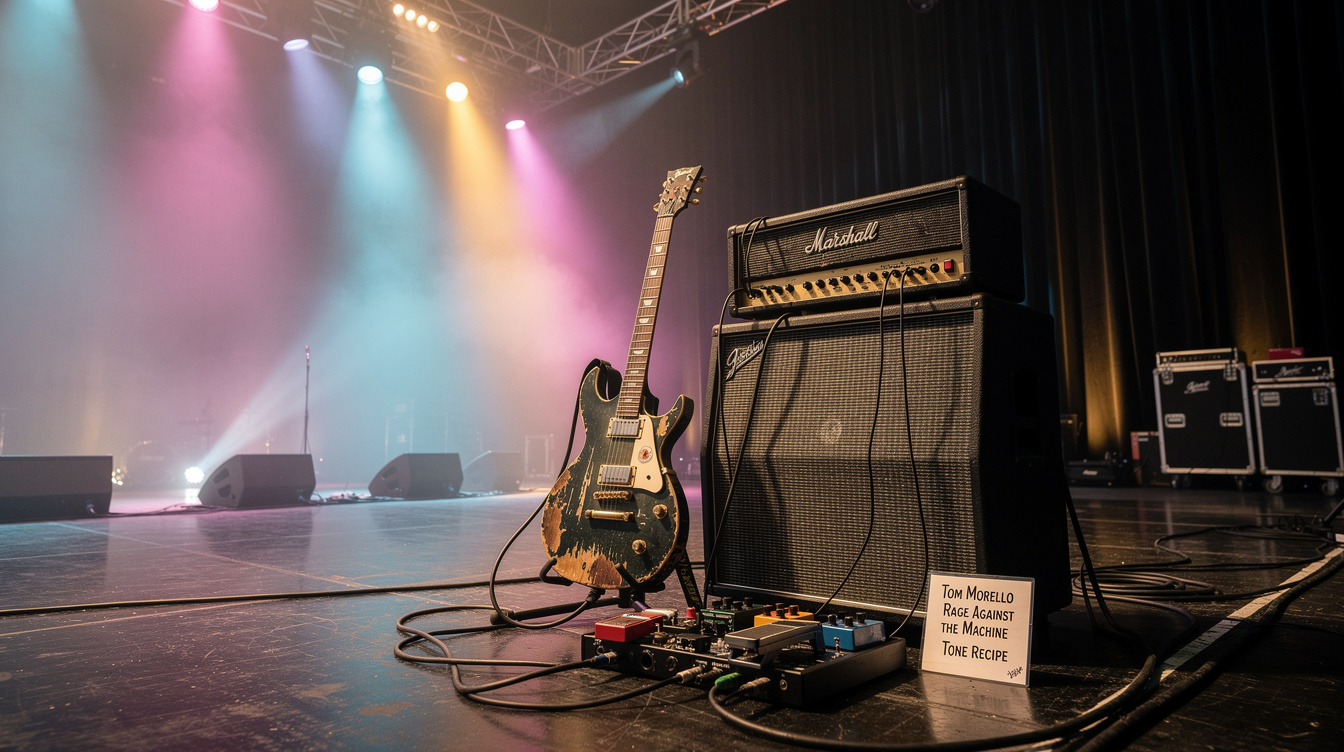
A Marshall JCM800, specifically the 2203 head, into a Marshall 4x12. No channel switching, no exotic cabinet voicing. The JCM800 at about 2 o'clock on the preamp gain: controlled, tight, forward. Not a modern high-gain setup with maximum saturation and a scooped EQ. The JCM800 here is doing what a Marshall does best: aggressive midrange authority and punchy pick attack that doesn't dissolve into noise.
The JCM800 settings deep-dive covers the full character of this amp across different gain levels and EQ combinations. Worth reading if this is your first time working with one (or a model of one).
The common mistake is treating this like a modern metal amp and pushing the gain until notes blur together. Morello's riffs are rhythmically intricate. The gain level has to preserve the attack and definition of each muted note. If the gain is too high, you lose the articulation that makes the riffs identifiable. You want bite and sustain. You do not want a wall of undifferentiated distortion.
The DOD FX40B Parametric EQ
This pedal is often overlooked in discussions of Morello's rig because it sounds boring. It is not boring. Morello runs it as a pre-amp boost with specific frequency shaping, lifting the mids before the signal hits the JCM800's input stage, which tightens the low end and pushes the amp's gain stage harder in the midrange. Same principle as running a Tube Screamer before a high-gain amp, except the parametric EQ gives more precise control over which frequencies get boosted.
If you're not running a DOD FX40B specifically, a Tube Screamer or OD808 with the drive at minimum and the level elevated will accomplish a similar function. The overdrive vs. distortion vs. fuzz guide covers why an overdrive with low drive and high level tightens an amp rather than adding its own dirt.
What's the Role of the Wah Pedal in Morello's Tone?
This is one of the most misunderstood elements of Morello's rig. The Dunlop Cry Baby wah is not being used as a sweep effect in most RATM recordings. It's being used as a STATIC FILTER, set to a specific position in the pedal's travel, then left there.
A wah pedal parked in a fixed position functions as a bandpass EQ boost at whatever frequency corresponds to that sweep position. Heel-down emphasizes lower frequencies. Toe-down emphasizes upper frequencies. Parked in the middle, it creates a pronounced mid-frequency honk that colors the entire tone. This is the frequency character you hear in "Killing in the Name": that nasal, aggressive quality in the distortion is partly the Marshall's midrange and partly the wah sitting fixed in a half-cocked position.
Wah filter settings for the static position:
| Wah position | Frequency emphasis | Character |
|---|---|---|
| About heel-down (around 8-9 o'clock sweep) | Lower mids (~400–500 Hz) | Darker, heavier, more grunt |
| About half-cocked (around noon sweep) | Mid frequencies (~700–900 Hz) | Honky, nasal, aggressive |
| About toe-forward (around 2-3 o'clock sweep) | Upper mids (~1.2–1.8 kHz) | Brighter, more cutting |
For "Killing in the Name" rhythm tone: park the wah around half-cocked to about 2 o'clock in the sweep. That's the nasal quality you're chasing. Dial it in by ear while playing the main riff; you'll hear it lock into place.
A statically parked wah can also be automated via expression pedal on a modeler, which lets you set a fixed position and leave it without physically weighting the pedal. On an HX Stomp, set the WAH block to the appropriate frequency manually without assigning it to an expression pedal and it will sit at that position indefinitely. Clean, reliable, no foot gymnastics.
Whammy Pedal Settings
The DigiTech Whammy is responsible for most of Morello's pitch effects: the octave-up lead sounds, the divebombs (used in place of a Floyd Rose system), and the two-octave sweeps. The pedal he uses is an original first-generation DigiTech Whammy, though subsequent generations approximate the basic functionality.
Core Whammy settings by application:
| Effect | Mode | Expression position | Notes |
|---|---|---|---|
| Octave-up lead tone | Harmony: +1 oct | About full toe-down | Single note lines with the octave-up blend |
| Two-octave sweep | Whammy: +2 oct | Heel to toe sweep | The "rocket launch" effect in "Bulls on Parade" |
| Divebomb | Whammy: -2 oct | Toe-down to heel | Replaces whammy bar; drop a note by two octaves |
| Detune shimmer | Detune setting | About noon | Subtle widening on chord hits |
The "Bulls on Parade" intro effect is the Whammy set to the two-octave mode, rocking from heel position to toe position during sustained notes and chords. It's not a subtle shimmer; it's a full pitch-shift sweep that goes from the original pitch to two octaves up. The transition speed and timing are all manual expression pedal technique. Dialing it in is a matter of practice, not settings.
For the octave-up lead tone: Morello runs the Whammy in harmony mode at +1 octave, with the expression pedal at full toe-down. Combined with the distorted amp signal, this creates the "singing" upper-octave lead quality in tracks like "Guerrilla Radio" and "Renegades." It sounds like a synth. It is a guitar through a pitch pedal.
Song-by-Song Settings Guide
"Killing in the Name": Core Rhythm Tone
The main riff runs on the JCM800 core distortion tone with the wah in a fixed position. DOD EQ as a boost before the amp. Kill switch used for the stutter rhythms in the verse.
Settings summary:
- JCM800 preamp gain: about 2 o'clock
- Wah: fixed at about noon to 2 o'clock position in the sweep (half-cocked filter)
- DOD EQ: boosting around 800 Hz to 1 kHz, level elevated
- Kill switch: used rhythmically for the stutter in the verses
The bridge section uses the kill switch to create the chopped, rhythmic stutter. Without a kill switch, you can approximate this with a volume pedal or a tremolo effect at a fast rate with a square wave shape. It will not be as precise, but it gets the rhythmic idea across.
"Bulls on Parade": Whammy and Wah
The intro pitch sweep is all Whammy: two-octave mode, heel to toe, timed to the note sustain. The main riff uses the wah in a different static position, slightly more toe-forward than "Killing in the Name," adding a brighter quality to the distortion. Less nasal, more aggressive.
The breakdown section where the rhythm guitar drops into a quieter, more dynamics-based feel is where the JCM800's actual touch sensitivity becomes audible. The amp isn't compressing everything into a uniform wall; there's real dynamic range in the playing.
"Guerrilla Radio": Dynamics and Octave
More dynamic range than the other songs mentioned here. The rhythm guitar has a slightly cleaner, more open quality. The gain is still JCM800 territory but sitting a hair lower, or the playing is lighter. The Whammy octave-up effect appears in the lead sections. The overall character is less dense and more breathing than the heavier tracks.
Can You Replicate Morello's Tone on a Modeler?
Yes. With some caveats. The amp and most of the pedal sounds translate well to digital platforms. The kill switch does not.
HX Stomp / Helix
The Brit 2204 model (JCM800) is the correct starting point. Settings translate closely from the hardware amp targets listed above. The full signal chain order guide is worth reviewing before you build the preset; block order matters, especially with wah and Whammy-style pitch effects.
HX Stomp signal chain order:
| Block | Model | Notes |
|---|---|---|
| 1 | Parametric EQ or Tube Screamer (drive ~0%, level ~60-65%) | Pre-amp boost, mimics DOD FX40B |
| 2 | Wah (Fassel or Cry Baby model) | Set to fixed frequency position; no expression needed |
| 3 | Brit 2204 amp + cab | Core distortion |
| 4 | DigiTech Whammy (Pitch Wham) | Assign to expression pedal for sweep effects |
| 5 | Reverb (minimal) | Small room only; RATM is not a wet sound |
JCM800 model settings on HX Stomp:
| Control | Position | Notes |
|---|---|---|
| Gain | About 65-70% | Translates to roughly 2 o'clock on hardware |
| Bass | About 40-45% | Tight |
| Mid | About 60-65% | Forward |
| Treble | About 50% | Balanced |
| Presence | About 45% | Controlled |
| Master | About 65-70% | Push the power section model |
The cab block: a 4x12 with Celestion V30 IRs is the closest to what Morello ran live. On the stock HX cabs, the 4x12 Greenback and 4x12 V30 options both work; the V30 is generally brighter and more aggressive, which fits the RATM character better.
Note on wah: on the HX Stomp, if you set a wah block and don't assign it to an expression pedal, it sits at its default position. Manually set the position parameter to the frequency you want and it will function as a static bandpass filter. Exactly what you need.
Quad Cortex
The QC's Marshall JCM800 model is accurate and responds well to the settings above translated to the QC's 0-100% knob range. The Neural DSP platform also has community captures of the exact JCM800 voicing; search the Cloud for "JCM800 2203" captures and compare a few. Some will be closer than the built-in model.
For the Whammy effect: the QC's pitch-shifting options in the effects library cover the two-octave mode and the harmony modes. Assign to an expression pedal for the "Bulls on Parade" sweep.
For a deeper look at modeler-specific differences in amp models, the effects loop explained guide covers how routing structures in modelers differ from hardware rigs. This is relevant if you're placing the EQ boost in the chain and wondering whether it goes in the effects loop path or the pre-amp path.
How Do You Get the "Machine Gun" Sound Without a Kill Switch?
Short answer: imperfectly, but workably.
The kill switch stutter is a RHYTHMIC technique. Morello toggles a normally-open (or normally-closed, depending on the guitar's wiring) switch to cut the signal off and on in time with the groove. The cuts are precise, physically immediate, and happen at the guitar, not downstream in the signal chain.
Options for kill switch approximation:
Tremolo pedal with square wave: A tremolo set to a square wave shape at a fast, rhythmically relevant rate (synced to the tempo if the pedal has tap tempo) creates a similar on/off chopping effect. The limitation is that it's continuous and on a clock, so you can't make a spontaneous, rhythm-feel decision mid-phrase the way Morello does with the switch. But for replicating a specific recorded stutter pattern, it's reliable.
Volume pedal: Rock the volume pedal heel-to-toe in time. More physical. Less precise for rapid stutters, more expressive for slower volume swells. This is the technique that works for the slow swell passages rather than the machine-gun stutters.
Noise gate with side chain: Set a gate with a fast attack and fast release, then engage and disengage it manually via a footswitch. This requires a gate with a bypass footswitch and very fast response. More complex than either of the above. Gets closest to the immediate on/off character of an actual kill switch.
None of these are a kill switch. If you play Morello-style material regularly, wiring a toggle switch into a beater guitar is a one-afternoon project and costs about $5 in parts. The effect is immediate and worth the effort.
Full Signal Chain
Here's the complete RATM-era rig in order:
- Guitar (kill switch wired in)
- DOD FX40B parametric EQ (boost, frequency sculptor)
- Dunlop Cry Baby wah (often in static/half-cocked position)
- DigiTech Whammy (pitch effects)
- Boss DD-2/DD-3 delay (short delay for specific effects)
- Marshall JCM800 2203 head
- Marshall 4x12
The signal chain order guide covers the reasoning behind this arrangement in detail. The short version: the EQ boost goes before the amp to shape what the amp sees; the pitch pedal goes after the wah so the wah filters the pitched signal; the delay goes last so repeats decay naturally without re-entering the drive chain.
The Boss DD-2/DD-3 Delay
This doesn't come up in most discussions of Morello's tone, but it's in the rig and it serves a specific purpose. Short delay times (around 80-120ms) can create a rhythmic doubling effect that thickens the tone without being obviously "delay." For the "machine gun" stutter effect, a fast delay can add complexity to the rhythmic pattern without being a primary driver of the sound. On a modeler, a simple digital delay block at low mix (about 20-25%) and a short delay time (around 80-100ms) adds this texture without overwhelming the core tone.
FAQ
What are Tom Morello's exact amp settings?
Morello hasn't published a definitive spec sheet for his amp settings, and the tone has evolved across recordings and tours. Based on the recorded evidence and interviews, the JCM800 settings above are a reliable starting point: preamp gain about 2 o'clock, bass about 10 o'clock, mid about 2 o'clock, treble about noon, presence about 11 o'clock. The key is controlled gain, not maximum gain.
Why does my JCM800 tone sound different from RATM recordings?
Most likely causes: (1) gain is higher than it should be, which reduces articulation and pick attack definition; (2) the DOD EQ or equivalent boost isn't in the chain. Without a pre-amp boost, the JCM800 sounds more open and less focused in the mids; (3) the wah isn't in a static position. Without the half-cocked filter, the tonal character changes significantly. Start with the gain lower than feels right and work from there.
Can I use a Tube Screamer instead of the DOD FX40B?
Yes, and it's probably the most practical substitute. Set the drive to minimum (about 7 o'clock), the level to about 2 o'clock, and the tone knob around noon. The DOD FX40B gives more precise control over which frequency gets boosted, but the Tube Screamer's inherent midrange emphasis accomplishes a similar result. The overdrive vs. distortion vs. fuzz guide covers why the drive knob position on a Tube Screamer matters differently than the level knob.
Is the Whammy pedal necessary, or can I use a pitch shifter on my modeler?
A pitch shifter on a modeler (Helix, Quad Cortex, etc.) covers most of what the Whammy does functionally. The original first-generation Whammy has a specific tracking behavior and a particular artifact quality when tracking chords that some players find essential to the RATM character. Morello's Whammy effects on studio recordings reflect that specific behavior. Modern modeler pitch shifting is cleaner and more accurate. For playing live or approximating the tone, modeler pitch shifting is completely workable. For absolute authenticity to the recordings, the original first-gen Whammy is worth tracking down.
Does Morello use any effects loop routing?
Morello's RATM live rig runs everything in front of the amp; no effects loop. The DOD EQ, wah, Whammy, and delay all go before the amp's input. This matters if you're routing a modeler rig: place all blocks in the pre-amp path, not in a simulated effects loop path. The effects loop explained guide covers the technical difference between placing effects before the amp versus in the loop, and why it affects how the amp distorts the signal.
What's the best way to learn the kill switch technique?
Wire one into a cheap guitar first. This is not a modification you need to do to your main instrument. Once the switch is installed, practice toggling it in time with a metronome at slow tempos before working up to speed. Morello's stutter patterns are rhythmically specific; learning to feel the timing of the cuts is a practice exercise, not a settings problem. No pedal fully substitutes for the physical control of an actual kill switch.