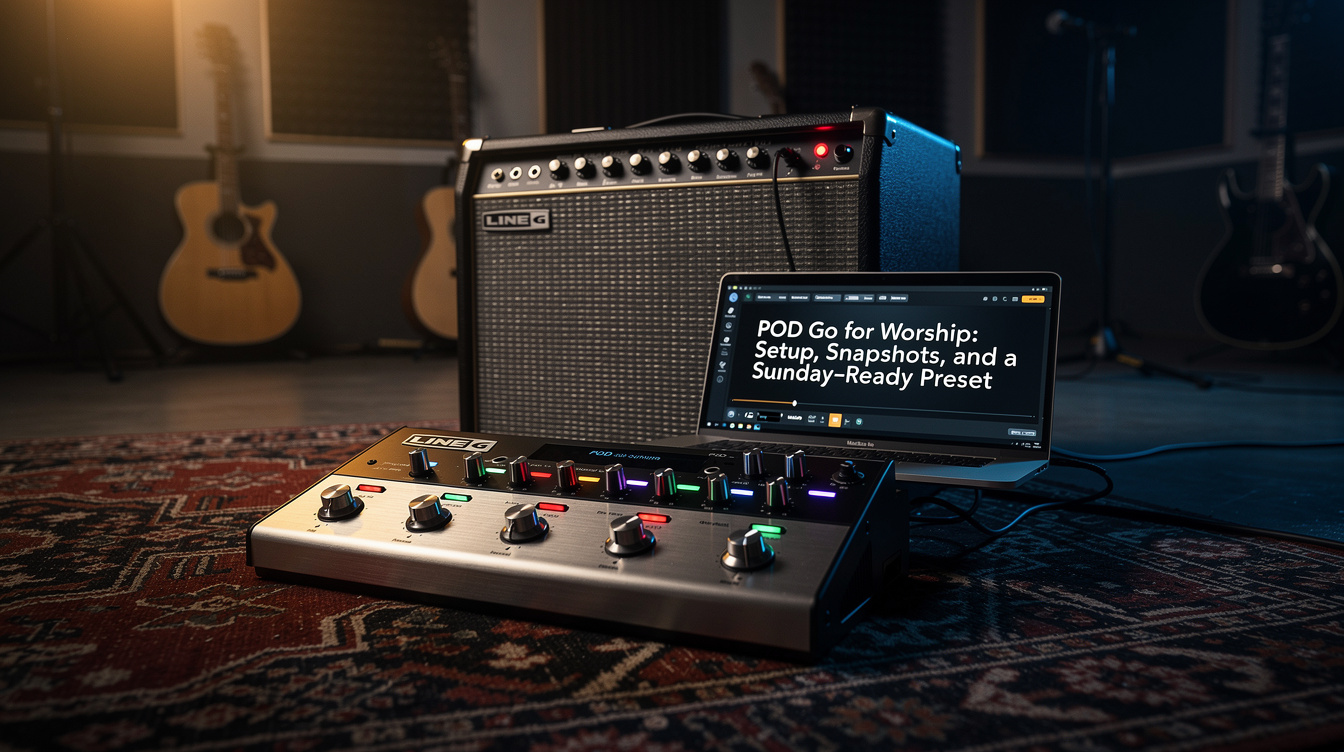
Start Here: The POD Go Worship Chain
- Fixed blocks (already there): Wah · Volume Pedal (your swells) · Preset EQ (your high cut) · FX Loop
- Amp: Essex A30 Fawn Brt — the AC30 chime
- Cab: 2x12 Blue Bell (bright) or 4x12 Greenback 25 (warm)
- Your four free blocks: Deluxe Comp → Minotaur (boost) → dotted-eighth Delay → Shimmer/Hall Reverb
- Snapshots: Clean · Pad · Drive · Lead
Why POD Go Fits Worship Better Than Its Price Suggests
The POD Go is Line 6's compact floor modeler, and on paper it looks like the budget compromise below an HX Stomp or a full Helix. For most genres, the trade-offs are real: fewer simultaneous blocks, four snapshots instead of eight, a partially fixed signal chain. What is easy to miss is that worship guitar is almost the one use case where those specific limits line up with the job instead of fighting it.
Here is the reasoning, and it is worth understanding before you buy anything, because it is also how you would decide against POD Go for a different style. A worship set needs a small, well-defined set of sounds: a clean bed, an ambient pad, a driven rhythm, and a lead. That is four sounds — and POD Go gives you exactly four snapshots. The core worship chain is a chime amp, a compressor, one drive, a dotted-eighth delay, and a reverb — and POD Go gives you an amp, a cab, and four free effect blocks, with the compressor-drive-delay-reverb chain fitting in those four exactly. The technique that defines the style, the volume swell, needs a volume pedal — and POD Go has one built in as a fixed block, so it does not cost you anything.
Run that same analysis for metal, where you might want a gate, a screamer, an amp, a cab, a delay, and two reverbs across eight snapshots, and POD Go starts saying no. For worship, it keeps saying yes.
What POD Go Actually Gives You
POD Go's signal chain is part fixed, part open. Knowing which is which is the whole setup:
| Block | Fixed or free | Worship use |
|---|---|---|
| Input + Noise Gate | Fixed | Leave the gate gentle; single coils hum. |
| Wah | Fixed slot | Unused for most worship; leave off. |
| Volume Pedal | Fixed | Your swells. Free technique, no block spent. |
| Preset EQ | Fixed | Your high cut — the harshness tamer. |
| Amp / Preamp | 1 block | Essex A30 or your chosen amp. |
| Cab / IR | 1 block | Blue Bell for chime, Greenback for wash. |
| FX Loop | Fixed | Unused unless you run an external pedal. |
| 4 effect blocks | Free | Comp · Drive · Delay · Reverb. |
The models themselves are the same HX models found on the Helix — the FAQ from Line 6 confirms POD Go carries "nearly all" of them, omitting only three effects (the Tone Sovereign and Clawthorn drives and the Cosmos Echo delay) for size. None of those three are in a worship chain, so in practice you lose nothing. That is why every settings number in the worship Helix recipes copies straight over.
The Sunday-Ready Preset, Block by Block
This is one preset that covers a typical modern-worship set. Build it once and it becomes the only patch you load.
Amp and Cab
Use the Essex A30 Fawn Brt — the AC30 Top Boost model — as the worship default. For a bright, chiming set (the Way Maker and Holy Forever end of the spectrum) pair it with the 2x12 Blue Bell cab. For darker, wash-forward tones (the Goodness of God end) swap to the 4x12 Greenback 25. That one cab swap moves the whole voicing, which is the entire Blue-versus-Greenback argument.
The Preset EQ Is Your Insurance
Set the fixed Preset EQ as a high cut around 7.5 kHz. Because it is a fixed block, it applies to all four snapshots automatically — one setting protects the whole preset. Church PAs run bright, and a modeled chime amp through a bright PA is where worship tone most often turns into an ice pick. If that happens, this is the knob you touch first: pull the high cut down toward 6.5–7 kHz. The full logic of that fix, and where the harshness actually lives, is in why your worship tone turns harsh through the PA.
The Four Free Blocks
- Deluxe Comp — always on. Threshold around −30, Ratio 4, Mix 60%. Evens the swells so a swelled pad and a strummed chorus land at the same level.
- Minotaur — Klon-style boost. Gain 4, Treble 5.5, Level 6. Off for pads, on for choruses and leads.
- Delay — a dotted-eighth digital or tape model. Set the time to the song: at 72 BPM a dotted eighth is 625 ms; the BPM-to-delay math is
(60000 / BPM) × 0.75. Feedback around 30, mix 25%, repeats slightly dark. - Reverb — a shimmer or large hall (Ganymede, Plateaux, or the Hall). Mix 28–35% depending on how ambient the song is, decay around 7, low cut 150 Hz.
The One Real Compromise: Two-Stage Drive
There is exactly one place the four-block limit bites, and it is worth naming so you are not surprised by it mid-service. Some worship tones — the big final-chorus lifts on Goodness of God or a Holy Forever tag — stack two drives, a boost into an overdrive. On POD Go, adding a second drive means you are at five effect blocks, one over the limit.
You have two honest options, and neither is a disaster:
- Keep the compressor, use one drive. Set the Minotaur hot enough to carry the biggest moment on its own. This is the right call for most volunteer teams — the compressor doing steady work matters more than a two-stage lift.
- Drop the compressor, run two drives. If your set leans on big driven leads and you are confident with your volume-pedal dynamics, trade the comp for a second overdrive (a Teemah stacked on the Minotaur).
That is the entire POD Go worship compromise. For a device at this price, one either-or decision is a remarkably short list.
The Snapshot Layout
Assign the four snapshots to the four worship sounds. The blocks stay the same across all four — only their on/off states and a few parameters change.
| Snapshot | Blocks changing | Use |
|---|---|---|
| 1 — Clean | Drive off, delay low, reverb medium | Verses, quiet moments. |
| 2 — Pad | Drive off, delay low, reverb up, swell in | Intros, atmospheric beds. |
| 3 — Drive | Minotaur on, delay mid | Choruses, driven rhythm. |
| 4 — Lead | Minotaur on, delay + reverb up | Solos, big tags. |
Turn trails on in the global settings so the delay and reverb tails carry across snapshot changes — the ambience should never audibly cut. This is the same four-sound architecture as the full Helix worship snapshot system; POD Go just happens to have exactly four snapshots to hold it.
Where POD Go Stops and the Helix Line Starts
POD Go is the right modeler for a worship guitarist who wants one clean, gig-ready floor unit and does not need eight snapshots or dual amps. The moment you want more than four sounds per song, a second amp path for an acoustic-plus-electric rig, or the headroom for two-stage drives without compromise, that is the signal to look at an HX Stomp or a Helix LT — which is exactly the tier-up decision worth thinking through before you spend the extra money. For a great many volunteers and worship leaders, though, that extra money buys headroom the set never actually uses.
Setting up a worship rig from scratch? Explore the worship guitar guides for the full tone cluster.