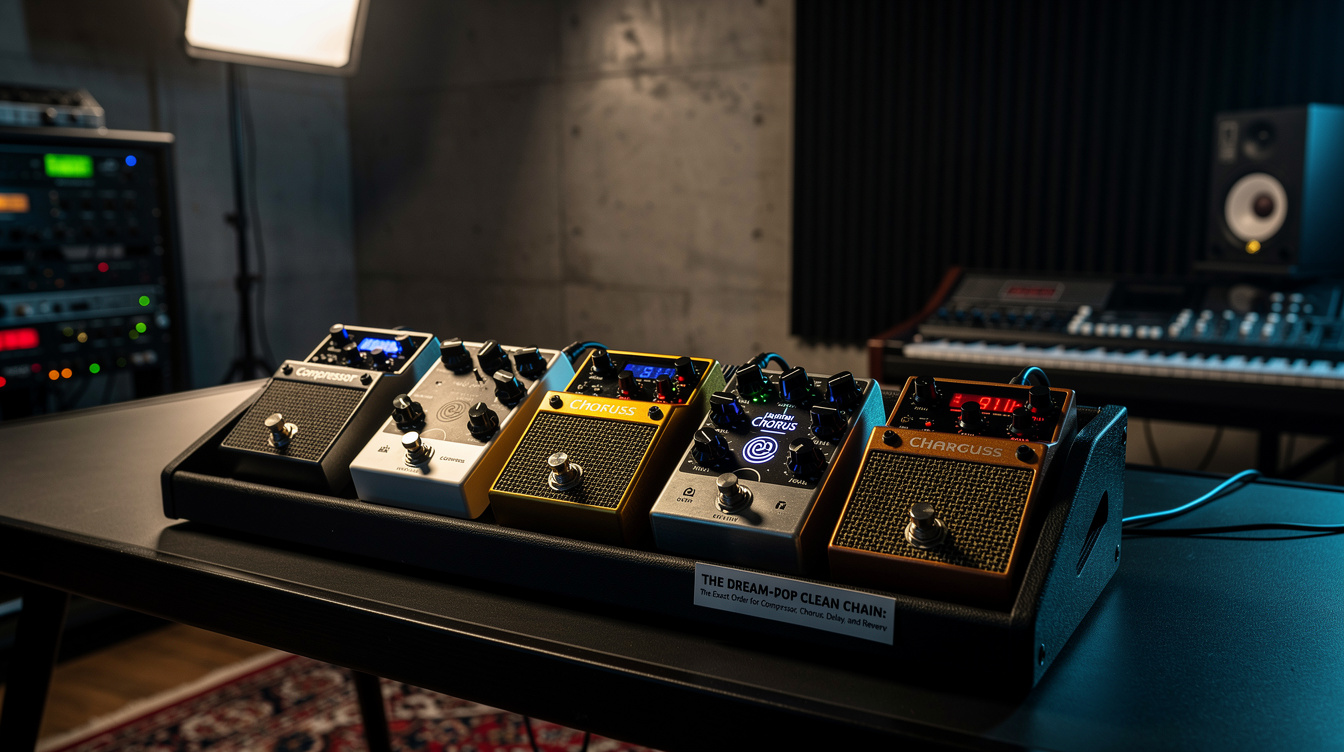
The clean tone at the center of dream pop isn't really a guitar tone — it's a weather system. Think of the half-melted, underwater chords on the Cocteau Twins' Treasure, or the way the guitar on Mazzy Star's "Fade Into You" sounds like it's bleeding through a wall from the next room. None of that is one pedal. It's an order of operations, four effects arranged so that each one hands the next a sound that's already been softened, widened, and set adrift. Get the order right and the chain does most of the work. Get it wrong and you get mud that's somehow both busy and lifeless.
So here's the chain, in order, with the reasoning for each placement and a couple of starting settings per block. This is a pedal-first recipe, but the order translates straight onto a modeler grid — the sequence is the recipe, not the boxes.
The Chain at a Glance
| Position | Block | Starting point | What it does here |
|---|---|---|---|
| 1 | Compressor | Gentle ratio, sustain ~10-11 o'clock, blend in some dry | Evens and sustains the clean source |
| 2 | (Light drive, optional) | Edge-of-breakup, low gain | A little hair, not distortion |
| 3 | Chorus | Rate ~10 o'clock, depth ~11 o'clock | Widens and detunes the note itself |
| 4 | Delay | Tape voicing, 350-450 ms, 2-3 repeats, low mix | Carries the note into time |
| 5 | Modulated reverb | Hall/plate, decay long, mix 30-40%, mod low | Washes it all into a moving space |
The signal flows guitar to amp, top to bottom. The two decisions people get wrong are putting the chorus too late and letting two things wobble at once. Both are below.
Compressor First: Sustain the Source
Dream pop lives on slow arpeggios and held chords that ring out forever. A compressor at the front of the chain does two things for that: it evens out your picking so every note in the arpeggio arrives at the same weight, and it lengthens the sustain so the note is still singing when the delay and reverb tails catch up to it. If the source note has already started decaying by the time the wash blooms, the whole thing sags. A steady source gives the ambience something steady to feed on.
Keep it gentle. This isn't the squashed, snappy compression of a chicken-pickin' country tone — it's the opposite. A low ratio, sustain around 10 to 11 o'clock, and a little dry blended back in if your compressor allows it, so the pick attack doesn't get flattened into nothing. You want the note held, not strangled. There's a quality to a lightly compressed Jazzmaster arpeggio — it breathes in, then holds — that's the whole foundation here.
Any light overdrive you use goes right after the compressor and before the chorus. Dream pop is mostly clean, but a touch of edge-of-breakup hair (think the grit under a Slowdive chord, not a fuzz) sits well here, feeding a clean-ish but textured note into the modulation.
Chorus Before Delay and Reverb: This Is the One That Matters
This is the placement that defines the genre, and it's the one most people reverse. The chorus has to come before the delay and reverb. Here's why: chorus works by detuning a copy of your signal and blending it back, so it makes the note itself shimmer and widen. When that already-moving note then hits the delay, the repeats inherit the shimmer, and when it hits the reverb, the wash is built out of a sound that was alive to begin with. The movement is baked into the source, and everything downstream multiplies it gently.
Flip it — put the chorus after the reverb — and you're now modulating the reverb tails themselves. You're wobbling a sound that's already a diffuse blur, and the result is exactly the muddy, unstable churn that makes a clean tone sound broken instead of dreamy. The detuning has nothing clean to hold onto. I had this backwards for an embarrassingly long time, chasing "more lush" by pushing the chorus later, and all I got was soup.
Settings: rate slow, around 10 o'clock, and depth moderate, around 11 o'clock. The Cocteau Twins sound is genuinely heavy chorus, so you can push the depth further than feels reasonable — but read the next section first, because depth is where the whole thing can capsize. (For the deep, watery end of chorus voicing specifically, the Robert Smith chorus breakdown covers how far you can take it before it stops sounding like a guitar.)
Delay in the Middle: Glue, Not a Part
The delay's job in this chain is connective tissue. It's not the rhythmic, dotted-eighth statement it would be in an Edge-style part — it's a soft smear that carries the chorused note forward in time so the reverb has something arriving in waves to wash. A tape voicing is ideal because the slight wow and flutter and the high-end roll-off on the repeats make each echo a little more degraded than the last, which is the texture you want. A pristine digital delay can sound too present and start counting time at the listener.
Set it to roughly 350 to 450 ms (or sync to a slow dotted figure if the song wants it), two or three repeats so it trails off rather than building up, and a low-to-medium mix so the repeats sit under the dry note. If your delay has a modulation control, a little is welcome — it pushes further into the dream. The analog vs. tape vs. digital delay guide goes deeper on why the tape character earns its place here.
Modulated Reverb Last: The Moving Room
The reverb is the bed everything settles into, and putting it last is non-negotiable — it's the space the whole sound lives in, so it has to come after the things that happen in that space. For dream pop, a long hall or plate with a slow modulation on the tail is the signature. The modulation keeps the wash from sitting as a static wall; instead the tail drifts and sways, which is the difference between a room and a dream. This is the same effect I broke down in the modulated-reverb guide — here it's just the final block in a longer story.
Decay long, mix around 30 to 40%, low cut around 200 Hz so the held chords don't pile up in the bass, and the modulation depth low. Which brings us to the trap.
The Seasick Threshold
Here's the discovery that took me a while to trust. I assumed the dreamiest possible tone meant maximum movement everywhere — deep chorus and deep reverb modulation, two sources of swirl stacking into something gorgeous. What actually happens is they fight. A deep chorus detunes the note, then a deeply modulated reverb detunes the tail of that already-detuned note, and on any sustained chord the pitch starts sliding around until the whole thing sounds drunk — not dreamy, seasick. The ear reads it as out of tune, because it is, constantly, in two directions at once.
The fix is simple and it's a rule I'd put on a sticky note: let one block do the wobbling. Usually that's the chorus — keep it as deep as you like, and pull the reverb's modulation way down, just enough to keep the tail from going static. Or invert it: run a shallow chorus and let a richly modulated reverb carry the movement. What you can't do is run both deep. One wobble, not two. The moment you internalize that, the genre stops sounding like a malfunction and starts sounding like Souvlaki.
On a Modeler
The order is the recipe, so it ports directly: drop the blocks left to right in the same sequence — compressor, optional drive, chorus, delay, modulated reverb — and the same logic holds. If your platform's reverb has a "mod" parameter, that's your modulated reverb in one block; if it doesn't, a chorus block placed before a plain long reverb fakes a lot of it. The general signal-chain order guide explains why this sequence is the default for time-and-space effects regardless of platform, and the reverb types guide covers which reverb to start from. If you're building toward the denser end of this — the full wall-of-sound shoegaze — the chain is the same skeleton with fuzz and a second reverb piled on.
The thing to hold onto is that none of these pedals is doing anything exotic on its own. A compressor, a chorus, a delay, a reverb — it's the most ordinary clean board imaginable. What makes it dream pop is the order, and the discipline to let it move just enough. The sound you're after is one that feels like it's slightly out of reach, dissolving as you listen. Stack it carefully, keep one hand on the wobble, and the guitar stops sounding like a guitar and starts sounding like a memory of one.